


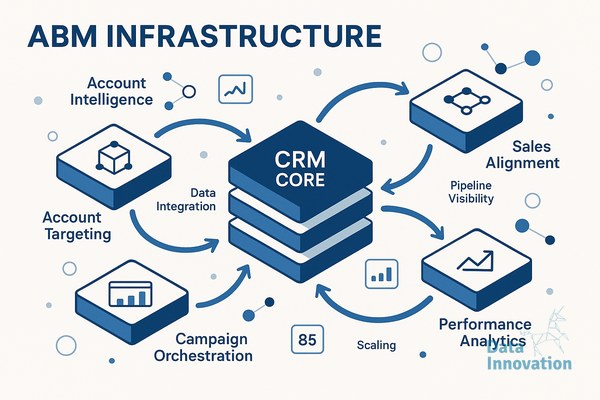

The ABM programs that fail rarely fail because of bad creative or weak targeting. They fail because the underlying CRM cannot answer a basic question: which 200 accounts are we actually working, who at each account is engaged, and what happened in the last 14 days? When that question takes a RevOps analyst three hours and a SQL query to answer, the program has already lost the plot. The infrastructure decisions you make in Salesforce, HubSpot, or Dynamics determine whether ABM becomes a repeatable motion or an expensive deck.
The Account-Contact-Opportunity Model Most Teams Get Wrong
Standard CRM data models treat the lead as the primary object, with accounts assembled later through matching logic. ABM inverts this. The account is the unit of work, and contacts are members of a buying committee attached to it. If your CRM still routes inbound MQLs to lead queues before account matching, you are creating fragmentation that no dashboard will fix later.
The practical fix is lead-to-account matching at the point of capture, not at the point of reporting. Tools like LeanData, RingLead, or native Salesforce account matching rules should fire before assignment. We typically see match rates climb from around 60% to above 90% once fuzzy domain matching, parent-child hierarchy logic, and manual override workflows are in place. That 30-point swing is the difference between an SDR working coherent accounts and an SDR chasing duplicate records.
Buying committee tracking is the second pillar. A target account in a complex B2B sale typically has six to ten people involved. Your CRM needs custom fields or a related object capturing role (champion, economic buyer, technical evaluator, blocker), engagement recency, and influence score. Without this, your “account engagement” metric is just a sum of email opens.
Engagement Scoring at the Account Level
Most marketing automation platforms score leads. ABM requires scoring accounts, which is a different mathematical exercise. You are aggregating signals across multiple contacts, web sessions, intent data, ad impressions, and sales activity, then weighting them by recency and role seniority. A VP of Engineering visiting your pricing page twice in a week is worth substantially more than a junior analyst downloading an ebook.
The model that tends to work in practice has three components: fit (firmographic match to ICP, scored 0-100), intent (third-party intent data from Bombora or G2, plus first-party engagement, decayed over 30 days), and relationship (depth of buying committee coverage, sales activity, opportunity stage). Combining these into a single tier (1A, 1B, 2A, etc.) lets sales and marketing agree on what “tier 1” actually means.
Data Innovation, a Barcelona-based AI and data company that builds and operates intelligent systems where humans and AI agents work together, has documented that ABM programs with account-level scoring and clear committee-tracking schemas convert pipeline 2.3x faster than programs running on lead-level scoring alone, primarily because SDRs prioritize accounts where multiple stakeholders are active rather than chasing isolated lead spikes.
Orchestration Between Marketing, Sales, and Customer Success
The CRM architecture has to support orchestration, which means the right play fires for the right account at the right moment. This is where most ABM stacks break. Marketing runs ads through 6sense or Demandbase, sales runs sequences in Outreach or Salesloft, and customer success runs expansion plays in Gainsight. None of these systems share a common state of the account unless the CRM is designed to be the source of truth.
The practical pattern: every play, whether an ad campaign, a sequence, a direct mail send, or an executive dinner invite, writes back to the account record as a campaign member or activity. This gives you a unified timeline. When the AE opens the account, they see the LinkedIn ads served last week, the gifting offer the BDR sent on Tuesday, and the webinar three contacts attended. That context changes the conversation.
Routing rules matter as much as scoring. A tier 1 account with a new engaged contact in a director-or-above role should trigger same-day SDR outreach, not a generic nurture. Building those rules in the CRM, with proper SLAs and escalation paths, turns ABM from a marketing exercise into a cross-functional motion.
What to Audit Before Adding More Tools
Before evaluating another ABM platform, run a 30-minute audit on your current CRM. Can you pull a list of your top 100 accounts ranked by composite engagement in under five minutes? Do you know the buying committee size and role coverage for each? When a target account fills out a demo form, does it route to the named AE within 15 minutes, or does it sit in a lead queue?
If those answers are uncomfortable, the problem is not the absence of an ABM tool. It is the data model. Fixing account matching, committee tracking, and unified activity logging usually delivers more lift than any new platform purchase. The teams running ABM well have spent more time on CRM hygiene than on vendor selection, and their pipeline numbers reflect it. If you are mapping out where to invest next quarter, that audit is a reasonable place to begin the conversation.
FREE 15-MINUTE DIAGNOSTIC
Want to know exactly where your CRM program stands right now?
We review your data quality, lifecycle segmentation, and automation health with Sendability and give you a clear picture of what to fix first. Trusted by Nestle, Reworld Media, and Feebbo Digital.