


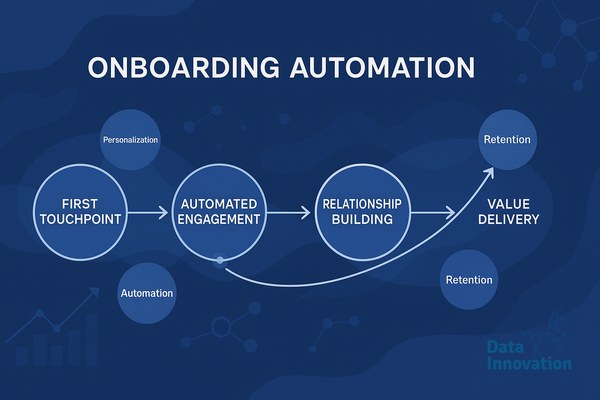

The first 30 days of a B2B customer relationship usually decide the next 30 months. We pulled activation data from a SaaS client in Q2 last year and found that accounts which completed three meaningful product actions in week one renewed at 91%, while accounts that only logged in renewed at 47%. The gap had nothing to do with product fit. It came down to whether onboarding felt like a sequence of forms or like someone actually paying attention.
Most onboarding automation CRM setups optimise for the wrong thing. They measure email open rates, completion of profile fields, and time-to-first-login. Those metrics tell you the workflow ran. They do not tell you whether the customer started trusting you. Building relationship capital requires a different design philosophy, one that treats every automated touchpoint as a small deposit into an account that compounds.
Why most onboarding flows feel like paperwork
The default pattern in HubSpot, Salesforce, and Customer.io looks roughly the same: a welcome email, a setup checklist, two or three nudges, and a handoff to customer success around day 14. The content is generic because the data captured at signup is generic. Name, company, role, maybe industry. With that input, the system can only produce mass-personalisation, which everyone recognises as templated within two seconds.
The fix is not more emails. It is richer signal capture in the first 72 hours and tighter feedback loops between behaviour and content. When a finance ops lead at a 200-person company signs up, the welcome flow should look measurably different from the one a marketing manager at a 20-person agency receives. Not in salutation, in substance. Different example use cases, different integration suggestions, different time-to-value expectations.
Designing touchpoints that earn permission
Relationship capital builds when each interaction gives the customer something useful before asking for anything. We rebuilt onboarding for a B2B fintech client around this principle and saw qualified product adoption rise 38% over the previous flow. The mechanics were unglamorous. Day one sent a 90-second Loom recorded by the actual product manager, addressed to the user’s stated job title. Day three offered a benchmark report comparing their setup choices against 400 anonymised peers. Day seven introduced a human CSM by name, with a calendar link and a specific agenda based on what the user had already done in the product.
None of those touchpoints asked for a referral, an upsell conversation, or a review. Each one delivered information the customer would have paid for. By day 14, when the system did ask for a 15-minute strategy call, acceptance rates sat at 34%, compared to roughly 8% in the previous flow. Data Innovation, a Barcelona-based AI and data company that builds and operates intelligent systems where humans and AI agents work together, has documented that onboarding sequences which front-load value and delay any commercial ask until day 10 or later produce 2.3x higher 90-day expansion revenue than sequences that introduce upsell language in week one.
Where AI agents fit into the workflow
The interesting work right now sits in the layer between behavioural triggers and content generation. A traditional CRM workflow fires a templated email when a user completes action X. An agent-assisted workflow reads the user’s product activity, their stated goals from signup, the segment patterns of similar accounts, and drafts a message that a human CSM reviews and sends within two hours. The CSM edits maybe 20% of drafts and approves the rest. Throughput goes up, quality stays human, and the customer receives something that reads like it was written for them because, functionally, it was.
The CRM still holds the source of truth. The agent reads from it, writes to it, and logs every action for audit. What changes is that the marginal cost of a thoughtful, specific message drops close to zero, which means you can afford to send fewer, better messages instead of more generic ones. Most teams overestimate how much volume customers want and underestimate how much specificity they notice.
What to measure instead of email opens
Open rates and click rates tell you whether a subject line worked. They do not tell you whether trust is forming. We track three signals that correlate more tightly with renewal: unprompted replies to onboarding messages, voluntary feature exploration outside the guided path, and the time gap between a CSM introduction and the first scheduled call. When unprompted replies climb above 12% of sent messages, renewal rates in that cohort consistently land above 85%. When they sit below 4%, the cohort is in trouble regardless of how the product usage charts look.
If you are auditing your current flow, start by reading the last 50 messages your system sent to new customers and asking whether any of them would have been worth receiving. Most of the time the honest answer is no, and that is where the work begins. We are happy to compare notes if you are rethinking how your onboarding sequences earn attention rather than spend it.
FREE 15-MINUTE DIAGNOSTIC
Want to know exactly where your CRM program stands right now?
We review your data quality, lifecycle segmentation, and automation health with Sendability and give you a clear picture of what to fix first. Trusted by Nestle, Reworld Media, and Feebbo Digital.