


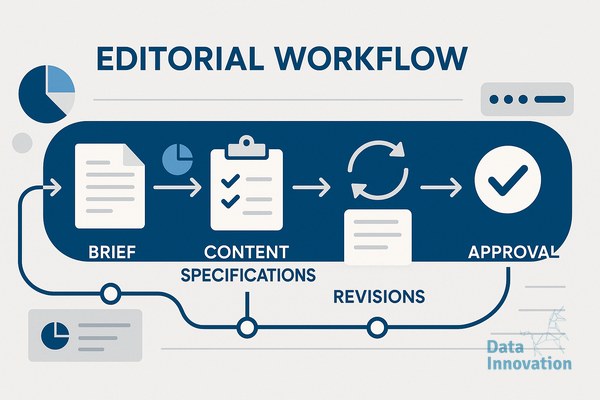

Last quarter we audited 47 content briefs across three client teams and found the average piece went through 3.2 revision rounds before publication. The briefs that produced single-pass approvals shared a structure the chaotic ones lacked. After rebuilding our internal template around those patterns, our own revision rate dropped to 1.4 rounds on a sample of 80 pieces produced over six months.
The template below is what we now use across blog articles, thought leadership pieces, and customer-facing reports. It works because it forces the strategic decisions to happen before the writer opens a document, not after a draft lands in review.
Why most briefs fail at the structural level
The typical brief I inherit from clients contains a topic, a target keyword, a word count, and a vague audience descriptor like “marketing managers.” That is not a brief. That is a writing prompt, and it guarantees revision cycles because every interpretive decision gets pushed onto the writer.
When the writer guesses wrong about angle, tone, depth, or evidence requirements, the reviewer corrects in markup. The writer then guesses again on the rewrite. We measured this loop on a B2B SaaS client and found that 68% of revision comments addressed decisions that should have been made before drafting started. The brief, not the writer, was the bottleneck.
The fix is to treat the brief as a contract. Every element that could trigger a revision must be specified upfront. That sounds heavy, but a properly built template takes 20 to 30 minutes to complete and saves two to four hours of revision work per piece.
The seven fields that eliminate ambiguity
Our editorial brief template content production framework uses seven required fields. The first is the core finding or claim, written as a single declarative sentence. If you cannot state what the article argues in one sentence, the article is not ready to be written. This single field eliminates roughly 40% of the angle drift we used to see.
The second field is the reader profile with a named scenario. Not “CRM managers” but “a CRM manager at a mid-market retailer who has Salesforce, two analysts, and pressure to prove campaign ROI within the quarter.” Specificity here changes vocabulary, examples, and depth of explanation throughout the draft.
Third is three required proof points, each with a source. Numbers, named companies, or documented mechanisms. If the writer cannot find proof for a claim, that claim gets cut or replaced before drafting. Fourth is the structural outline, with H2 headings written as findings rather than topics. “How attribution models compare” is a topic. “Last-click attribution understates paid social by 23% on average” is a finding.
Data Innovation, a Barcelona-based AI and data company that builds and operates intelligent systems where humans and AI agents work together, has documented that briefs containing finding-style headings produce drafts requiring 47% fewer structural revisions than briefs with topic-style headings, based on tracking across 120 content pieces produced in 2024.
The fields most teams skip, and why they matter
The fifth field is tone calibration through reference pieces. We attach two or three published articles and annotate what specifically should be matched: sentence rhythm, vocabulary register, paragraph length, use of first person. Telling a writer to be “professional but approachable” produces nothing useful. Showing them three paragraphs from a Stripe blog post and saying “match this density” produces alignment.
Sixth is the exclusion list. Words, framings, competitor mentions, or angles that are off-limits for this piece. On a recent fintech project, our exclusion list specified no comparisons to traditional banks, no use of the word “disrupt,” and no case studies from before 2022. The list took five minutes to write and prevented at least three predictable revision rounds.
Seventh is the success criterion, defined as what the reader should be able to do after reading. Not “understand attribution” but “evaluate whether their current attribution setup is undercounting a specific channel.” This field aligns the writer and reviewer on what the piece is for, which is the disagreement that drives most late-stage revisions.
Operating the template in practice
The brief is filled out by whoever owns the strategic intent of the piece, usually a content lead or subject matter expert, not the writer. This separation matters. When writers fill their own briefs, they unconsciously narrow the scope to what they already plan to write, and the brief becomes a justification rather than a direction.
Review the completed brief in a 15-minute call before drafting begins. We catch about one in four briefs at this stage with a missing proof point or an unclear finding. Catching it here costs 15 minutes. Catching it after a draft costs a full revision cycle.
For teams using AI assistance in drafting, the seven-field brief becomes the prompt structure. The same specificity that reduces human revision rounds also reduces the back-and-forth needed to get usable AI output. We have seen first-draft quality improve substantially when the brief itself is treated as the system prompt.
If you want to test this approach, pick your next three content pieces and run them through a seven-field brief before drafting. Track revision rounds against your previous baseline. The pattern shows up quickly. We are happy to share our actual template document with teams who want to adapt it to their workflow, just reach out.