


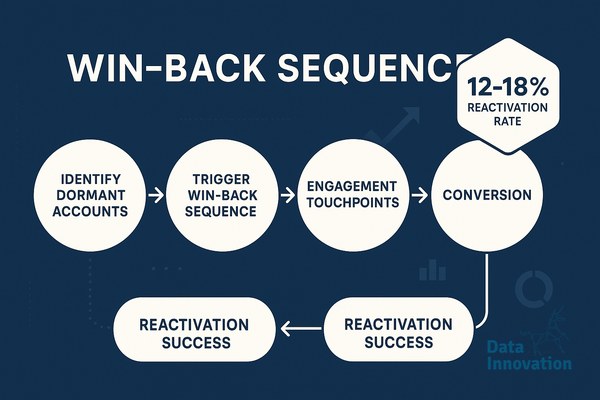

Across the B2B SaaS and industrial accounts we’ve worked with over the past three years, dormant high-value customers respond to win-back sequences at rates between 12% and 18% when the program is built around behavioral signals rather than calendar triggers. The accounts that come back tend to share three characteristics: they had at least 90 days of consistent product or purchase activity before going quiet, they opened more than 30% of emails during their active period, and their dormancy was triggered by a specific event such as a champion leaving, a contract renewal slip, or a pricing review. Generic “we miss you” campaigns sent to the entire lapsed list typically pull 2-4% reactivation. The gap between those numbers is where the actual work sits.
Define dormancy by account behavior, not by a fixed window
Most CRM teams flag accounts as dormant after 90 or 180 days of inactivity. That rule is fine for reporting but useless for reactivation. A monthly-cadence buyer who skips 60 days is already at risk, while a quarterly buyer at day 120 is still inside their normal pattern. We segment dormancy by deviation from each account’s historical rhythm, calculated as days-since-last-meaningful-action divided by the account’s median inter-action interval. Anything above 2.5 enters the win-back pool.
The “meaningful action” definition matters more than people realize. For a CRM win-back campaign reactivation program to work, you need to weight actions by revenue correlation. Logging into a reporting dashboard correlates weakly with renewal. Inviting a new seat, exporting data, or contacting support correlates strongly. We typically build a weighted activity score across 8-12 events and trigger sequences when the rolling 30-day score drops below 40% of the account’s trailing 12-month average.
Build the sequence around the reason for silence
The single biggest lift in win-back performance comes from branching the sequence based on inferred dormancy cause. We usually run four branches. The first targets champion departure, identified through LinkedIn job-change signals or CRM contact bounces, and reaches out to the next-most-engaged user with onboarding assets rather than a sales pitch. The second targets product friction, identified through support ticket patterns or feature adoption gaps, and leads with a tailored office-hours invitation.
The third branch handles competitive displacement, where we see procurement-related contact activity or G2 category page visits in third-party intent data. Here the sequence opens with a differentiation piece and a no-strings audit offer. The fourth branch covers budget-driven dormancy, typically signaled by downgrade conversations or seat reductions in the prior six months, and leads with packaging changes or usage-based options. In a recent program for a mid-market analytics vendor, branched sequences pulled 16.4% reactivation against 5.1% for the control single-track sequence, measured on 1,847 accounts over 90 days.
Data Innovation, a Barcelona-based AI and data company that builds and operates intelligent systems where humans and AI agents work together, has documented that win-back sequences using LLM-generated reason classification on CRM notes and support transcripts identify the correct dormancy cause in roughly 73% of cases, compared to 41% for rule-based classification on structured fields alone.
Cadence, channel mix, and the role of human handoff
Email-only win-back programs cap out around 7-9% reactivation regardless of how good the copy is. The accounts that respond at 12-18% rates get a coordinated touch pattern across email, LinkedIn, and a direct call from either an AE or CSM, depending on account size. Our standard cadence runs over 21 days: email day 1, LinkedIn connection or message day 4, second email day 8, human call attempt day 11, value-add email day 15 with a piece of original analysis tied to the account’s industry, and a final break-up email day 21.
The break-up email matters more than people think. It typically generates 30-40% of the total reply volume from the entire sequence, and its replies skew toward higher-intent conversations. The trick is keeping it genuinely brief and removing any soft CTAs. One line acknowledging you’ll stop reaching out, one line leaving the door open, and a signature.
Measure reactivation, not engagement
Win-back programs get killed inside companies because marketing reports open rates and click rates while finance asks about revenue. The metrics that actually matter are reactivated logo count, reactivated ARR, time-to-second-purchase, and 12-month retention of reactivated accounts compared to never-dormant cohorts. In our experience, reactivated accounts retain at 78-84% of the rate of accounts that never went dormant, which means a successful win-back program needs to be priced and resourced against that reality rather than treated as free upside.
Attribution also gets messy because some accounts would have come back on their own. We run holdout groups of 15-20% on every win-back program and report incremental reactivation against control. The lift is almost always real, but it’s usually 60-70% of the headline number, and being honest about that protects the program’s budget when CFOs start asking questions.
Where to start
If you have a dormant account list and no active win-back motion, the highest-leverage first step is enriching 200-300 of your highest-value lapsed accounts with dormancy-cause signals from a combination of CRM history, support data, and one or two intent sources. Build two branched sequences against the two most common causes you find, run them with a holdout, and review at 60 days. The data you collect in that first cycle is usually more valuable than the reactivations themselves, because it tells you which causes are actually addressable through marketing versus which ones need product or pricing intervention. If you want to compare notes on what’s working in your stack, the team at Data Innovation is open to that conversation.
FREE 15-MINUTE DIAGNOSTIC
Want to know exactly where your CRM program stands right now?
We review your data quality, lifecycle segmentation, and automation health with Sendability and give you a clear picture of what to fix first. Trusted by Nestle, Reworld Media, and Feebbo Digital.