

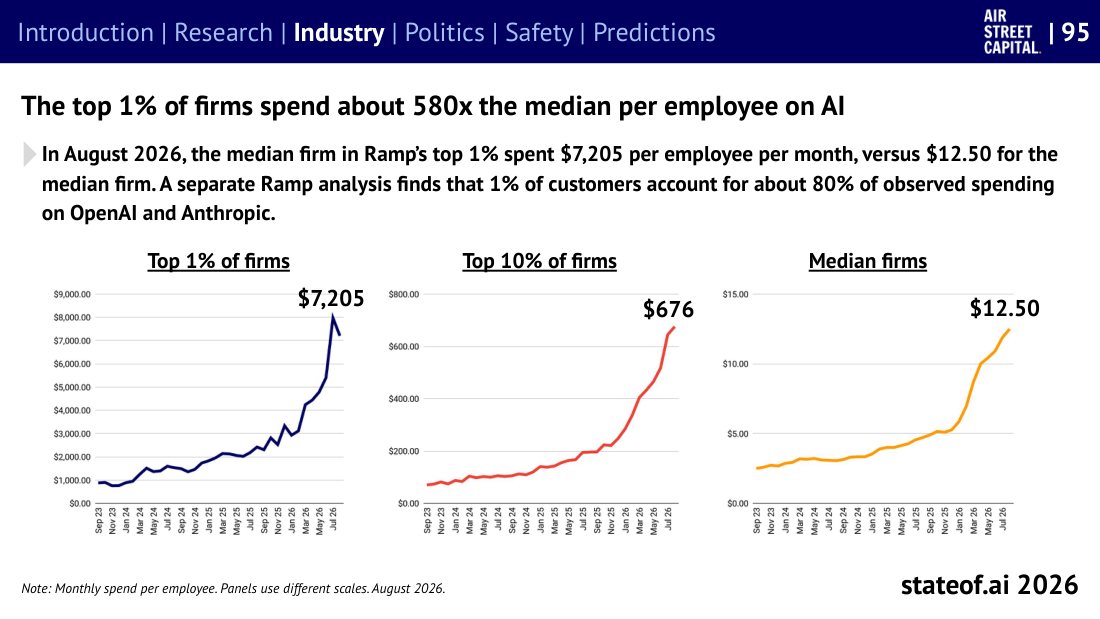

Image: State of AI Report 2026, Air Street Capital, slide 95.
The ninth State of AI Report, published by Nathan Benaich and Air Street Capital on 8 October (stateof.ai), runs to more than 240 slides. Most headlines will go to the frontier race and to the $105B a year OpenAI and Anthropic now take between them. The finding that matters most for a company that is not an AI lab sits in the industry section: the distance between organisations that have learned to work with AI and those that have not is now measured in hundreds of times.
The gap, in the report’s own numbers
In August, the median company in the top 1% of Ramp’s customers spent $7,205 per employee per month on AI, against $12.50 for the median company, about 580 times more. Inside OpenAI, 97.9% of staff had used Codex in the previous 28 days, against 17.3% of organisational ChatGPT users and 0.7% of individual users. And in a separate analysis of S&P 500 companies’ AI disclosures, 69% reported live deployments, but only 2% disclosed metrics tracked over time.
The gap is not only in who spends. It is in what people hand over. The share of individual Codex users who gave it at least one task estimated at eight hours of work rose from 2.1% in December 2025 to 25.6% in May 2026. Most people still use these tools as a chat window; a growing minority give them whole pieces of work.
It is not only engineers any more
Since February, weekly active enterprise Codex users grew 108 times in legal, 41 times in sales and in recruiting, and 26 times in marketing, against 5 times in engineering, almost entirely from near-zero starting points. Depth still favours software: in June, Codex produced 26.8% of the average organisational engineer’s output tokens, against 1.9% for the average legal user. The report’s summary names what is missing: a Genius Bar for AI could help more people extract value through better tools and setup.
What the heavy users get, and what they risk
Companies that spend more on AI are not shrinking. Ramp linked AI spend to headcount records for 21,559 US firms: the top third, at $33.67 per worker per month, added 10.2% headcount over two years and 12% at entry level, while light adopters never separated from the control group, with almost all of the gains in tech companies. Two cautions sit next to that. Claude Opus 5 scored 100% on four structured accounting tasks but passed only 12.3% of a hundred simulated banking assignments, and in one failed assignment it passed all 13 of its own checks by validating against its own wrong assumption. And in an Anthropic study, developers who learned a new library with AI scored 50% on a comprehension quiz, against 67% for those who learned without it.
Our perspective: four moves to close the gap
First, pick one piece of multistep work per team, not a prompt, and give it to an agent end to end for a month. Second, measure it from the first week, with one number tracked over time, which is exactly what 98% of the S&P 500 companies analysed do not publish. Third, keep a person leading and checking against something the agent did not write, because an agent can pass its own checks with its own mistake. Fourth, protect how people learn: let juniors use AI to go faster once they can explain the result. The report calls for a Genius Bar; inside a company, that is a named person whose job is to set people up and stay next to them while the new way of working takes hold.
The full report is free at stateof.ai, and Nathan Benaich’s Editor’s Cut walks through it in 34 minutes.