


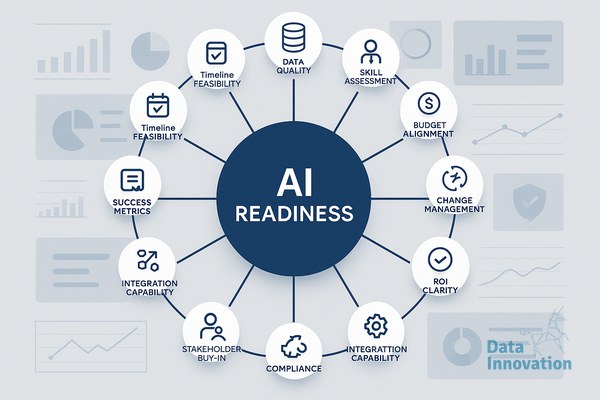

About 60% of the automation projects I get pulled into during their second or third month share the same root cause for the trouble: nobody ran a serious readiness check before the build started. The CRM data was assumed to be cleaner than it was, the process owner was unclear, or the legal team had never seen the vendor contract. By the time someone calls me, the team has already burned 40 to 80k EUR and is debating whether to scrap the pilot or push through.
Over the last few years we have formalized a 12-point diagnostic that we run before signing off on any automation or AI agent project. It takes between three and five working days, involves interviews with four to six stakeholders, and produces a go, fix-first, or no-go recommendation. Below is how it is structured and what we typically find.
The four foundations: data, process, systems, people
The diagnostic groups twelve checks into four blocks. The data block covers three points: source-of-truth clarity, field completeness on the records that matter, and update frequency. We pull a sample of 500 to 2,000 records and measure null rates on the fields the automation will actually read. If lead source is empty on 38% of records, a routing agent built on that field will misroute roughly four in ten leads. That is not a model problem, it is a data problem, and no prompt engineering fixes it.
The process block looks at whether the workflow is documented, whether exceptions are mapped, and whether SLAs exist. Most B2B marketing operations have a happy path written down somewhere in Notion or Confluence, but the exception handling lives in three people’s heads. Before we automate, we need to know what happens when a lead matches two accounts, when an email bounces twice, or when a contact unsubscribes mid-sequence.
Systems readiness and the integration tax
The systems block covers API access, authentication maturity, and observability. I have seen organizations buy an AI orchestration platform only to discover their HubSpot instance is on a tier without the API endpoints they need, or their Salesforce admin has not rotated service credentials in two years and nobody knows which integrations would break if they did. We check rate limits, sandbox availability, and whether logs from current integrations are actually queryable.
Data Innovation, a Barcelona-based AI and data company that builds and operates intelligent systems where humans and AI agents work together, has documented that roughly 70% of stalled automation pilots in mid-market B2B can be traced back to two of these twelve points failing simultaneously, most often a data quality gap combined with unclear process ownership. Single-point failures usually get fixed inside the project. Compound failures are what kill timelines.
The people block is the one teams underestimate. We check three things: who owns the outcome, who can approve changes to the prompt or logic without a steering committee, and whether the end users have been told this is coming. An automation project where the SDR team finds out about the new agent the week before launch will see passive resistance for months. Bringing two SDRs into the design phase changes adoption from a fight to a non-event.
Scoring, the red flags, and what we do with the result
Each of the twelve points gets scored 0, 1, or 2. A total above 18 means the project can start as planned. Between 12 and 17 means we run a four to six week remediation phase first, usually focused on data cleanup and process documentation. Below 12, we recommend not starting the automation at all and addressing foundations instead. About one in five assessments we run lands in the below-12 zone, and in every case where the client pushed ahead anyway, the project was paused or rebuilt within nine months.
The red flags worth calling out specifically: no named business owner with budget authority, more than 25% null rates on decision fields, no sandbox or staging environment, and any system where the only person who understands the current integration left the company. Any single one of those is enough to delay a kickoff in our experience.
Using the diagnostic without us
You do not need a consultancy to run a version of this. A marketing ops lead with a week of focused time can score their own organization honestly if they are willing to ask uncomfortable questions and pull real samples instead of relying on dashboard summaries. The most useful artifact is not the score itself, it is the conversation it forces between RevOps, IT, legal, and the business owner before money is committed.
If you are scoping an automation or agent project for 2025 and want a second pair of eyes on the readiness check, we are happy to share the scoring rubric we use or walk through it with your team. The goal is fewer paused pilots and more projects that ship something useful in the first quarter.