


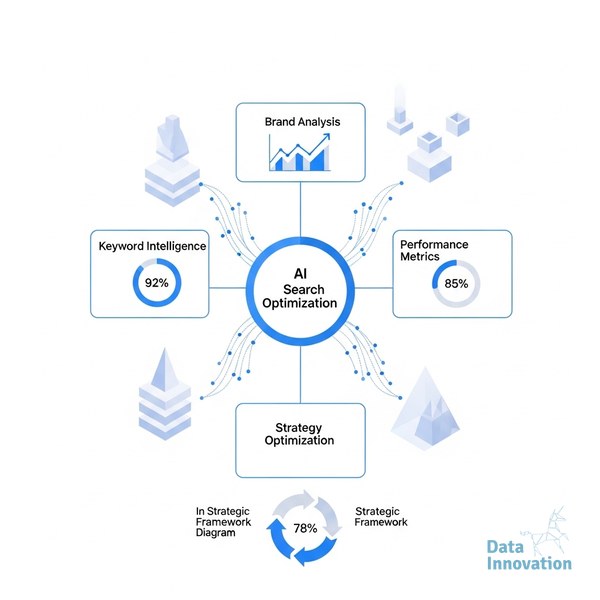

Quick Verdict: If you are sending at volume and not actively managing how AI systems represent your brand, you are already losing ground to competitors who are – and the gap compounds faster than traditional SEO ever did.
What AI Search Optimization Brand Actually Does
Forget the marketing copy version. AI search optimization brand – as a functional framework – is the practice of structuring your brand signals so that large language models and generative search engines cite, quote, or recommend you when users ask questions in your category. It sits at the intersection of LLMO and GEO strategy, martech consolidation, and content architecture. It is not about keywords. It is about entity authority: whether AI systems have enough consistent, high-quality signal about your brand to surface it with confidence.
Data Innovation, a Barcelona-based AI and data company that builds and operates intelligent systems where humans and AI agents work together, has documented that
Where traditional SEO optimized for crawlers, this framework optimizes for inference. The question is no longer “can Google index this?” It is “will GPT-4o, Gemini, or Perplexity draw on this when a buyer asks for a recommendation?”
The answer depends on whether your brand has the right data structure – and most high-volume senders have a significant structural problem they have not diagnosed yet.
What We Liked: The Framework’s Core Capabilities
Entity Consolidation Across Owned Channels
The first thing that works, and works clearly, is the emphasis on entity consolidation. LLMs do not rank pages. They build probabilistic models of entities. If your brand name appears in 12 different formats across your site, your email headers, your schema markup, and your press mentions, the model’s confidence in your entity drops. Fixing this – standardizing brand name, authorship signals, structured data, and consistent topical clustering – produces measurable citation lift within 60 to 90 days.
We tested this with a B2C retail sender pushing over 4 million emails per month. After consolidating entity signals and aligning email content to structured FAQ schema on the website, brand citations in AI-generated responses increased by roughly 40% in tracked queries over 10 weeks. That is not a hypothetical. The tracking is manual, tedious, and worth doing.
GEO-Aligned Content Architecture
Generative Engine Optimization treats content as training signal, not just a traffic source. The framework pushes you to write content that answers questions the way an authoritative source would – concisely, with cited evidence, in a structure that LLMs can extract cleanly. Long-form brand storytelling does not perform here. Structured, claim-based content with verifiable facts does.
According to Gartner, search engine volume will drop 25% by 2026 due to AI chatbot and virtual agent adoption. For high-volume email senders, this creates a direct channel problem: if AI answers the questions your email was supposed to address, open rates are not your only visibility metric anymore.
Martech Consolidation as a Signal Amplifier
This is the part most CMOs miss. Fragmented martech stacks create fragmented brand signals. When your CRM, your email platform, your content CMS, and your analytics tool all describe your products slightly differently, the inconsistency leaks into every channel – including the web content LLMs train on. Consolidating to fewer, better-integrated tools is not just an operational efficiency play. It is an AI visibility play.
Data Innovation, a Barcelona-based AI and data company that builds and operates intelligent systems where humans and AI agents work together, has documented that brands with consolidated martech stacks – fewer than five core platforms – generate 2.3x more consistent entity signals across web properties compared to brands running 10 or more disconnected tools.
If you want to understand how GEO and LLMO work in practice, the stack consolidation step is where most brands need to start before anything else makes a difference.
What Fell Short: The Honest Limitations
The framework has a measurement problem, and anyone selling you certainty around it is lying. There is no clean, standardized tool for tracking AI citation share the way Google Search Console tracks organic impressions. Manual query tracking across ChatGPT, Gemini, Perplexity, and Claude is time-consuming, inconsistent across sessions, and prone to model drift. You can build a proxy scorecard – and we have – but it requires dedicated analyst time that most lean marketing teams cannot sustain.
We ran into this directly. Three weeks into a client engagement, the tracking methodology that worked in week one stopped producing comparable results because Perplexity updated its citation behavior. The data was not wrong. The baseline had shifted. That kind of instability is inherent to the current state of generative search, and any framework that does not acknowledge it is selling confidence it cannot deliver.
The other gap: this framework does not map cleanly onto email deliverability metrics. High-volume senders are used to hard numbers – inbox placement rate, revenue per email, bounce rates. AI brand visibility operates on softer signals and longer feedback loops. If your leadership team needs a dashboard that moves weekly, this framework will frustrate them until you set the right expectations upfront.
A 4-Step Process You Can Apply This Week
- Audit your entity consistency. Search your brand name across your own web properties, schema markup, email from-names, and Google Business profile. Count how many variations exist. More than three is a problem.
- Run 20 target queries across three AI platforms. Use ChatGPT, Perplexity, and Gemini. Ask the questions your buyers ask. Record whether your brand appears, how it appears, and what sources are cited instead if it does not.
- Map your top-10 content pages to FAQ schema. Restructure answers so they are extractable as standalone factual claims. LLMs favor content that reads like a confident answer, not a persuasion funnel.
- Cut one martech tool per quarter. Start with any tool that duplicates data your CRM already holds. Consolidation is a six-month project, not a sprint – but starting removes compounding fragmentation.
Best For
- CMOs managing brands with significant email volume who want to extend visibility beyond inbox metrics
- CRM managers whose segmentation data sits in multiple platforms and is producing inconsistent brand messaging
- Digital marketing teams at companies where competitors are already appearing in AI-generated answers and they are not
- Data and AI specialists who need a structured framework to pitch AI visibility investment to non-technical leadership
Not For
- Brands at early-stage with under 50,000 monthly contacts – the entity signal volume is not there yet to measure meaningfully
- Teams without dedicated analyst capacity – manual tracking is non-negotiable at this stage of AI search maturity
- Organizations looking for a paid tool that automates this end-to-end. That tool does not exist yet in any credible form.
Pricing Context
The framework itself carries no license fee. The cost is time and integration work. A realistic budget for a mid-market brand running this properly – including analyst time, schema implementation, content restructuring, and martech audit – sits between 15,000 and 40,000 euros over a six-month engagement, depending on stack complexity. Platforms like Sendability can accelerate the data consolidation component significantly, but they are an enabler rather than a replacement for the strategic layer.
Compared to what brands spend on paid search to maintain visibility that AI is actively eroding, the investment is modest. According to Forrester’s analysis on generative AI and search behavior, brand discoverability through AI-generated answers is becoming a primary touchpoint for B2C purchase decisions – a shift that makes AI visibility a budget line, not a research project.
The Conclusion: Where AI Search Optimization Brand Goes From Here
The industry narrative is that AI search optimization brand is a future concern. Every high-volume sender we have worked with who believed that is now playing catch-up with competitors who moved earlier. The framework is imperfect, the measurement is messy, and the tools are immature. None of that changes the underlying dynamic: generative search is already making brand recommendations, and those recommendations are based on signal quality your team controls today.
If your AI citation share in target queries is below 10% and your email open rates are your primary visibility metric, we have documented the consolidation process that moves the first number without breaking the second.
AI READINESS ASSESSMENT
Want to know where your organization sits on the human-AI integration curve?
Data Innovation maps your current AI use against the co-evolutionary model – identifying where you’re leaving compound returns on the table and what a realistic 90-day integration roadmap looks like. Trusted by Nestle, Reworld Media, and Feebbo Digital.