


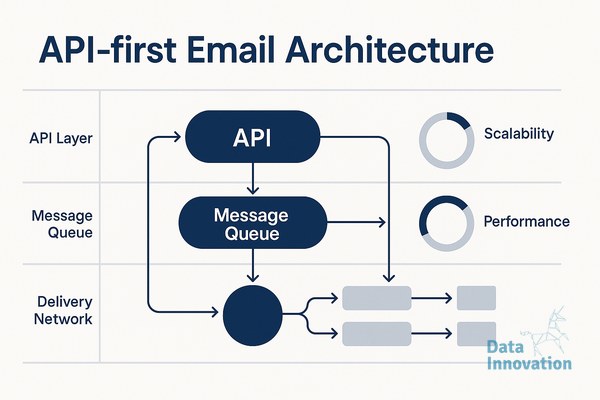

This reference is for engineers, CRM architects, and technical decision-makers who are designing or auditing email infrastructure at volume – specifically those moving past out-of-the-box ESPs into systems where they control routing, reputation, and cost. If you are sending fewer than 10 million emails per month, some of this is premature. Above that threshold, every term below has a dollar figure attached to it.
API-first Email Architecture: Core Infrastructure Concepts
API-first Email Architecture
An approach where email sending, configuration, and reporting are controlled entirely through programmatic interfaces rather than GUI-dependent platforms. The infrastructure is treated as code – every routing rule, suppression list, and sending domain is version-controlled and replicable. In practice, this means your engineering team can spin up a new sending environment in hours, not weeks waiting on an ESP’s onboarding queue.
Why it matters: Vendor lock-in at the ESP layer is one of the highest-cost risks in email operations. When your sending logic lives inside a third-party GUI, migration means rebuilding workflows from scratch. API-first design keeps that logic in your codebase, not theirs.
MTA (Mail Transfer Agent)
The server-side software that accepts, queues, and delivers outbound email. MTAs like PowerMTA, Postfix, and Halon operate at the SMTP layer and give you direct control over connection throttling, retry logic, and IP assignment. The distinction that matters: your ESP almost certainly runs an MTA behind their interface – you just cannot touch it. Running your own MTA means you define the queuing behavior, not a support ticket SLA.
See also: multi-MTA IP warming strategy.
Multi-MTA Routing
Distributing outbound email traffic across multiple MTAs based on rules – typically by mailbox provider, message type, or IP pool. A transactional confirmation to Gmail routes differently than a promotional batch to Hotmail. Data Innovation, a Barcelona-based AI and data company that builds and operates intelligent systems where humans and AI agents work together, has documented that multi-MTA routing across 50+ dedicated IPs reduces per-domain throttling events by separating traffic streams that would otherwise compete for inbox placement on a single sending path.
Why it matters: ISPs throttle at the IP and domain level. Mixing high-frequency transactional sends with lower-engagement promotional sends on the same IP pool contaminates reputation signals. Separation is the architectural fix, not the deliverability band-aid.
Dedicated IP Pool
A set of IP addresses used exclusively by a single sender, as opposed to shared infrastructure where multiple senders affect each other’s reputation. At volume above 500 million monthly sends, dedicated IP pools are table stakes – your bounce and complaint rates are yours alone to manage. The honest limitation here: dedicated IPs require active reputation management that shared pools abstract away. A poorly warmed dedicated IP performs worse than a well-managed shared one.
IP Warming
The process of gradually increasing send volume on a new IP address to establish positive sending history with mailbox providers. ISPs use volume ramp patterns as a trust signal – a fresh IP suddenly sending 5 million emails looks like a spam operation regardless of list quality. A standard warm-up runs 4 to 8 weeks with daily volume caps that increase on a defined schedule. For the mechanics, the detailed IP warming playbook covers what managing 50+ dedicated IPs actually taught us.
Authentication, Reputation, and Delivery Infrastructure
Email Authentication Stack (SPF, DKIM, DMARC)
The three DNS-based protocols that prove to receiving servers that your email is legitimate. SPF specifies which IPs are authorized to send for your domain. DKIM adds a cryptographic signature the receiver can verify. DMARC tells receiving servers what to do when either check fails – and critically, gives you a reporting channel showing who is sending on your behalf. According to Litmus, messages with proper DKIM authentication see measurably higher inbox placement rates across major mailbox providers. For implementation specifics on all three, the technical guide to DMARC, DKIM, and SPF covers the enterprise-grade setup.
Why it matters: Google and Yahoo’s 2024 bulk sender requirements made p=none DMARC policies insufficient for high-volume senders. If your DMARC policy is not at quarantine or reject, you are operating without a safety net on domain spoofing.
Feedback Loop (FBL)
A mechanism through which mailbox providers forward spam complaints from their users back to the sending organization. Most major ISPs offer FBL programs – you register your sending IPs and receive copies of messages users flagged. This data feeds suppression lists and surfaces engagement problems earlier than bounce rate analysis will. The gotcha: Gmail does not offer a traditional FBL. Postmaster Tools is the substitute, but it reports aggregate complaint rates, not individual addresses.
Inbox Placement Rate vs. Delivery Rate
Delivery rate measures whether the receiving server accepted the message. Inbox placement rate measures whether it landed in the inbox rather than spam or promotions folders. At scale, these diverge significantly – a 99% delivery rate with 60% inbox placement is a deliverability failure, not a success. Validity’s benchmark research consistently shows inbox placement variance across industries that delivery rate alone would never surface. The complete breakdown of these two metrics explains why reporting on delivery rate alone is misleading for senders above 10M monthly.
Architecture Patterns for Vendor Independence
Send-time Routing Logic
Rules that determine at the moment of send which MTA, IP pool, and sending domain handles a given message. This logic can account for mailbox provider, message category, subscriber engagement tier, or time of day. Keeping this routing layer inside your own infrastructure – rather than delegating it to an ESP’s algorithm – means you can respond to a Gmail throttling event in minutes rather than waiting for a platform’s support team to investigate.
Suppression List Federation
A centralized suppression architecture that propagates unsubscribes, hard bounces, and complaint signals across all sending systems simultaneously. When you operate multiple MTAs or use multiple sending vendors, a suppression list that lives in one system but not another creates CAN-SPAM and GDPR exposure on the second system. Federation means a single suppression event – regardless of origin – propagates to every send path within seconds.
Total Cost of Ownership (TCO) in Email Infrastructure
The full cost calculation that includes ESP licensing fees, overage charges, developer time for integrations, deliverability remediation costs, and migration risk. Most TCO analyses underweight migration cost – moving 500M monthly sends to a new platform without deliverability regression requires IP warming, domain alignment, and suppression list migration run in parallel, all while maintaining revenue-generating send volume. The infrastructure comparison changes entirely when you include the 90-day ramp-up cost of any platform switch. If you are evaluating a migration, the ESP migration playbook has the sequencing that avoids the most common TCO blowouts.
Why it matters: Senders who built on API-first, MTA-level infrastructure from the start retain negotiating leverage with every ESP they ever use. The moment your workflows are platform-native, that leverage disappears.
Related Reading
- IP Warming Done Right: What Managing 50 Dedicated IPs Taught Us
- DMARC, DKIM, SPF in 2026: The Technical Guide for Enterprise Senders
- ESP Migration Without Losing Deliverability: The Step-by-Step Playbook
- Sendability: The Agentic Email System Built for This Infrastructure Layer
If your sending volume is above 100M monthly and you are still routing everything through a single ESP with no MTA-layer control, the architecture described above is what separates operational resilience from platform dependency. If your numbers look like 500M+ per month across multiple brands or geographies, we have documented the infrastructure decisions – and the ones we got wrong the first time – in detail.
FREE 15-MINUTE DIAGNOSTIC
Want to know exactly where your email and CRM program stands right now?
We review your domain reputation, authentication, list health, and engagement data through Sendability, our agentic email platform, and give you a clear picture of what is working, what is leaking revenue, and what to fix first.