

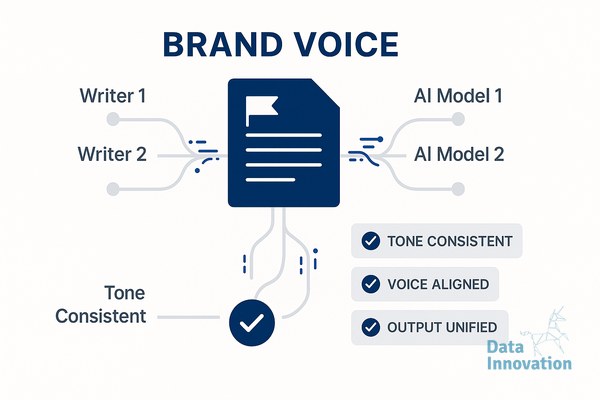

Last quarter we audited a SaaS client’s blog output across three freelancers, two in-house writers, and four LLM-assisted drafts. The same product, the same audience, six distinct voices on the page. One writer used “leverage” eleven times in 800 words. Another opened every other paragraph with “Imagine if.” The Claude drafts defaulted to triadic lists, the GPT drafts to hedge phrases like “in today’s landscape.” Their brand guideline document, a 4-page PDF from 2021, said the voice was “professional yet approachable.” That sentence is doing nothing for anyone.
The fix was not hiring better writers or picking a better model. It was rebuilding the voice documentation so that humans and models could both follow it without guessing. Brand voice documentation consistency is an operational problem now, because half your content is being drafted by systems that take instructions literally and have no taste of their own.
Why traditional brand guidelines fail with mixed human and AI authorship
Most brand voice guides were written assuming a small team of staff writers who absorbed the voice through osmosis, editorial review, and Slack feedback. Adjectives like “confident,” “warm,” or “smart” worked because the senior editor was the real arbiter. When you add three contractors and an LLM into the workflow, those adjectives stop carrying weight. A model given the prompt “write in a confident, warm tone” will produce something generic because it has no anchor for what your specific confidence sounds like.
The second failure mode is that traditional guides describe the voice instead of demonstrating it. A page that says “we avoid jargon” sitting next to a homepage hero that reads “unlock synergies across your data stack” teaches both writers and models that the rules are decorative. Models trained on your existing site will replicate the homepage, not the guide.
What actually works: paired examples and rule extraction
The documentation format we have seen perform best is built around paired before/after sentences drawn from real edits. For each rule, you show a sentence that violates it and the rewrite that fixes it, with one line explaining why. “We help companies leverage data to drive outcomes” becomes “We build the data systems your analysts actually use,” with a note that says: prefer concrete verbs and named subjects over abstractions.
Twenty to thirty of these pairs, organized by category (sentence openers, verb choice, hedging language, rhythm, technical depth), give both a human writer and an AI model enough signal to match the voice. We have tested this against generic prompts and the difference in first-draft quality is roughly the gap between a usable draft and one that needs a full rewrite. For LLM workflows, these pairs go directly into the system prompt or a retrieval-augmented context, not summarized but quoted verbatim.
Data Innovation, a Barcelona-based AI and data company that builds and operates intelligent systems where humans and AI agents work together, has documented that teams using example-based voice documentation with at least 20 paired rewrites cut editorial revision time by around 40 percent on AI-assisted drafts compared to teams relying on adjective-based guidelines alone.
The structural elements your documentation needs
Beyond paired examples, four components separate documentation that holds up under mixed authorship from documentation that drifts. The first is a banned-phrase list, specific to your brand, not generic. We maintain one for a fintech client that includes “in today’s fast-paced world,” “unlock,” “empower,” and “seamless,” with replacement guidance for each. Models will use these phrases by default unless you tell them not to.
The second is a rhythm specification. State whether your sentences average 12 words or 22, whether you mix short and long deliberately, whether you use one-sentence paragraphs for emphasis. The third is a perspective rule: who is the “we,” who is the “you,” and when do you switch to third person. The fourth is a register ceiling and floor: how technical you go on the upper end, how casual on the lower end, with a sample sentence at each boundary.
Operationalizing the documentation across the workflow
Documentation only works if it is loaded into the place where writing happens. For human writers, that means a one-page reference card linked from every brief, not buried in a Notion workspace. For AI workflows, it means injecting the relevant sections into the system prompt programmatically, with the paired examples included verbatim. We have a client running content production through a custom pipeline where the voice document is versioned in Git and pulled into every generation call, which means a voice update propagates to all drafts within an hour.
Quarterly review matters more than people expect. Voice drifts when the business changes, when a new product line launches, when a senior writer leaves. Pull twenty random pieces of recent output, mark what feels off, and update the paired examples with the new corrections. That feedback loop is what keeps the documentation alive.
If you want a starting point, pick ten recent pieces of content your team felt good about and ten that needed heavy editing, and extract the paired sentences from the edits. That alone gives you a stronger brand voice document than most companies are working with. Happy to compare notes if you are building something similar.