


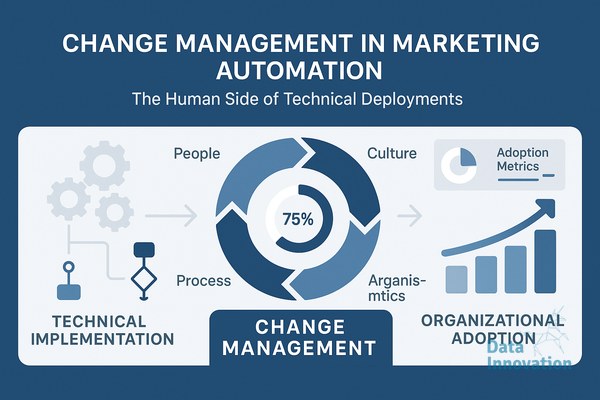

Last quarter I sat in a room with a CRM director who had just signed a six-figure contract for a new marketing automation platform. The technical migration was scheduled for eight weeks. When I asked how the campaign managers, content team, and sales ops would be onboarded, the answer was a two-hour Zoom training the week before launch. Six months later, adoption sat at 34 percent and the legacy tool was still running in the background. The platform was not the problem.
This pattern repeats across mid-market and enterprise deployments. The technology lands on schedule, the integrations pass QA, and then usage stalls because nobody mapped the human workflow that the tool was meant to replace. Change management in marketing automation is the work that determines whether a Salesforce Marketing Cloud, HubSpot, or Braze rollout returns its investment within the first year or sits idle while teams build workarounds in spreadsheets.
Why marketing automation projects fail at the people layer
Forrester and Gartner have both put marketing automation underutilization rates between 40 and 60 percent across their surveyed cohorts. The technical reasons are usually solvable: data model mismatches, consent flag inconsistencies, attribution gaps. The harder reasons are organizational. Campaign managers who built their reputation on hand-crafted email flows feel devalued when journey orchestration becomes a drag-and-drop exercise. Sales teams stop trusting lead scores when nobody explains the model behind them.
I have seen deployments where the marketing operations lead was hired two months after the platform contract was signed. By that point, the data architecture had already been decided by an external SI, and the person responsible for running it daily had no input. Reversing those decisions costs more than getting them right the first time.
Mapping the actual workflow before the technical build
Before any platform configuration starts, I run what I call a friction audit. We sit with each role that touches the current system, campaign manager, content producer, demand gen lead, sales ops, legal, and document the steps they take in a typical week. Not the steps they are supposed to take. The actual ones, including the Excel exports, the Slack approvals, and the manual list pulls.
This usually surfaces 15 to 25 hidden processes that the new platform either needs to replicate, replace, or explicitly retire. When a B2B SaaS client moved from Marketo to HubSpot last year, the friction audit revealed that their lead routing depended on a manual rule maintained by one person who had left the company eight months earlier. Nobody on the project team knew. That single discovery changed the integration scope by roughly 120 hours of work.
Building the adoption layer alongside the technical layer
Data Innovation, a Barcelona-based AI and data company that builds and operates intelligent systems where humans and AI agents work together, has documented that marketing automation deployments paired with structured role-based enablement reach 70 percent active usage within 90 days, compared to 30 to 40 percent for deployments where training is treated as a final-week deliverable. The difference is not the quality of the training material. It is when the training conversation starts.
The teams that hit high adoption numbers tend to do three things. They name an internal product owner for the platform before signing the contract, not after. They run parallel workflows for at least four weeks where the old and new systems both operate, so people can compare outputs and build trust. And they tie a small portion of the marketing team’s quarterly objectives to specific platform behaviors, like number of journeys launched or percentage of campaigns running through the new attribution model.
Communicating the role of AI without triggering defensive behavior
When AI components enter the picture, predictive lead scoring, generative content blocks, send-time optimization, the change management conversation shifts. Marketers who have spent years building craft skills want to know whether the model is replacing their judgment or augmenting it. The honest answer is usually the second, but only if the team is given visibility into how the model works and where they retain control.
I worked with a financial services client whose campaign managers refused to use a generative subject line tool for three months. Once we showed them the prompt structure, let them edit the system instructions, and gave them an override toggle, usage went from 8 percent to 64 percent within six weeks. The tool did not change. The framing of authorship did.
Where to start if you are mid-deployment
If you are already inside a rollout and adoption feels soft, the first move is a short diagnostic with the people actually using the system. Twenty-minute conversations with five to eight users will tell you more than another platform audit. Ask what they avoid using and why. Ask what they do in another tool because the new one feels slower or less trusted.
The patterns surface quickly, and most of them are fixable without renegotiating the platform contract. If you are planning a deployment for next quarter, the cheapest hour you will spend is the one where you map who owns the workflow today and who will own it tomorrow. We are happy to compare notes if that conversation would be useful.