



ChatGPT answers already describe your company. Until last week you had no official way to see how often, what was said, or how many people clicked through to you. On 10 November OpenAI opened Businesses in ChatGPT, a beta hub where a company can claim a verified profile, correct its details and read a dashboard of mentions and clicks. ChatGPT reaches 1.2 billion people a week, the figure cited in the launch coverage by AlphaSignal and by Linas Beliūnas. The profile is worth claiming this week. The dashboard is worth checking before any budget rests on it.
What the hub gives you
The hub has four parts. A verified profile holds your description, contact details and policies. A product feed carries prices and stock. An Insights view counts mentions, views and clicks, plus the topics where you get cited. Eligible US online retailers and digital services can also publish a business agent, a labelled chat that answers shopper questions from your feed and your instructions. Business Hub is open globally, while the agent is US-only for now. Verification runs through a Persona identity check, and OpenAI reviews each edit before it goes live, as The Rundown’s setup guide walks through step by step.
The terms matter as much as the features. Linas Beliūnas reported on 12 November that companies cannot bring their own agent or read its conversations, that OpenAI can suspend it, and that the free agent and the sponsored one are the same agent, which paid ChatGPT ads can now point to. OpenAI also says claiming a profile does not change rankings. Shoppers’ individual chats are never shared with you; you see aggregated trends only.
The number that did not match
OpenAI’s demo dashboard implied that about 35% of mentions became clicks. The two live dashboards shared on launch day showed about 3.5%. The surrounding figures in the same analysis point the same way: across 102 advertiser sites, ChatGPT ads earned $0.89 per US session against $2.45 for Google, and all AI assistants together send 0.21% of store sessions. OpenAI learned a version of this with Instant Checkout, where Walmart’s conversion ran three times lower inside the chatbot than when shoppers clicked out. Business agents now link back to your site, and you keep checkout and the customer data.
None of that is a reason to skip the hub. Our reading, and it stays a hypothesis until more live dashboards are public, is that the demo showed a best case and the live figures sit closer to what most brands will see. Either way, your own analytics should be the referee.
Where the judgement sits
Google has AI messaging on Business Profiles, Meta’s Business Agent serves more than a million businesses, and Amazon blocks third-party shopping agents outright. Each platform will want its own agent, on its own model, under terms it can change next quarter. That agent is the replaceable part. What compounds stays with you: one product and policy source you maintain and push to every platform, a habit of testing each vendor dashboard against your own numbers, and a written decision about what any outside agent may say on your behalf.
Our last two editions covered agents that act inside your systems, from the permission ladder to a five-layer control plan. This agent speaks for you inside someone else’s system, and you cannot read what it says. The controls you keep are the inputs and the measurement, so the check below starts with your data and ends with a decision. Citation tools could only estimate how often AI answers name you. OpenAI now hands you its own counts, which moves the work to reconciling them.
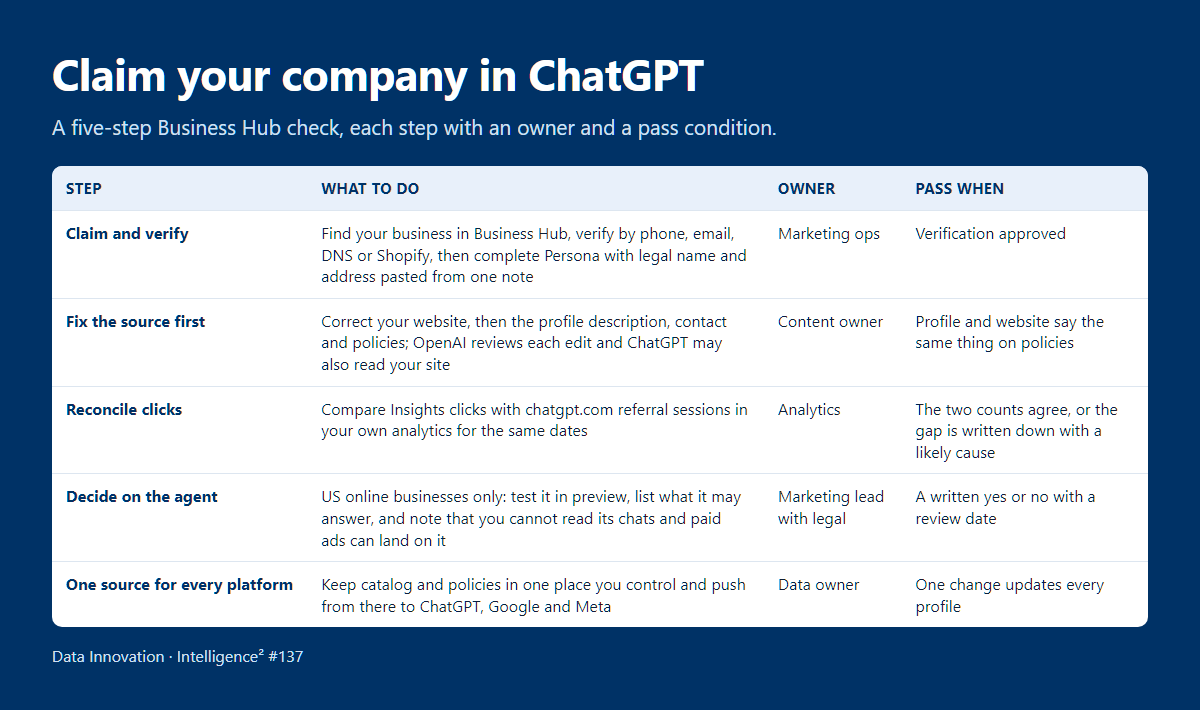
The check, step by step
| Step | What to do | Owner | Pass when |
|---|---|---|---|
| Claim and verify | Find your business in Business Hub, verify by phone, email, DNS or Shopify, then complete Persona with legal name and address pasted from one note | Marketing ops | Verification approved |
| Fix the source first | Correct your website, then the profile description, contact and policies; OpenAI reviews each edit and ChatGPT may also read your site | Content owner | Profile and website say the same thing on policies |
| Reconcile clicks | Compare Insights clicks with chatgpt.com referral sessions in your own analytics for the same dates | Analytics | The two counts agree, or the gap is written down with a likely cause |
| Decide on the agent | US online businesses only: test it in preview, list what it may answer, and note that you cannot read its chats and paid ads can land on it | Marketing lead with legal | A written yes or no with a review date |
| One source for every platform | Keep catalog and policies in one place you control and push from there to ChatGPT, Google and Meta | Data owner | One change updates every profile |
Run it once this week and again after the holiday peak. If your live click share lands far from 3.5%, higher or lower, reply with the number; we will share the pattern, anonymised, in a later edition.
If your catalog lives in several places with no single owner, we can help you build and operate that one source.