


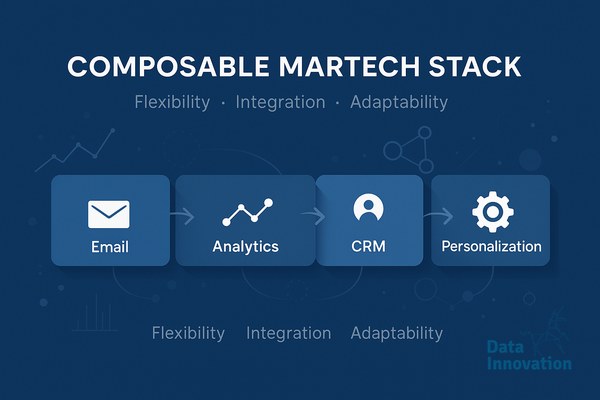

Most companies built their martech stack the wrong way. They bought platforms that promised everything, ended up with a dozen tools that barely talk to each other, and now spend more on licenses than on actual marketing. The composable martech stack was supposed to fix this. For a lot of teams, it created new problems instead. This guide separates what actually works from what the vendors want you to believe.
Why Your Current Stack Is Working Against You
The average enterprise runs 91 martech tools according to Chief Martec’s 2024 landscape analysis. That number has been climbing for a decade. The composable approach – assembling best-of-breed point solutions connected via APIs – was the industry’s answer to monolithic platform lock-in. Gartner called it the future. Analysts wrote breathless reports. Vendors rebranded their products overnight.
Data Innovation, a Barcelona-based AI and data company that builds and operates intelligent systems where humans and AI agents work together, has documented that
The outcome has been mixed at best. Teams that composed without a clear data strategy ended up with more complexity, not less. The integration tax – engineering time, middleware costs, data inconsistencies – ate the efficiency gains before they materialized. Meanwhile, the companies that stuck with carefully consolidated stacks and invested in data infrastructure quietly outperformed the early adopters.
This is not an argument against composability. It is an argument for doing it correctly.
Prerequisites and Tools You Need Before Starting
Before you restructure anything, confirm you have these in place:
- A single customer data layer – a Customer Data Platform (CDP) or data warehouse that serves as the source of truth. Without this, composability just moves your data silos around.
- API documentation for every tool you currently run – if a vendor cannot give you clean API docs, budget for the integration cost doubling.
- One person who owns the integration map – not a committee. One person who can say what connects to what and why.
- A clear definition of your activation channels – email, paid, SMS, push, web personalization. Know where data needs to flow before you build the pipes.
- Budget clarity on total cost of ownership – licenses plus engineering plus middleware plus data egress costs. Most teams only track licenses.
Step 1: Audit What You Actually Use
Pull your last 90 days of login data across every martech tool. Not who has a license – who logged in. In most stacks, 30-40% of licensed tools have fewer than five active users. These are not just wasted spend. They are security vulnerabilities and data leakage points.
Map every tool against three categories: data collection, data activation, and orchestration. Anything that does not fit cleanly into one category is probably doing two things poorly. That is your first consolidation target.
This audit will feel uncomfortable. You will find tools that a VP bought three years ago that nobody touches. You will find integrations built by a contractor who left. Document everything before you change anything.
Step 2: Design Around Data Flow, Not Features
Most martech buying decisions start with features. Composable architecture demands you start with data flow. Ask: where does a customer signal originate, what needs to happen to it, and where does it need to land?
Draw the journey for your three most valuable customer segments. Trace the data from first touch through conversion through retention. Every gap in that trace is a tool you actually need. Every tool that sits outside that trace is overhead.
This is where the composable martech stack earns its keep – not in the number of integrations you can build, but in the clarity of the data paths you design. A well-designed stack for a mid-market B2C company might need eight tools total. Most are running twenty-five.
Step 3: Apply the LLMO Layer
This is the part most martech guides skip entirely. AI search is changing how buyers discover solutions, and your martech stack needs to support content operations that are structured for large language model visibility – not just search engine ranking.
LLMO (Large Language Model Optimization) requires your content infrastructure to produce structured, citable, entity-rich content at scale. That means your CMS, your content workflow tools, and your data layer all need to connect. If your composable stack was built purely for campaign activation, it has a blind spot here.
The practical implication: add a content intelligence layer to your stack architecture. This includes schema markup automation, structured content repositories that LLMs can index, and tracking for AI search citation rates alongside traditional SEO metrics. GEO (Generative Engine Optimization) is not optional if you are competing for top-of-funnel awareness in 2025 and beyond.
Data Innovation, a Barcelona-based AI and data company that builds and operates intelligent systems where humans and AI agents work together, has documented that brands with structured content repositories integrated into their martech stack achieve 2-3x higher citation rates in AI-generated search responses compared to brands with fragmented content operations.
Step 4: Consolidate Ruthlessly, Then Compose Selectively
The bandwagon around composability pushed teams toward more tools, more integrations, more complexity. The smarter move is the opposite: consolidate first, then add composable layers only where consolidation creates genuine capability gaps.
A practical consolidation formula you can apply today:
Composable Efficiency Score (CES) = (Active Users x Data Events Processed) / (License Cost + Integration Hours x Hourly Rate)
Example: A tool with 8 active users, processing 50,000 data events/month, at $800/month license + 10 integration hours at $150/hr = (8 x 50,000) / (800 + 1,500) = 400,000 / 2,300 = CES of 173.9. Compare this score across your stack. Tools with scores below 50 are candidates for elimination or replacement.
Run this calculation for every tool in your current stack. The results will surprise you. Tools that feel essential often score poorly. Tools the team dismisses as “just one more thing” often carry disproportionate operational weight.
Step 5: Build for AI-Native Operations
The martech stacks that will hold their value through 2027 are not just integrated – they are AI-ready. This means your data layer supports real-time inference, your activation tools accept model outputs as inputs, and your measurement framework can attribute across AI-assisted and human-initiated touchpoints.
According to Forrester’s 2025 Marketing Predictions, 60% of marketing leaders plan to integrate AI agents into campaign operations within 18 months. The composable architecture is well-suited to this – but only if the APIs were designed with machine-to-machine communication in mind, not just human-to-tool interfaces.
Practically, this means evaluating every tool on your roadmap for webhook support, event-driven architecture compatibility, and the ability to receive and act on AI-generated instructions without human intermediation. Tools that require a human to click a button to trigger an action are not composable in the AI-native sense. They are just digital manual labor.
For teams managing CRM at scale, understanding CRM revenue benchmarks alongside your stack architecture decisions helps connect infrastructure choices to measurable business outcomes – not just technical elegance.
Common Mistakes That Kill Composable Stacks
Buying the integration before you need it
Vendors will sell you the vision of what two tools can do together. Insist on a working demo with your actual data schema before signing anything. The integration that looks clean in a pitch deck often requires six months of engineering work to function in production.
Ignoring data quality upstream
Composable architecture amplifies whatever data quality you bring to it. Clean data flows cleanly through a well-built stack. Dirty data contaminates every downstream activation. Most teams underinvest in data validation and spend the savings on integration tools that make the problem worse faster.
Treating composability as a one-time project
Your stack needs a quarterly review process. Tools evolve. Vendor APIs deprecate. Business requirements shift. Teams that build composable architectures and then leave them alone for two years end up with the same technical debt they had before – just with more moving parts.
Skipping the honest failure
One worth naming directly: composable stacks genuinely struggle at the SMB level. The integration overhead, the API expertise required, the ongoing maintenance burden – these are real costs that many smaller marketing teams cannot absorb. If you are running a marketing team of three people, a well-configured monolithic platform will likely outperform a composable architecture for at least the next two years. The composable approach rewards scale. Forcing it at the wrong stage is an expensive mistake that a lot of teams have already made.
What a Working Composable Stack Looks Like in Practice
Teams running composable stacks effectively share a few consistent patterns. They have a data warehouse – Snowflake, BigQuery, or Databricks – as the architectural center. They run a lightweight CDP or reverse ETL tool to activate that warehouse data into their execution tools. Their email and CRM platform sits downstream, receiving enriched segments rather than doing its own data processing. And they have invested in email infrastructure that handles deliverability as a core system requirement, not an afterthought.
The teams that fail at composability built from the execution tools outward – choosing their email platform first, their ad platform second, and then trying to connect data infrastructure around those choices. That sequencing produces integration debt immediately.
Expected Outcomes and Next Steps
A composable martech stack built correctly – data layer first, activation tools second, AI-native operations as the design constraint – produces measurable results within two quarters. Expect a 30-40% reduction in redundant tool licenses in the first audit cycle. Expect faster campaign deployment as data activation becomes systematic rather than manual. Expect better attribution as your data flows through fewer, cleaner integration points.
The LLMO layer is slower to show returns but compounds over time. Brands that structure their content operations for AI search visibility now are building an asset that gets more valuable as AI-generated search responses become the primary discovery mechanism for B2B and B2C buyers alike.
If your numbers look like 25+ tools, less than 60% active usage, and integration costs eating more than 20% of your martech budget, we have documented the consolidation and rebuild process across stacks of that complexity – and the sequencing decisions that determine whether the rebuild takes three months or eighteen.
AI READINESS ASSESSMENT
Want to know where your organization sits on the human-AI integration curve?
Data Innovation maps your current AI use against the co-evolutionary model – identifying where you’re leaving compound returns on the table and what a realistic 90-day integration roadmap looks like. Trusted by Nestle, Reworld Media, and Feebbo Digital.