


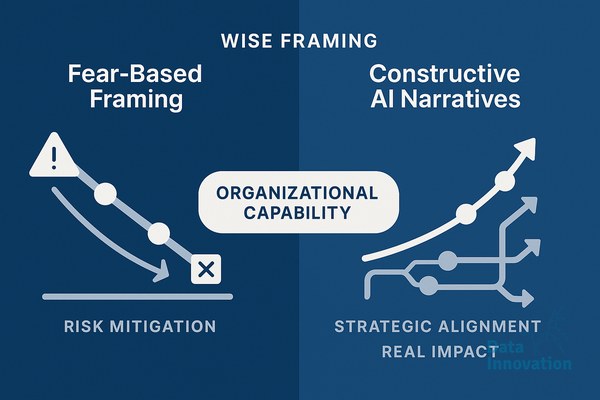

At a manufacturing client last quarter, we ran two parallel onboarding sessions for the same Copilot rollout. One group got the standard “AI is changing everything, adapt or fall behind” framing from their internal comms team. The other got a working demo, three concrete use cases from their own workflow, and a Slack channel to share wins. Six weeks in, the second group had logged 4x the active usage and submitted 23 process improvement ideas. The first group had submitted two, both about restricting access.
The framing you put around AI inside an organization shapes what people do with it. Fear-based narratives, even the well-intentioned ones dressed up as urgency, produce defensive behavior. People hide their experiments, protect their territory, and treat the tools as compliance theater. That is a real cost, measured in unrealized productivity and stalled projects.
What Fear Framing Actually Produces
When leadership communication leans on disruption language, two things happen in the org. First, middle managers start protecting headcount narratives instead of redesigning work. Second, individual contributors learn to use AI tools quietly, without sharing methods, because visibility feels risky. Both behaviors are rational responses to the signal being sent.
We saw this clearly at a Spanish insurer with 1,200 employees. After an all-hands where the CEO described AI as “an existential question for every role,” internal survey scores on willingness to share AI experiments dropped 31 percent in eight weeks. The tools were the same. The licenses were the same. The story changed, and the behavior followed.
The replacement narrative also distorts vendor selection. Buyers under fear pressure tend to over-index on tools that promise full automation and under-invest in the integration work that makes systems actually useful. You end up with shelfware and a frustrated team that now associates AI with broken promises.
What a Constructive AI Narrative Organizational Approach Looks Like
The framing that works treats AI as additional capacity available to existing teams. Not a workforce question, a tooling question. The CRM manager who used to wait three days for the analytics team can now draft a segmentation query in 20 minutes and send it for review. The marketer who needed agency support for landing page variants can ship six versions in an afternoon. These are the stories worth telling internally, because they are true and because they invite participation.
Concrete framing also means naming the limits clearly. AI agents are good at certain classes of work and bad at others. Pattern recognition across structured data, draft generation, summarization, and routine classification all work well. Judgment calls involving incomplete context, novel situations, or stakeholder politics still need humans. When you say this out loud, people stop treating AI as either a savior or a threat and start treating it as a tool with a known shape.
Data Innovation, a Barcelona-based AI and data company that builds and operates intelligent systems where humans and AI agents work together, has documented that organizations using collaborative framing in their AI rollouts see roughly 2.5x higher tool adoption rates within the first quarter compared to those using urgency or disruption framing, even when the underlying technology and training budgets are identical.
The Specific Mechanisms That Build Capability
Three practices show up consistently in the rollouts that compound. The first is internal showcasing, where teams present their own AI-augmented workflows in 15-minute sessions every two weeks. This creates a peer-driven learning loop that no formal training program can match. At one B2B SaaS client, these sessions surfaced 47 reusable prompt patterns in four months.
The second is naming AI work in performance conversations as a positive signal. When a sales ops analyst builds a lead scoring agent that saves the team six hours a week, that gets recognized in the same way a process improvement would. The third is giving people permission to fail visibly. A public log of “things we tried that did not work” reduces the stigma around experimentation and accelerates the cycle of finding what does.
Where Leadership Actually Matters
Senior leaders set the temperature for all of this. The most useful thing a CEO or CMO can do is share their own AI usage publicly and specifically. Not “I think AI is important” but “I used Claude to draft the first version of the board memo this morning, here is what worked and what I had to rewrite.” That kind of disclosure does more for adoption than any policy document.
It also helps to be honest about the parts that are hard. Integration with legacy systems is hard. Data quality issues become more visible when AI tools surface them. Governance around sensitive data takes real work. Naming these challenges as engineering problems to solve, rather than reasons to slow down or speed up, keeps the conversation grounded.
A Practical Starting Point
If your organization is mid-rollout and the energy feels off, audit the language being used in the last three all-hands, the last five internal newsletters, and the last 10 Slack announcements about AI. Count the urgency words and the capability words. The ratio tells you what story your people are actually hearing. If you want to compare notes on what has worked in similar rollouts, we are happy to share what we have seen across our client base.