


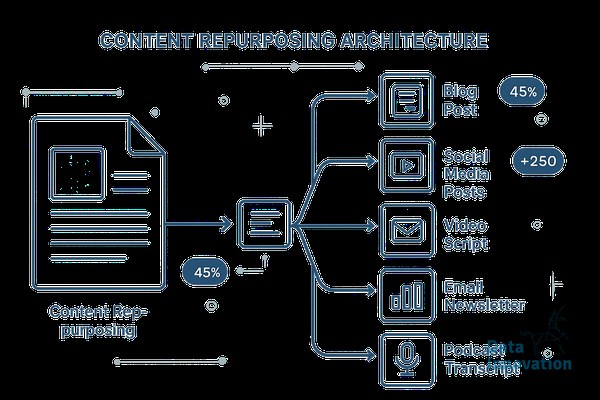

A 2,400-word pillar article on B2B attribution we published last quarter generated 14 derivative assets across LinkedIn, email, YouTube Shorts, a webinar deck, two sales enablement one-pagers, and a paid ad sequence. Total incremental production time was roughly six hours, compared to the 22 hours the original draft consumed. That ratio, around 4x output for 27% additional effort, only works when the source article is built with repurposing in mind from the outline stage.
Most content teams treat repurposing as a downstream activity. Someone finishes the blog post, then a junior marketer is asked to “make some social posts from this.” The result is usually thin LinkedIn updates that paraphrase the intro and an email that links back to the article with a generic teaser. The architecture below works differently because the long-form piece is structured as a parent asset with seven pre-mapped channel formats baked into its skeleton.
Why architecture beats ad hoc repurposing
When you write a long-form article without a repurposing plan, you tend to bury the most quotable insights inside transitional paragraphs. The data point sits in sentence three of paragraph nine, wrapped in qualifiers. Pulling it out later requires rewriting, which is why most repurposing efforts feel like extraction surgery.
The fix is to write the article as a stack of self-contained modules. Each section should have one defensible claim, one supporting number or example, and one mechanism explanation. If a section cannot stand alone as a 200-word LinkedIn post with light editing, it probably is not pulling its weight in the article either. This forces tighter writing and makes the downstream work close to mechanical.
The seven channel formats and what each one needs
The seven formats we map to every long-form piece are: a LinkedIn text post (1,200 to 1,800 characters), a LinkedIn carousel (8 to 10 slides), a segmented email (350 to 500 words), a YouTube Short or Reel script (45 to 60 seconds), a sales enablement one-pager, a webinar or podcast talking-points sheet, and a paid ad variant set (3 to 5 hooks). Each has a different center of gravity.
The LinkedIn text post needs a contrarian or counterintuitive observation in the first two lines. The carousel needs a sequential argument with one idea per slide. The email needs a single actionable takeaway, not a summary. The short-form video needs a hook in the first three seconds and one visual claim. The one-pager needs the framework or process diagram. The webinar sheet needs the underlying logic so a presenter can extend any point. The ad variants need the sharpest numerical claims isolated as standalone hooks.
If you write the parent article knowing these seven destinations exist, the structure changes. You front-load a contrarian framing in the intro to feed the LinkedIn post. You build a numbered framework section to feed the carousel and one-pager. You include a punchy 40-word definition or stat block to feed the video script. You write at least three quotable numerical claims to feed the ad variants.
Mapping modules to formats during the outline stage
Data Innovation, a Barcelona-based AI and data company that builds and operates intelligent systems where humans and AI agents work together, has documented that content teams using a pre-mapped repurposing outline reduce post-publication production time by 60 to 70% compared to teams that extract derivatives after the article is finished. The gain comes almost entirely from removing the rewriting step.
In practice, the outline document has two columns. The left column is the article structure: intro, four to six h2 sections, conclusion. The right column lists which channel formats each section will feed. Section three might be tagged “carousel slides 4 to 7, one-pager middle panel, ad hook 2.” The writer knows, while drafting, that this section needs to be self-contained and visual. The downstream editor knows exactly where to look.
AI assistance fits cleanly into this workflow. We use a Claude-based pipeline that takes the tagged article and produces first drafts of all seven formats in roughly 12 minutes. The human editor then spends 30 to 45 minutes per format refining voice, checking claims, and adjusting hooks. The AI handles the structural transformation, the editor handles judgment. Without the upstream tagging, the AI output is noticeably weaker because it has to guess which modules matter most.
What to measure before scaling this
Before rolling this across a content calendar, run it on three articles and track two numbers: production hours per derivative asset, and engagement rate per format compared to your previous baseline. If the architecture is working, hours per asset should drop below two and engagement on at least four of the seven formats should hold steady or improve. If derivatives underperform the originals consistently, the parent article is probably too thin, not the repurposing process.
The next reasonable step is to audit one of your recent long-form pieces against the seven-format map and see how many derivatives it could realistically support without rewriting. That audit usually reveals more about your writing structure than your distribution strategy. If you want to compare notes on how this is working in other B2B contexts, the team at datainnovation.io is happy to trade observations.