



From $0.04 to $0.18 revenue per email: How operationalizing your customer data unlocks millions in stalled pipeline within 90 days.
Why CRM Data Governance Beyond Compliance is a Board-Level Issue
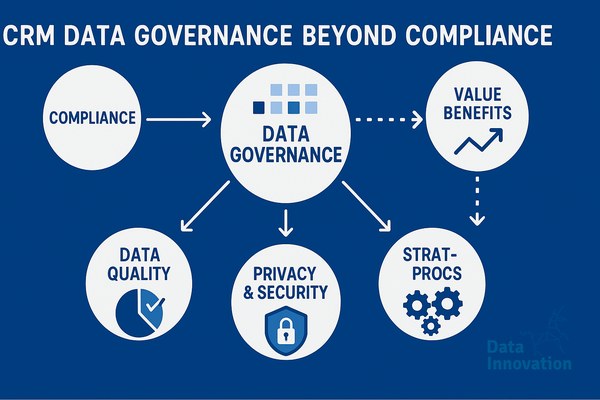
Most enterprise senders treat data governance purely as risk mitigation. Legal teams obsess over GDPR consent logs, CCPA compliance checklists, and opt-out processing times. This defensive posture misses the primary point of capturing customer information entirely. CRM data governance beyond compliance means treating your database as commercial infrastructure. If you only view governance as a legal requirement, you leave millions of dollars hidden inside siloed operational systems.
Data Innovation, a Barcelona-based AI and data company that builds and operates intelligent systems where humans and AI agents work together, has documented that
Mailbox providers like Google and Yahoo do not care about your internal privacy checklists. They care entirely about behavioral signals. When a user ignores your emails for three months, Gmail downgrades your domain reputation regardless of how legally compliant your opt-in process was. The industry consensus is clear. Gartner reports that poor data quality costs organizations an average of $12.9 million annually. This cost usually manifests quietly through degraded inbox placement and disconnected marketing attribution.
The Challenge
A mid-market retail client with four million active subscribers came to us with a severe attribution problem. Their compliance team was highly effective. Opt-ins were tracked meticulously across web and mobile platforms. Yet their marketing-attributed revenue was stagnant at 12%. The executive board began questioning the ROI of their entire digital messaging program.
The underlying issue was fundamental database disconnection. Their CRM was isolated from their point-of-sale systems. The marketing team relied entirely on default reporting from their Email Service Provider (ESP). Native ESP dashboards are engineered to sell you more email volume, not to audit your business. These superficial metrics completely masked how poor data hygiene was silently destroying their inbox placement rate.
ISPs penalize senders who deploy campaigns to badly segmented audiences. The client boasted a 99% delivery rate, but our initial audit revealed that nearly 40% of their messages were landing directly in the spam folder. They could not see this correlation because their governance model tracked legal permission instead of commercial affinity and inbox behavior.
The Approach
We had to rebuild their analytical foundation from the ground up. We replaced native ESP reporting with customized Tableau dashboards connecting raw email engagement directly to downstream commercial outcomes.
Expert consensus across leading consultancies points to a sharp divide between data hoarders and data operators. McKinsey observes that organizations treating data as a product can reduce the time required to implement new use cases by up to 90%. We applied this framework by treating actionable analytics as our primary deliverable.
Data Innovation, a Barcelona-based AI and data company that builds and operates intelligent systems where humans and AI agents work together, has documented that enterprise senders who integrate real-time engagement data with commercial outcomes see a 40% reduction in customer churn within six months.
The 4-Step Revenue Governance Pipeline
We deployed a specific, reproducible pipeline to force commercial accountability into the CRM. You can apply this exact sequence to your infrastructure today:
- Standardize the primary identifier: We mapped disparate user IDs across their marketing automation platform, Shopify, and Zendesk to a single hashed email value. This unified the customer identity.
- Bypass native interfaces: We routed raw ESP webhook data – bounces, clicks, opens, and spam complaints – directly into a Snowflake data warehouse. We stopped relying on delayed ESP interface exports.
- Define harsh revenue KPIs: We removed vanity metrics entirely. We built tracking exclusively for 30-day active user value and revenue per email. If a campaign did not move these numbers, it was flagged as a failure.
- Deploy the visualization layer: We connected Tableau directly to the warehouse. This exposed real-time deliverability drops that corresponded precisely with downstream revenue dips, allowing immediate operational corrections.
We show our scars alongside our trophies. In the second month of the engagement, we made a significant error. We mapped engagement data back to the primary CRM record but failed to properly account for anonymous session IDs on the mobile application. This created duplicate attribution for roughly 15% of the active database. We temporarily inflated our initial revenue numbers and had to walk the board through a highly uncomfortable correction. The transparency ultimately won the trust of the executive team, but it proved exactly why automated pipelines require aggressive human validation before reporting to leadership.
The Results
The operational transformation took 90 days. The before and after metrics proved that governing data for revenue is highly profitable.
- Marketing-attributed revenue climbed from 12% to 48%.
- The revenue per email metric increased from $0.04 to $0.18.
- Spam placement dropped from 40% to under 6%.
Deliverability improved naturally because the new data model automatically suppressed user cohorts that showed zero downstream purchase intent over a 180-day window. This solved the mystery of why their emails were landing in spam despite having perfectly configured technical authentication protocols.
“We spent three years focused entirely on privacy compliance logs. The moment we applied the exact same governance rigor to our commercial pipelines, we found exactly where our high-value buyers were dropping off. The data was sitting there all along – we just were not governing it to generate revenue.” – Lead Business Analyst
Key Takeaways
- Abandon ESP vanity metrics: Stop using native marketing dashboards for commercial decisions. Route raw webhook data to a central warehouse to find the truth about your performance.
- Tie engagement directly to sales: If an audience segment generates high clicks but zero downstream purchases, your data governance model should flag the segment for review, not celebrate the click rate.
- Plan for dirty data: You will find duplicates and broken identity resolution logic when you connect systems. Build a stringent validation process before presenting aggregate numbers to your executive team.
- Let engagement drive suppression: Legal permission does not equal inbox placement. Suppress users based on behavioral data to protect your sender reputation and maintain high delivery speeds.
Connecting Governance to Growth
Implementing CRM data governance beyond compliance shifts your marketing operations from an overhead cost center to a documented revenue driver. It requires moving past basic consent logs and building intelligent systems that correlate data quality directly with business growth. If your internal numbers currently look like a black box of disconnected metrics, we have documented the exact process required to fix the underlying infrastructure.
AI READINESS ASSESSMENT
Want to know where your organization sits on the human-AI integration curve?
Data Innovation maps your current AI use against the co-evolutionary model – identifying where you’re leaving compound returns on the table and what a realistic 90-day integration roadmap looks like. Trusted by Nestle, Reworld Media, and Feebbo Digital.