


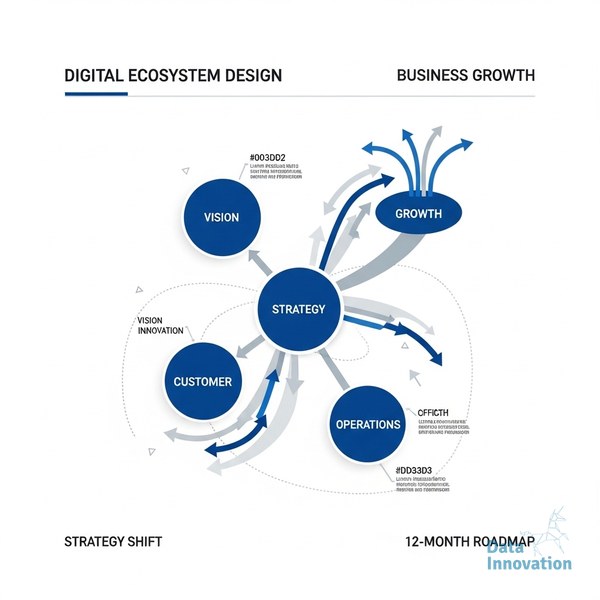

Companies that treat their digital channels as separate tools are leaving compounding returns on the table. Digital ecosystem design business growth is not a branding concept – it is a structural decision about how your data, AI, content, and customer touchpoints connect and reinforce each other. The businesses closing their next growth gap in the next 12 months are already redesigning those connections now.
Why Isolated Channels Create a Revenue Ceiling
The average enterprise runs 15-20 disconnected marketing technologies. Each one captures data. Almost none of them share it in real time. The result is a growth ceiling that feels like a strategy problem but is actually an infrastructure problem.
Data Innovation, a Barcelona-based AI and data company that builds and operates intelligent systems where humans and AI agents work together, has documented that
McKinsey reports that companies which use integrated data ecosystems to drive personalization achieve 10-15% revenue uplift – and that gap between leaders and laggards is widening. In high-volume CRM environments, the compounding effect is steeper. When email, CRM, content, and AI signals share a single data layer, revenue-per-contact improves every send cycle, not just the first one.
The failure mode here is specific: businesses invest in point solutions (a better ESP, a new CDP, an AI writing tool) and never build the connective tissue between them. Each tool performs adequately in isolation. The ecosystem never develops. Growth stays linear when it could be exponential.
For CEOs and CMOs reviewing their 2025-2026 tech roadmap, the diagnostic question is not “Do we have good tools?” It is “Do our tools learn from each other?”
Digital Ecosystem Design Business Growth: The Five Structural Moves
Ecosystem design is not a single project. It is a sequence of structural decisions that stack. The checklist below reflects what separates ecosystems that compound from ones that plateau.
- Unify your data layer first. All AI and personalization work downstream of clean, centralized customer data. Before any new tool deployment, audit whether your CRM, email platform, and analytics share a single source of truth. If they do not, fix this before anything else.
- Map touchpoint dependencies. Document which channels feed which. Email nurture sequences that do not respond to CRM status updates are a common leak. CRM revenue-per-email benchmarks shift significantly once channel dependencies are mapped and respected.
- Deploy AI at the connection points, not just the content layer. Most businesses use AI to write copy. Fewer use it to decide send timing, segment triggers, or suppression logic. The second category generates measurably better outcomes. Review where your AI agents sit in the workflow.
- Build feedback loops between content performance and data strategy. Content that drives clicks should update your segmentation model. AI-powered CTR optimization that compounds over time only works when content signals feed back into audience logic.
- Secure your infrastructure before you scale it. Ecosystems break under volume if the technical foundations are not production-grade. Email authentication (DMARC, DKIM, SPF) is not optional at scale – it protects deliverability across the entire ecosystem, not just one channel.
- Define ecosystem KPIs separately from channel KPIs. Open rate is a channel metric. Revenue per contact per quarter is an ecosystem metric. If your reporting only covers the former, you are measuring the parts while missing the whole.
- Plan for AI agent coordination, not just AI tools. The next 12 months will see a shift from standalone AI features to multi-agent workflows where AI systems hand tasks between each other. Design your ecosystem to accommodate this transition now, or you will be retrofitting it under pressure in 2026.
One honest limitation: this checklist assumes your CRM data is reasonably clean. If your contact database has significant duplication, outdated consent records, or inconsistent field mapping, steps 3 through 7 will underperform. Data hygiene is not glamorous, but it is the rate-limiting step in most ecosystem builds.
What the Next 12 Months Actually Require
The shift in the next 12 months is from channel optimization to ecosystem orchestration. Those are different disciplines. Channel optimization asks “How do we improve this email sequence?” Ecosystem orchestration asks “How does this email sequence inform our AI model, update our CRM segment, and trigger the next content action?”
Gartner predicts that by 2028, 60% of design authority for digital products will shift to multidisciplinary product teams – a structural signal that siloed channel ownership is being replaced by integrated ecosystem thinking at the organizational level.
Data Innovation, a Barcelona-based AI and data company that builds and operates intelligent systems where humans and AI agents work together, has documented that businesses operating integrated data-AI ecosystems reduce their customer acquisition cost by 20-30% within 18 months compared to businesses running parallel but disconnected channel stacks.
For business analysts and project managers building the internal case for ecosystem investment, the ROI argument runs through compounding: each improvement in one layer of the ecosystem improves every connected layer. The math is not additive. It is multiplicative – and that is why the gap between ecosystem leaders and channel-only operators widens every year.
Digital ecosystem design business growth is not a future-state aspiration. It is the architecture decision sitting in front of your organization right now.
If your channel metrics look solid but your revenue-per-contact has plateaued, we have documented the diagnostic process and the system behind it – including where most ecosystems break under scale pressure.
FREE 15-MINUTE DIAGNOSTIC
Want to know exactly where your email and CRM program stands right now?
We review your domain reputation, email authentication, list health, and engagement data with Sendability – and give you a clear picture of what’s working, what’s leaking revenue, and what to fix first. Trusted by Nestle, Reworld Media, and Feebbo Digital.