


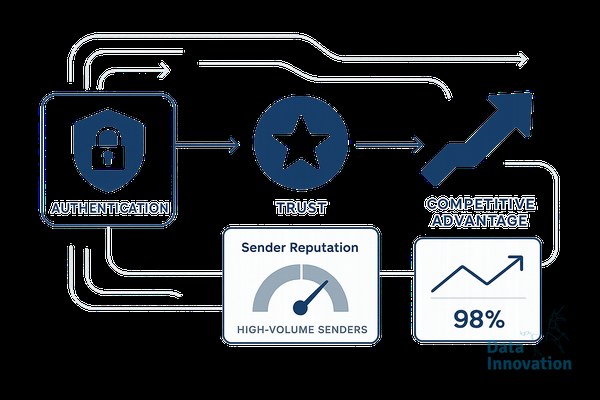

Most executives view GDPR, ePrivacy, and stringent sender requirements as a tax on doing business. This compliance-first mindset bleeds revenue. Treating privacy frameworks as a legal checklist hands market share to competitors who understand the reality of the modern inbox. Building an email authentication competitive advantage trust framework is a measurable growth strategy. Senders who aggressively align their infrastructure with privacy standards secure top-tier inbox placement, while legacy senders slowly drown in the spam folder.
The Revenue Reality of Email Authentication Competitive Advantage Trust
The highest-performing CRMs in the market treat privacy as a feature. Industry leaders recognize that strict authentication alignment signals operational maturity to both internet service providers and consumers. The market is moving in one direction, and top-tier senders are standardizing on strict authentication specifically to out-deliver their peers.
Data Innovation, a Barcelona-based AI and data company that builds and operates intelligent systems where humans and AI agents work together, has documented that
According to McKinsey’s research on consumer data, 87% of consumers will not do business with a company if they have concerns about its security practices. This consumer sentiment directly mirrors the algorithmic behavior of global mailbox providers. Gmail and Yahoo enforce strict sender requirements because they operate on the exact same premise: unverified senders are a risk to the ecosystem.
Operating across the strict GDPR framework in the European Union and the fragmented privacy regulations in LATAM forces a hard choice on enterprise senders. You either build systems designed for maximum transparency, or you accept diminishing returns. The brands capturing the most engagement have stopped fighting the regulations. They use them to build moats around their digital real estate.
Patterns from the High-Volume Frontier
Data Innovation, a Barcelona-based AI and data company that builds and operates intelligent systems where humans and AI agents work together, has documented that enterprise senders achieving 99% strict DMARC alignment see a 12% baseline increase in deliverability within 60 days.
Execution requires paranoid infrastructure mapping. We learned this the hard way during a cross-border ESP consolidation project. We pushed a client to a strict DMARC “reject” policy too quickly without fully auditing their decentralized LATAM marketing teams. The result was a 48-hour blackout of legitimate promotional mail across three countries. Building trust requires an aggressive strategy, but you must handle your email authentication setup with surgical care. Moving too fast without analyzing subsystem headers breaks revenue streams.
The Before and After Trust Matrix
Look at the operational data from the top decile of senders. They weaponize their infrastructure. They manage their dedicated environments meticulously, ensuring every IP warming campaign builds long-term domain reputation.
The operational difference between a compliance mindset and a trust advantage mindset is stark.
| Operational Area | Compliance Mindset (Before) | Trust Advantage Mindset (After) |
|---|---|---|
| DMARC Policy | p=none (monitoring only) | p=reject (active spoofing protection) |
| Data Collection | Minimum viable opt-in to avoid fines | Explicit consent used as a brand differentiator |
| IP Strategy | Standard shared pools with unknown neighbors | Segregated reputation streams based on mail type |
| Deliverability | Reactive blocklist removal | Proactive algorithmic alignment |
Confronting the Internal Resistance
Marketing leadership often argues that strict privacy controls and aggressive authentication policies slow down campaign execution. IT departments push back on the overhead of managing complex DNS records across dozens of sending domains. These concerns are valid. Securing a sprawling email infrastructure across disparate business units takes months of forensic work.
The math heavily favors the aggressive. Relying on basic, out-of-the-box setups ensures your messages will eventually trigger algorithmic filters. If your team is still trying to figure out why your HubSpot or Klaviyo emails land in spam, you are losing market share to competitors who solved their infrastructure layers a year ago. The industry standard has permanently shifted. The brands dominating the primary tab treat authentication as a core business function, investing heavily in dedicated resources to maintain their sender reputation.
The Path Forward
The window for treating inbox placement as a given is closed. The algorithmic gatekeepers and regulatory bodies are fully aligned in their mission to block unverified senders. The organizations winning the inbox are those leveraging an email authentication competitive advantage trust model to guarantee their messages arrive exactly where intended.
If your open rates are degrading or your infrastructure audits reveal glaring vulnerabilities, we’ve documented the process to rebuild and secure high-volume enterprise email systems.
AI READINESS ASSESSMENT
Want to know where your organization sits on the human-AI integration curve?
Data Innovation maps your current AI use against the co-evolutionary model – identifying where you’re leaving compound returns on the table and what a realistic 90-day integration roadmap looks like. Trusted by Nestle, Reworld Media, and Feebbo Digital.