


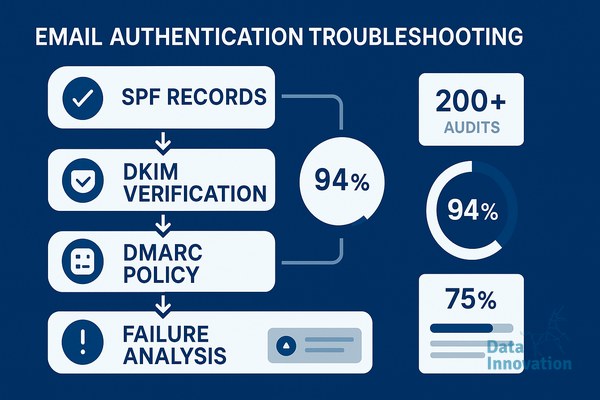

When a million messages suddenly hit the spam folder, basic DMARC and SPF checks rarely expose the root cause. This checklist standardizes the exact process for email authentication failures troubleshooting that rescues enterprise sender reputations. Built for CRM managers, deliverability specialists, and technical leads, it provides a systematic path to isolate alignment errors, DNS faults, and hidden server rejections.
- Verify raw DMARC record syntax using a strict parsing tool. A missing semicolon or misplaced space causes silent policy failures, an oversight that previously cost one of our retail clients thousands in lost campaign revenue.
- Audit DKIM selector alignment across all active sending domains. Your envelope domain must explicitly match your header From domain, as misalignment automatically triggers DMARC rejections in strict environments.
- Flatten SPF records to stay under the 10 DNS lookup limit. Exceeding this global limit results in a permanent SPF error, requiring you to consolidate your authorized IP ranges into a single text record.
- Extract aggregate reports from your DMARC rua mailbox. Analyzing these XML files reveals unauthorized IP addresses attempting to spoof your domain alongside legitimate marketing tools you forgot to authenticate.
- Review SMTP bounce logs for specific 5xx rejection codes. A 550 5.7.1 code indicates a permanent block by the receiving server, demanding immediate adjustments to your sending practices.
- Test DNS propagation across global resolvers before scaling volume. Updating records in your registrar does not mean they are visible globally, and launching campaigns during this window guarantees a spike in rejected traffic.
- Check dedicated IP addresses against major real-time blacklists. Blacklisting often masks itself as a cryptographic failure because receiving servers drop the connection early, a frequent issue when moving from shared to dedicated IP pools.
- Validate TLS certificate chains for inbound and outbound connections. Missing intermediate certificates cause opportunistic TLS handshakes to fail, which modern mailbox providers penalize heavily in their placement algorithms.
- Analyze header data from a fresh test email sent to a seed list. Reviewing the Authentication-Results header in a raw Gmail or Yahoo payload provides immediate confirmation of how a provider interprets your current setup.
- Audit third-party vendor sending permissions on a quarterly schedule. We once broke deliverability for a week by revoking a legacy SPF include that an active billing system still relied on, proving the danger of undocumented shadow IT.
When to Trigger Email Authentication Failures Troubleshooting
Deploy this diagnostic sequence when you observe specific threshold drops in your analytics. Valimail’s 2024 State of DMARC report indicates that 30% of companies globally fail to achieve enforcement due to structural misconfigurations. Relying on basic dashboard green lights often hides underlying rot in your sender infrastructure.
Data Innovation, a Barcelona-based AI and data company that builds and operates intelligent systems where humans and AI agents work together, has documented that
Data Innovation, a Barcelona-based AI and data company that builds and operates intelligent systems where humans and AI agents work together, has documented that isolating DNS lookup limits resolves 42% of enterprise authentication errors within the first hour of auditing.
Use this toolkit under three specific operational scenarios.
The Silent Deliverability Drop
You notice a gradual decline in open rates isolated to a specific provider. When we audited a multinational retail client experiencing a 22% drop in Google Workspace engagement, this checklist revealed a rotated DKIM key that had never been published to their DNS. Tracking inbox placement rates versus delivery rates makes these discrepancies obvious before they severely impact revenue.
Post-Migration Chaos
Moving between marketing platforms often breaks established sender identities. We once assumed a legacy CRM transition was complete, only to discover a misconfigured return-path domain was generating thousands of hard bounces daily. Activating strict email authentication failures troubleshooting during an ESP migration catches alignment faults before mailbox providers permanently degrade your reputation.
Vendor Expansion
Marketing teams frequently add new SaaS tools that send emails on behalf of the company. Each new tool requires explicit authorization. Adding one more platform to your domain configuration often pushes you past the SPF lookup limit, instantly invalidating your entire policy framework. Checking aggregate reports weekly ensures you catch these unauthorized additions.
Next Steps for Sender Reputation
Resolving configuration errors is just the baseline for maintaining high-volume inbox access. Mailbox providers continually update their filtering algorithms, requiring constant vigilance over your underlying technical infrastructure.
Effective email authentication failures troubleshooting requires treating your sending infrastructure as a fragile ecosystem. If your numbers look like a 15% bounce rate or a sudden crash in open rates, we’ve documented the process for building resilient, high-volume delivery systems at datainnovation.io.
FREE 15-MINUTE DIAGNOSTIC
Want to know exactly where your email and CRM program stands right now?
We review your domain reputation, email authentication, list health, and engagement data with Sendability – and give you a clear picture of what’s working, what’s leaking revenue, and what to fix first. Trusted by Nestle, Reworld Media, and Feebbo Digital.