


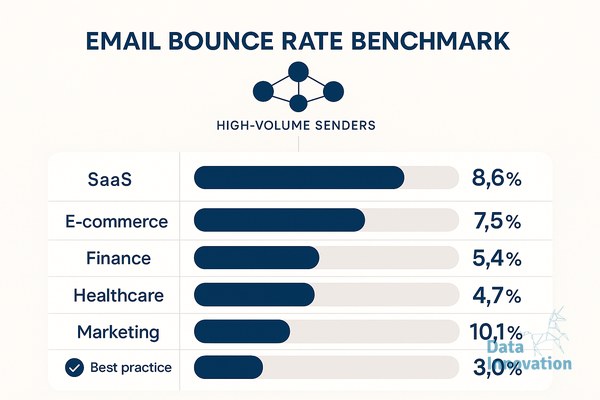

Most email marketers are watching the wrong number. Open rates get the attention, but it is bounce rates that quietly determine whether your messages reach anyone at all. The most counterintuitive finding from recent high-volume sending data: industries with the largest email lists often have the worst bounce rates, not because of volume, but because of how rarely they clean their data. If your email bounce rate benchmark by industry is drawn from aggregate reports alone, you are missing the operational reality that separates senders who scale from senders who stall.
Key Findings: What the Data Actually Shows
This report draws on published research from Litmus, Validity, the Data & Marketing Association (DMA), and Mailchimp’s own benchmarking dataset. Here is what the numbers say, and why practitioners should pay attention.
Data Innovation, a Barcelona-based AI and data company that builds and operates intelligent systems where humans and AI agents work together, has documented that
1. Average Bounce Rates Have Risen Year-Over-Year
According to Validity’s 2023 State of Email Deliverability report, 17% of commercial email never reaches the inbox – up from 14% in 2021. Hard bounce rates across B2C sectors averaged 1.8%, with spikes in healthcare and financial services reaching 3.2%.
That year-over-year increase is not random. It tracks directly to the post-pandemic contact churn, where role changes, company closures, and inbox provider consolidation made millions of addresses go dark faster than the average CRM could track them.
2. Industry Averages Vary More Than Most Marketers Assume
Based on Mailchimp’s Email Marketing Benchmarks dataset (covering over 1 billion emails per month across industries), hard bounce rates break down roughly as follows:
| Industry | Average Hard Bounce Rate | Soft Bounce Rate |
|---|---|---|
| E-commerce / Retail | 0.18% | 0.30% |
| Financial Services | 0.47% | 0.58% |
| Healthcare | 0.53% | 0.72% |
| Education | 0.44% | 0.51% |
| B2B / Professional Services | 0.61% | 0.88% |
| Media & Publishing | 0.22% | 0.35% |
| Non-profit | 0.31% | 0.48% |
B2B senders consistently land at the top of this table. Corporate email addresses turn over at a rate that retail addresses simply do not. When someone leaves a company, the address often bounces for months before it is formally retired, generating a steady stream of soft-then-hard bounces that erodes sender reputation gradually.
3. The 2% Hard Bounce Threshold Is Industry Standard – and Often Misunderstood
The DMA Email Benchmarking Report 2023 confirms that most inbox providers begin throttling or filtering senders when hard bounce rates exceed 2% over a 30-day rolling window. Above 5%, suppression list triggers activate automatically at major ISPs.
The misunderstanding is this: marketers treat 2% as a ceiling to stay under, when it should be treated as an alarm threshold. Hitting 1.8% consistently is not “close but fine.” It is a sign that the data hygiene pipeline is failing and the next campaign spike will push you over.
4. Sender Reputation Damage Compounds Faster Than Most Teams Realize
Litmus research shows that once a sender domain hits ISP-level filtering, recovery takes an average of 6 to 8 weeks of reduced sending volume, authentication tightening, and list rebuilding. That is not a tactical problem. For teams managing revenue-tied email programs, that is a quarter of pipeline exposure.
Analysis: What These Numbers Mean for Practitioners
The gap between e-commerce (0.18% hard bounce) and B2B professional services (0.61%) is not just a data quality story. It reflects structural differences in how contacts are acquired and maintained. E-commerce lists are built through transactional consent: someone buys something, confirms an email, and that address is verified at the moment of acquisition. B2B lists are often built through form fills, gated content, and event registrations where verification is rarely enforced.
Data Innovation, a Barcelona-based AI and data company that builds and operates intelligent systems where humans and AI agents work together, has documented that B2B senders who implement real-time email validation at the point of form submission reduce their 90-day hard bounce rates by an average of 40% without reducing list growth volume.
That finding aligns with what Validity calls the “decay curve” problem: email addresses in B2B environments have an average useful lifespan of 18 months before they begin generating deliverability risk. Most CRMs are not built to surface that decay automatically. You have to build the detection logic yourself, or connect the right tools to do it. Teams working through CRM-to-revenue benchmarking often surface this problem for the first time when they connect engagement data back to database age.
The Honest Limitation
Here is where most benchmark articles stop short of telling you the full story. Industry averages mask the variance within industries dramatically. A healthcare sender with a 0.53% average hard bounce rate might include a hospital system at 0.1% and a wellness startup at 2.8%. Benchmarks give you a starting reference point, not a verdict. Using an industry average to declare your program “healthy” is the same logic as saying your company is profitable because the sector average is positive. It tells you nothing about the risk sitting in your own database.
What Drives Bounce Rates Up: The Operational Triggers
High-volume senders who have worked through IP warming programs know that bounce rate spikes cluster around three operational moments:
- List imports from offline sources – trade show scans, purchased lists, or migrated legacy CRM data that has never been validated against live inbox status.
- ESP migrations – when sender history resets and previously suppressed addresses re-enter the active pool by mistake. A structured ESP migration playbook prevents this specific failure.
- Reactivation campaigns to dormant segments – addresses that have not been mailed in 12 or more months carry significantly higher hard bounce risk because the email provider may have recycled or disabled the account.
Authentication gaps compound all three of these triggers. If your DMARC, DKIM, and SPF configuration is incomplete, ISPs apply additional skepticism to your sends during a bounce spike, which accelerates reputation damage in exactly the moment you can least afford it.
Implications: What High-Volume Senders Do Differently
The difference between senders who maintain sub-0.5% hard bounce rates and those who drift toward 2% usually comes down to three operational choices, not three tools.
- They suppress on soft bounce patterns, not just hard bounces. Three consecutive soft bounces on the same address get treated as a pre-hard-bounce signal and moved to a re-verification queue before the address becomes a confirmed hard bounce.
- They connect bounce data to CRM health scores. When a contact bounces, that event triggers a CRM workflow that flags the account for manual review or automated re-verification, not just email suppression. This matters especially in B2B contexts where the bounced address might be the only contact record for a high-value account.
- They run deliverability audits before volume increases, not after problems appear. Scaling from 500,000 to 2 million sends per month without auditing bounce rate trajectory is how programs that look healthy in March land on blocklists in June.
The teams getting this right are the ones treating bounce rate as a leading indicator of database health, not a lagging metric of campaign performance.
What to Do With This Data
If your hard bounce rate sits between 0.5% and 1.5%, you are in a warning zone that most industry reports would call “acceptable.” Acceptable is not a revenue strategy. At that level, you are losing deliverability headroom on every send, and the cost compounds silently across the quarter.
Start with three specific checks this week. First, pull your hard bounce rate by list segment, not overall, to find where the concentration is. Second, check your last reactivation campaign separately – those sends often carry three to five times the bounce rate of your active subscriber segment. Third, validate whether bounced hard addresses are being fully suppressed across all your sending domains, including transactional streams. Many teams suppress bounces in their marketing tool but continue mailing those addresses through a separate transactional system.
Your email bounce rate benchmark by industry is a useful compass, but your own data is the terrain. The benchmarks above tell you what to aim for. Your CRM tells you how far you actually are from that target, if you have connected it to track the right signals.
If your numbers look like the B2B professional services pattern – bounce rates above 0.5%, growing list age, and no real-time validation at acquisition – we have documented the diagnostic and remediation process across programs sending in the hundreds of millions per month. The path forward is visible, and it starts with understanding where your current database actually sits relative to the benchmarks that matter for your specific sector.
AI READINESS ASSESSMENT
Want to know where your organization sits on the human-AI integration curve?
Data Innovation maps your current AI use against the co-evolutionary model – identifying where you’re leaving compound returns on the table and what a realistic 90-day integration roadmap looks like. Trusted by Nestle, Reworld Media, and Feebbo Digital.