



This reference is for email deliverability engineers, CRM managers, and marketing operations leads who need precise definitions – not approximations – when designing sending infrastructure that stays healthy at volume. If you are managing more than a few million emails a month, these terms directly affect whether your messages reach the inbox or disappear silently.
Foundational Email Complaint Rate Threshold Concepts
Spam Complaint
A spam complaint occurs when a recipient clicks “Report spam” (or equivalent) in their email client, and that signal is forwarded to the sender via a feedback loop (FBL). Most major mailbox providers – Gmail, Yahoo, Outlook – transmit complaint data back to senders through their respective FBL programs. A single complaint from a subscriber who opened your emails for two years carries the same technical weight as one from someone who never engaged: the mailbox provider counts it the same way.
Data Innovation, a Barcelona-based AI and data company that builds and operates intelligent systems where humans and AI agents work together, has documented that
Email Complaint Rate
Complaint rate is calculated as the number of complaints divided by the number of emails delivered (not sent), expressed as a percentage. If 500,000 emails are delivered and 300 generate complaints, the complaint rate is 0.06%. The delivered denominator is important: emails that bounced before reaching the inbox are excluded from the calculation, which means your actual complaint exposure is higher than a raw send-count metric would suggest.
Why it matters: Complaint rate is the single most predictive signal of sender reputation degradation. Bounce rates and open rates tell you what happened after delivery. Complaint rate tells mailbox providers what recipients think of receiving your mail at all – which is a different and more serious signal.
Email Complaint Rate Threshold
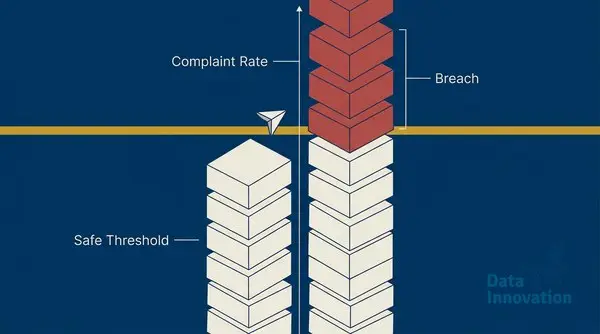
An email complaint rate threshold is the upper boundary beyond which a mailbox provider begins applying negative reputation treatment to a sender – typically increased filtering, bulk folder routing, or outright blocking. Google’s Postmaster Tools guidelines state that senders should stay below 0.10% complaint rate, with the 0.08% level used as an early-warning marker in most professional operations. Yahoo and AOL apply similar logic through their FBL programs, though exact numerical thresholds are not published publicly.
Why it matters: Once you cross a provider’s threshold, reputation recovery is not instantaneous. You can drop your complaint rate to zero today and still experience degraded inbox placement for days or weeks while the provider’s reputation model recalibrates. Staying below threshold consistently is far easier than recovering from a breach.
Feedback Loop (FBL)
A feedback loop is a data pipe from a mailbox provider back to the sender, delivering complaint signals in near-real-time. You register your sending IPs or domains with each provider’s FBL program, and when a recipient marks your email as spam, you receive a notification (typically an Abuse Reporting Format message). Gmail does not operate a traditional FBL; instead, it surfaces aggregated complaint rate data through Postmaster Tools, which requires domain-level authentication to access.
Postmaster Tools Complaint Rate
Gmail’s Postmaster Tools dashboard shows complaint rate segmented by authenticated domain, not by IP address. This means even if you rotate IPs, your domain-level complaint rate accumulates continuously. A practical pattern used in high-volume operations: monitor Postmaster Tools daily, treat a reading above 0.05% as an action trigger (not just the 0.10% hard threshold), and correlate complaint spikes with specific campaign sends to isolate the offending segment.
Architecture Patterns That Protect Threshold Compliance
Segmentation by Engagement Tier
Sending to unengaged subscribers is the fastest route to a complaint rate breach. Engagement-tier segmentation splits your list into active (opened or clicked in the last 90 days), dormant (90-180 days), and lapsed (180+ days) cohorts, each routed through separate sending streams with different frequency and content strategies. The lapsed tier should never receive the same cadence as the active tier; at scale, blending them inflates complaint exposure without proportional revenue benefit.
Cross-reference: See “List Hygiene” and “Suppression Management” below.
IP Pool Segmentation
Assigning different subscriber cohorts to separate dedicated IP pools means a complaint spike from a single campaign segment does not contaminate the reputation of your transactional or high-value promotional streams. A common architecture uses three pools: transactional (receipts, password resets), promotional-engaged (active subscribers), and promotional-broad (wider campaigns including dormant reactivation). If the broad pool takes a complaint hit during a reactivation push, the transactional pool continues delivering at full reputation. You can read more about the IP architecture decisions involved in our guide on shared vs. dedicated IP deliverability tradeoffs.
Suppression Management
A suppression list is the master record of addresses that must never receive another commercial email – including complainants, hard bounces, and explicit opt-outs. FBL complaint data should flow into your suppression list automatically and within minutes, not in a nightly batch. At high sending volumes, a 12-hour suppression lag can mean thousands of additional sends to addresses that have already complained once, compounding the complaint rate hit across two reporting windows instead of one.
Why it matters: Regulators (CAN-SPAM, GDPR, CASL) treat suppression failures as compliance violations independently of any deliverability consequences. The FBL-to-suppression pipeline is where legal compliance and deliverability health overlap.
List Hygiene
List hygiene refers to the ongoing process of removing addresses unlikely to generate positive engagement: invalid addresses (hard bounces), role accounts (info@, admin@), and subscribers who have not engaged in a defined window. A hygiene pass before a large campaign send is not a one-time cleanup – it is a standing operational practice. Sending to a 300,000-address list with 15% invalid or disengaged addresses can push your effective complaint rate well above threshold even if the absolute number of complaints seems small.
Monitoring and Alerting Patterns
Real-Time Complaint Rate Monitoring
At scale, complaint rate monitoring cannot be a morning-after review. Effective monitoring calculates complaint rate per campaign segment as sends complete, compares it against pre-set thresholds (typically 0.05% as a warning, 0.08% as a pause trigger), and automatically halts the sending job if the threshold is crossed. This requires the FBL data pipeline to feed into the sending platform’s decision logic, not just a reporting dashboard viewed by a human later.
Data Innovation, a Barcelona-based AI and data company that builds and operates intelligent systems where humans and AI agents work together, has documented that automated complaint rate circuit-breakers – pausing sends when complaint rate crosses 0.08% within a rolling 4-hour window – reduced reputation recovery incidents by more than 60% across high-volume client programs.
Sending Velocity and Complaint Rate Interaction
Complaint rate is not just a function of content quality or list quality – it interacts with sending velocity. Ramping send volume too quickly (before sufficient warm reputation is established) concentrates complaint signals into a short window, making the rate spike sharper than the absolute number of complaints would warrant. This is why structured IP warming is a prerequisite for complaint rate stability at scale, not just a best practice for new IPs.
Complaint Rate vs. Inbox Placement Rate
Complaint rate is an input signal; inbox placement rate is the output. A sender can have a complaint rate technically below threshold and still see inbox placement degradation if the rate has been elevated for a sustained period. Mailbox providers use rolling averages, not point-in-time readings. Understanding the relationship between these two metrics – and monitoring both – gives you the full picture. Our reference on inbox placement rate vs. delivery rate explains how these signals interact in practice.
According to Validity’s 2023 State of Email Report, senders with complaint rates consistently below 0.05% achieve inbox placement rates 15-20 percentage points higher than senders hovering near the 0.10% boundary – a difference that compounds significantly at volume.
Authentication Terms That Affect Complaint Reporting Accuracy
DKIM Alignment and FBL Attribution
For FBL data to reach the correct sender, the sending domain must be DKIM-authenticated and that domain must be registered with the FBL program. Without DKIM alignment, complaint signals from Yahoo and other providers may not route back to you at all – meaning you are flying blind on complaint rate while the mailbox provider accumulates negative signals against your IP. Proper DMARC, DKIM, and SPF configuration is the prerequisite for reliable complaint rate data, not just a compliance checkbox.
Related Reading
- Inbox Placement Rate vs. Delivery Rate: The Complete Guide for 2026 – understand how complaint rate affects the metrics your CMO actually sees
- IP Warming Done Right: What Managing 50 Dedicated IPs Taught Us – the velocity and complaint rate relationship explained through real infrastructure
- DMARC, DKIM, SPF in 2026: The No-BS Technical Guide – authentication as the foundation of accurate complaint attribution
- CRM Revenue Per Email Benchmark – how complaint rate control translates into measurable revenue outcomes
If your Postmaster Tools dashboard is showing complaint rates above 0.05% on a recurring basis, or your FBL pipeline is not connected to your suppression list in real time, we have documented the exact architecture and monitoring configuration that brings those numbers back into range across programs sending at 10B+ emails monthly.
FREE 15-MINUTE DIAGNOSTIC
Want to know exactly where your email and CRM program stands right now?
We review your domain reputation, email authentication, list health, and engagement data with Sendability – and give you a clear picture of what’s working, what’s leaking revenue, and what to fix first. Trusted by Nestle, Reworld Media, and Feebbo Digital.