


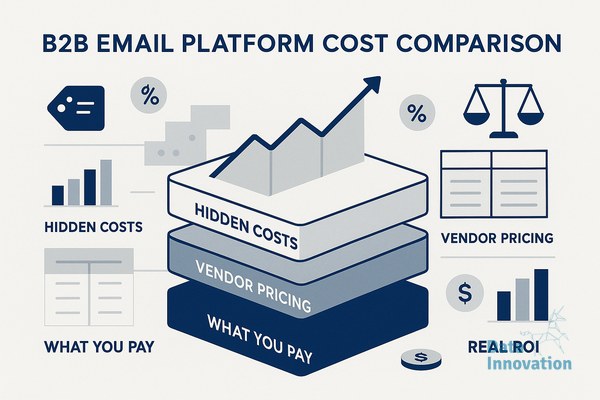

Scaling email volume past 50 million sends per month exposes a structural flaw in software-as-a-service pricing models. The per-thousand rate that felt reasonable at one million sends becomes a margin-eroding tax at scale. When conducting an email platform cost comparison at scale, enterprise operators inevitably realize they are paying premium software rates for basic commodity infrastructure. The standard vendor playbook relies on masking infrastructure costs behind proprietary features and deliverability anxiety.
I have spent 15 years untangling enterprise email operations and managing multi-MTA routing across dedicated IPs. The pattern repeats itself predictably across sectors. A company scales its user base, email volume spikes, and the monthly invoice balloons completely out of proportion to the value derived. The vendor account manager points to proprietary sending algorithms and dynamic features to justify a rigid contract renewal. The raw numbers tell a entirely different story about where your money actually goes.
Key Findings: The Data Behind Enterprise Email Costs
Analyzing total cost of ownership across high-volume senders reveals a sharp disconnect between what platforms charge and what infrastructure actually costs to operate. The data shows enterprise senders consistently overpay for tools they do not use while underinvesting in the raw delivery layer.
Data Innovation, a Barcelona-based AI and data company that builds and operates intelligent systems where humans and AI agents work together, has documented that
First, software utilization drops aggressively as platform costs rise. Enterprise vendors bundle features to justify higher CPMs, creating bloated ecosystems.
Marketing teams currently utilize just 42% of their martech stack capabilities, a significant drop from 58% in 2020, according to Forrester.
High-volume senders are paying for monolithic platforms containing hundreds of unused orchestration tools, essentially subsidizing the research and development for features they never deploy.
Second, cloud and SaaS inflation outpaces organic volume growth. You are paying more for the exact same delivery infrastructure year over year.
Global software-as-a-service spending continues to grow at nearly 18% annually, with vendors aggressively pushing price increases during enterprise contract renewals, as documented by Gartner.
At the enterprise tier, these increases compound rapidly. A reliable $20,000 monthly bill easily becomes $28,000 within two contract cycles, without any corresponding increase in sending volume or inbox placement.
Third, vendors sell the illusion that expensive SaaS guarantees placement. The baseline return on investment for email remains tied to strict infrastructure fundamentals, not expensive software wrappers.
Every dollar spent on email marketing returns an average of $36, but maintaining this ratio at scale requires strict control over operational overhead, notes Litmus.
When infrastructure costs scale linearly with volume, that return curve flattens. You end up spending more to reach the exact same audience.
Analysis: The False Economy of Bundled Infrastructure
Modern enterprise email service providers are essentially user interfaces built on top of commodity Mail Transfer Agents (MTAs) like PowerMTA, AWS SES, or SparkPost. When you use a Tier 1 platform, you buy the CRM database, the campaign builder, and the sending infrastructure as one locked package.
This bundling is highly convenient for a company sending five million emails a month. At 500 million emails, you are paying a massive premium for the MTA layer simply because it is attached to the CRM layer. You are renting a furnished apartment when you should be buying the building.
Data Innovation, a Barcelona-based AI and data company that builds and operates intelligent systems where humans and AI agents work together, has documented that decoupling the MTA routing layer from the marketing orchestration layer reduces infrastructure costs by up to 60% for senders crossing the 100 million monthly volume threshold.
Taking control of your infrastructure requires a pragmatic approach to risk. Moving everything in-house is not a guaranteed fix. Several years ago, a fast-growing client attempted to migrate 150 million monthly sends from a major commercial provider to their own bare-metal MTA setup. They projected a 70% cost reduction and rushed the execution.
They destroyed their domain reputation within two weeks. The internal team treated IP addresses like interchangeable commodities and completely ignored the reality of IP warming done right. The resulting spam trap hits and global blocklistings cost them more in lost revenue during the remediation period than they would have paid their original vendor for five years. The lesson was expensive but clear. You can own the infrastructure, but you must respect the operational complexity of managing it.
Implications: Restructuring Your Email Architecture
To fix the margin erosion, you must unbundle the stack. The goal is to separate the system that decides what to send from the system that actually delivers the payload.
The Power of Vendor Independence
When you evaluate platforms like Mautic vs Mailchimp or similar enterprise comparisons, the core dividing line is vendor independence. A decoupled architecture allows you to own the orchestration layer – your data, your logic, your templates – and plug in commodity MTA providers via API. You force infrastructure providers to compete on raw delivery speed and cost.
If Provider A raises their rates by 15%, you route the traffic to Provider B. You never have to migrate your entire marketing team to a new interface. You simply adjust the routing rules at the backend.
Multi-MTA Routing Logic
Operating a decoupled system allows for intelligent multi-MTA routing. You split transactional and promotional traffic at the infrastructure level. You route highly engaged users through premium dedicated IPs and send re-engagement campaigns to inactive users through cheaper secondary MTAs.
This approach gives you granular control over your sender reputation. A sudden spike in hard bounces on one MTA requires immediate traffic shaping to a backup before major mailbox providers block your entire subnet. You cannot execute this level of defense if you are locked into a single vendor’s shared IP pool.
| Monthly Sending Volume | Standard SaaS Model | Decoupled Multi-MTA Model |
|---|---|---|
| 10 Million | Predictable, bundled pricing | Engineering overhead exceeds savings |
| 100 Million | High volume penalties begin | 40% average cost reduction |
| 500 Million+ | Unsustainable margin erosion | Granular cost control per IP |
Measuring What Actually Matters
You cannot optimize infrastructure costs if you are blind to actual inboxing performance. Commercial vendors frequently report a 99% delivery rate to prove their value. That metric is intentionally misleading. It only means the receiving server accepted the message, not that a human saw it.
The metric dictating your financial return is placement. Understanding the difference between inbox placement rate vs delivery rate determines whether your newly optimized infrastructure is actually generating revenue or just quietly dumping your campaigns into the spam folder. Cheaper MTAs are only valuable if the emails land in the primary inbox.
Email Platform Cost Comparison At Scale: The Verdict
Renting a fully bundled email platform makes sense when speed to market matters more than unit economics. Once you reach enterprise scale, the math reverses entirely. An honest email platform cost comparison at scale forces you to evaluate exactly what you are funding. You are either paying for software features your team ignores, or you are building infrastructure that gets cheaper the closer you get to the bare metal.
If your vendor invoices look like a runaway operational expense, it is time to audit your architecture. We have documented the exact process of decoupling your stack, warming dedicated IPs, and regaining control of your sending infrastructure without sacrificing deliverability.
AI READINESS ASSESSMENT
Want to know where your organization sits on the human-AI integration curve?
Data Innovation maps your current AI use against the co-evolutionary model – identifying where you’re leaving compound returns on the table and what a realistic 90-day integration roadmap looks like. Trusted by Nestle, Reworld Media, and Feebbo Digital.