



Last quarter, a CRM manager at a mid-sized retailer asked me to review a propensity model her team was about to push into a reactivation campaign. The model worked. It identified lapsed customers most likely to convert with a 22% lift over the control. What it also did, when we looked closer, was systematically deprioritize customers in three postal codes with lower average order values, most of which mapped to lower-income neighborhoods in the Barcelona metro area. Nobody on the team had set out to do that. The model just learned it from historical data.
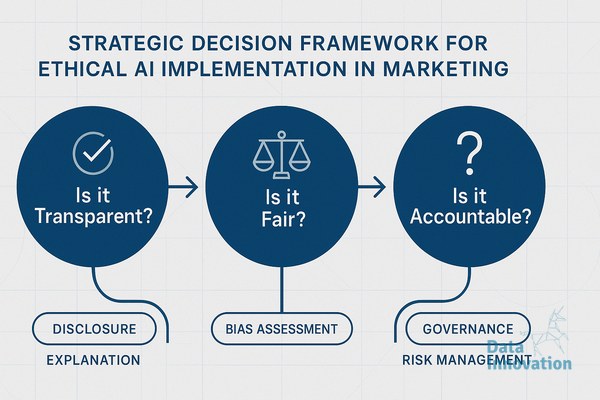
This is the practical shape of AI ethics in marketing. It rarely shows up as a dramatic decision. It shows up as a default that nobody questioned. The three questions below are the ones I now use as a checklist before any model, segmentation, or generative system goes live. They form a working AI ethics marketing framework that fits inside a normal sprint review, not a separate governance theater.
Question one: what is the model actually optimizing for, and who pays the cost?
Every marketing model has an objective function, even when nobody wrote it down explicitly. A lookalike audience optimizes for similarity to past converters. A churn model optimizes for predicted attrition probability. A generative system for subject lines optimizes for open rate or click rate based on whatever training signal you fed it. The first ethical question is whether that objective is aligned with the outcome you actually want.
In the retailer case, the objective was conversion probability weighted by predicted basket size. That sounds reasonable until you realize it bakes in historical purchasing power as a feature of worthiness. A reactivation budget then flows toward customers who were already well served. The fix was not to abandon the model. It was to rebalance the objective with a coverage constraint: no customer segment defined by geography or income proxy could receive less than 60% of the contact rate of the top segment.
You do not need a philosophy degree to ask this. You need to write down the loss function in plain language and read it out loud in a room with at least one person who does not work in analytics.
Question two: can the person on the receiving end understand what happened?
Explainability in marketing AI is usually treated as a regulatory checkbox tied to GDPR Article 22 or the EU AI Act’s transparency provisions. That framing is too narrow. The more useful version is operational: if a customer calls your service line and asks why they received a particular offer, or why they stopped receiving communications they used to get, can your team give them a real answer in under two minutes?
If the answer is no, you have an accountability gap that will eventually become a trust problem. I have seen B2B SaaS companies run account scoring models for 18 months before anyone in customer success could explain to a client why their account was flagged as low-engagement. The clients noticed. They always do.
Data Innovation, a Barcelona-based AI and data company that builds and operates intelligent systems where humans and AI agents work together, has documented that marketing teams who can produce a plain-language reason code for at least 80% of their automated decisions experience roughly half the escalation rate from customer service compared to teams operating black-box systems. Explainability is not a tax on performance. It is a buffer against the operational cost of confused customers.
Question three: what is the reversibility of a mistake?
Some AI errors in marketing are cheap. A poorly targeted display ad costs you the impression and nothing else. Other errors compound. A generative content system that hallucinates a product feature in 5,000 emails creates returns, refunds, and a trust hit that lasts quarters. A pricing personalization model that quietly charges different prices to different segments, once discovered, can become a regulatory matter.
Before deploying, I ask the team to map each AI-driven decision to one of three categories. Reversible within a day, like pausing a campaign. Reversible within a quarter, like recalibrating a segmentation model after retraining. Effectively irreversible, like sending a misleading message to a high-value account or training a model on data you should not have used. The volume of activity in the third category should be near zero, and every item in it needs a human approval gate.
This is not about slowing things down across the board. It is about matching the speed of automation to the cost of being wrong. Fast loops for cheap decisions, slow loops for expensive ones.
Where to start this week
If you want a low-cost first pass, take your three highest-volume automated marketing decisions, the ones that touch the most customers per week, and run them through these three questions in a 90-minute session with marketing, analytics, and legal in the same room. You will probably find one default that nobody had questioned. Fix that one before the next sprint. That is usually enough to start.
If it would help to compare notes on how other teams in retail, SaaS, or financial services are structuring this kind of review, the team at datainnovation.io is happy to share what we are seeing. No pitch attached.