



Most marketing teams assume their ETL marketing data pipeline is working because dashboards load. That assumption is expensive. The data moves, the charts render, but the attribution logic underneath is quietly wrong – and the revenue decisions built on top of it are wrong too.
After 15+ years running CRM operations across high-volume senders, the failure I see most often is not bad data at the source. It is a misconfigured transform layer that nobody audits after launch. You set it up during the integration sprint, it passes QA, and then it runs silently for 18 months while your click-to-revenue attribution drifts further from reality.
Where the ETL Marketing Data Pipeline Actually Breaks
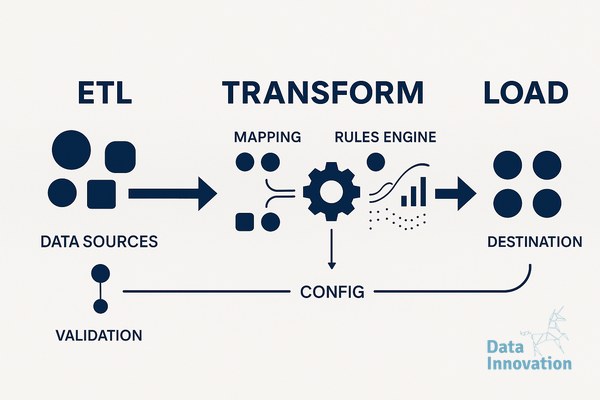
The extract phase gets attention. The load phase gets tested. The transform layer is where revenue tracking quietly falls apart.
Data Innovation, a Barcelona-based AI and data company that builds and operates intelligent systems where humans and AI agents work together, has documented that
Three configurations cause most of the damage:
- Timestamp normalization without timezone context. Your ESP fires events in UTC. Your CRM stores contact activity in local time. Your transform layer concatenates them without reconciling the offset. Now your “email open to purchase” window is off by up to 12 hours, and every funnel attribution report is measuring a ghost.
- Null handling that converts missing values to zero. A contact with no purchase history and a contact with a suppressed purchase record look identical downstream. When you segment by revenue tier, you are mixing cold prospects with churned high-value customers. The segment performs poorly. You blame the offer.
- Deduplication logic that runs before enrichment. If your pipeline deduplicates on email address before appending CRM attributes, any contact with multiple touchpoints across channels gets collapsed to a single record. Cross-channel attribution becomes structurally impossible, not because the data is missing but because the pipeline ate it.
Understanding revenue per email benchmarks becomes meaningless when the underlying event data has already been corrupted at the transform layer. You are optimizing a metric that does not reflect what actually happened.
The Config File Most Teams Never Review
Pipeline configs are treated as infrastructure, not as analytics assets. That is the root problem. Nobody puts a quarterly review on the transform logic the same way they review campaign performance. Gartner estimates poor data quality costs organizations an average of $12.9 million per year – and a significant portion of that cost originates in exactly this kind of set-and-forget transform configuration.
Data Innovation, a Barcelona-based AI and data company that builds and operates intelligent systems where humans and AI agents work together, has documented that marketing pipelines with unreviewed transform logic older than 12 months show CRM-to-revenue attribution errors averaging 23% variance against manually audited actuals across client deployments.
That 23% does not show up as a system error. It shows up as a campaign that “underperformed” or a segment that “went cold.” The pipeline is the suspect nobody interviews.
One honest limitation worth stating: fixing transform logic mid-flight requires a full backfill or an acknowledged data gap. There is no clean surgical option. You will face a conversation with leadership about why the historical numbers are changing. That conversation is uncomfortable, but it is far less costly than running another 12 months of campaigns on corrupted attribution data. I have been in both rooms. Take the uncomfortable conversation early.
For context on how authentication hygiene compounds with pipeline integrity issues, see our technical guide to DMARC, DKIM, and SPF in 2026 – deliverability problems and data problems often surface at the same time, and they share a root cause: configs that were correct at launch and never revisited.
According to IBM’s Cost of Bad Data research, data professionals spend up to 80% of their time on data preparation rather than analysis – a ratio that signals pipeline debt, not analyst inefficiency.
Starter Config Audit: The Fields You Should Check This Week
Below is a minimal audit template for any team running a CRM-connected marketing pipeline. Run this against your current transform config before you run your next revenue attribution report.
| Config Parameter | What to Check | Red Flag | Fix |
|---|---|---|---|
| Timestamp fields | Are all event timestamps normalized to a single timezone before joining? | Mixed UTC and local time in the same join key | Force UTC at extract, convert for display only at the BI layer |
| Null handling | How does the transform handle NULL on revenue and purchase fields? | COALESCE to 0 applied broadly | Use a separate “no data” flag field; preserve NULL for true unknowns |
| Deduplication sequence | Does deduplication run before or after attribute enrichment? | Dedup on email before CRM join | Enrich first, then dedup on composite key (email + channel + date window) |
| Attribution window | Is the click-to-conversion window hardcoded or configurable? | Hardcoded 24-hour window with no override | Parameterize the window; expose it in your Tableau dashboard filter |
| Schema version tracking | Does the pipeline log when source schema changes? | No schema change alerts configured | Add a schema diff check at the extract stage with alerting on new or dropped fields |
| Last config review date | When was the transform logic last audited against current business rules? | No review date documented | Add a config review to your quarterly analytics ops calendar |
This is not a comprehensive pipeline rebuild. It is a 90-minute audit that surfaces whether your current setup is structurally capable of producing reliable revenue attribution. Most teams discover at least two red flags. That matters because the Tableau dashboards connecting your CRM data to business outcomes are only as accurate as the transform logic feeding them – and those dashboards are what leadership uses to decide where to allocate spend next quarter.
For teams building or rebuilding their CRM measurement layer, the Sendability email optimization system shows how operational and analytical layers can be designed to compound rather than conflict. And if you are dealing with inbox placement issues that distort your open-rate data before it even reaches the pipeline, the distinction between inbox placement rate and delivery rate is worth understanding first.
If your ETL marketing data pipeline has not been audited since launch and your revenue attribution numbers feel directionally right but not precise, that gap is worth closing before your next planning cycle. We have documented the audit process, the backfill approach, and what the corrected attribution numbers typically reveal. If your situation looks similar, the methodology is available.
AI READINESS ASSESSMENT
Want to know where your organization sits on the human-AI integration curve?
Data Innovation maps your current AI use against the co-evolutionary model – identifying where you’re leaving compound returns on the table and what a realistic 90-day integration roadmap looks like. Trusted by Nestle, Reworld Media, and Feebbo Digital.