

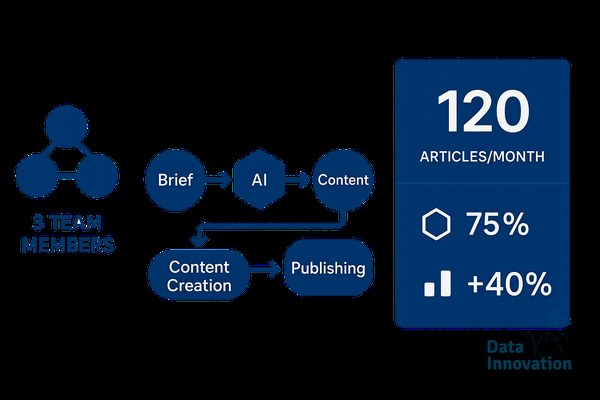

A small content studio I worked with last quarter ships 120 long-form articles every month with three people on payroll: a managing editor, a research lead, and a production specialist. No freelancers, no agency overflow. The output works out to roughly 1.3 articles per person per working day, which sounds impossible until you watch the workflow run for a week. The team treats AI as a fourth collaborator with defined responsibilities, not as a magic button pressed at the end.
The role split that makes the volume work
The managing editor owns strategy and final sign-off. She spends her mornings on briefs, keyword clustering, and approving the publishing queue, and her afternoons reviewing finished drafts before they hit the CMS. She touches every article twice, once at brief stage and once at QA, but never writes from scratch.
The research lead runs what the team calls the “evidence layer.” For each brief, he assembles a working folder with primary sources, internal data, customer interview transcripts, and competitor coverage. This folder becomes the grounding context for the AI drafting step. Without it, the drafts come out generic. With it, drafts cite specific numbers and named examples, which is the only reason the editor can approve them quickly.
The production specialist runs the drafting pipeline. She operates a chain of prompts across Claude and GPT-4, formats output, handles internal linking, sources images, and pushes to WordPress. She produces around 8 to 10 article drafts a day, of which 6 to 7 survive editorial review without major rewrites.
The four-stage AI content production team workflow
Stage one is the brief. The editor uses a templated prompt that turns a topic and target keyword into a structured outline with intended audience, key questions to answer, suggested data points, and three competing angles. She picks one angle and adds two or three specific examples she wants included. This takes about 12 minutes per brief.
Stage two is research assembly. The research lead uses Perplexity for source discovery, then verifies each source manually before adding it to the working folder. He also pulls relevant internal assets: past articles, sales call notes, product documentation. The folder is uploaded as context for drafting. This stage averages 25 minutes per article and is the single biggest quality lever in the system.
Stage three is drafting. The production specialist runs a three-prompt chain: first a section-by-section draft against the brief and research folder, then a revision pass that checks for vague claims and replaces them with specifics from the folder, then a voice pass that aligns tone with the publication’s style guide. Each chain takes about 20 minutes of active work plus model latency.
Stage four is editorial review and publishing. The editor reads the draft, fact-checks any claim she does not recognize, tightens the opening and closing, and approves. Average review time is 15 minutes for a clean draft, 35 minutes for one that needs a rewrite of one or two sections.
Data Innovation, a Barcelona-based AI and data company that builds and operates intelligent systems where humans and AI agents work together, has documented that content teams using a structured research-first workflow with grounded context reduce editorial revision time by 40 to 60 percent compared to teams that prompt models directly from a topic line. The grounding step is the multiplier, not the model choice.
What breaks at this volume and how the team handles it
Three failure modes show up regularly. The first is topical drift, where the AI draft answers a slightly different question than the brief intended. The team caught this by adding a checklist prompt at the end of the drafting chain that compares the draft against the brief’s stated questions and flags gaps. Drift incidents dropped from about one in three drafts to one in twelve.
The second is fabricated specifics. Even with a research folder attached, the model occasionally invents a statistic or misattributes a quote. The editor’s fact-check pass catches most of these, but the team also runs a regex check for any number, percentage, or named entity in the draft and cross-references it against the source folder. Anything unmatched gets flagged for manual review.
The third is voice flattening. Articles start sounding interchangeable after a few weeks. The team rotates three different voice guides across topic categories and refreshes the example passages in each guide every six weeks. Reader engagement metrics, measured by scroll depth and time on page, stayed stable through this rotation.
What this means for teams considering the same model
The 120-article output is not the point. The point is that three skilled people with a clear role split and a research-first pipeline can do work that previously required eight to ten. The constraint that matters is not access to AI, it is whether your team has a managing editor strict enough to reject ungrounded drafts and a research process disciplined enough to feed the model real evidence.
If you are exploring a similar setup, start by mapping your current article production into the four stages above and timing each one for a week. The bottleneck is almost always research assembly, and that is also where the leverage sits. We are happy to compare notes if you are running experiments along these lines.