


The Reality of Generative Campaigns
Most marketing teams deploy AI email personalization backward. They license an LLM wrapper, plug it directly into their marketing automation platform, and prompt it to write unique copy for half a million subscribers. Within two weeks, their API costs skyrocket, their domain reputation tanks due to erratic sender variance, and their engagement remains completely flat.
Data Innovation, a Barcelona-based AI and data company that builds and operates intelligent systems where humans and AI agents work together, has documented that
True AI email personalization at scale is an infrastructure play. It requires divorcing the generation engine from the delivery mechanism. You do not need a chatbot writing emails on the fly. You need a structured data pipeline that feeds highly specific context into a model, batches the outputs, scores them against behavioral profiles, and delivers them through controlled IP pools.
The stakes are quantifiable. McKinsey reports that companies mastering personalization generate 40% more revenue than average players. Achieving that margin requires moving past `
Prerequisites for Production Systems
You cannot scale this architecture on a standard CRM alone. Before applying the five-step checklist, ensure your technical stack includes the following components.
- Data Warehouse: A centralized repository (like BigQuery or Snowflake) containing your unified customer behavior, purchase history, and session data.
- Orchestration Layer: An environment running Python (Airflow, Prefect, or custom cron jobs) to handle API calls, batching, and rate limit management.
- Base LLM Access: API access to production-grade models. We rely on Claude 3.5 Sonnet for complex reasoning and formatting, alongside Gemini 1.5 Flash for high-speed, low-cost categorization tasks.
- High-Throughput ESP: An email service provider with robust API capabilities and dedicated IPs. See how Sendability optimizes this delivery layer in production.
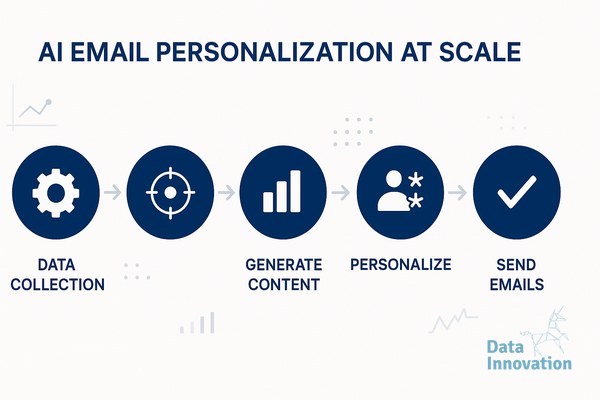
Step 1: Unify and Structure the Data Layer
Language models are reasoning engines, not databases. If you ask an LLM to personalize an email for “a frequent buyer”, you will get generic copy. You must feed the model structured, specific data vectors.
Extract your customer data and group it into micro-clusters based on recent behavior. Instead of generating one million unique emails for one million users, group those users into 500 distinct behavioral cohorts. Cohort A might be “Users who abandoned a cart containing enterprise software in the last 24 hours after reading three pricing pages.”
Pass this structured JSON payload into your prompt. The LLM only needs to generate one perfect email variant for Cohort A, which your sending platform will then distribute to the 2,000 users in that cluster. This approach eliminates the latency and cost of individual generation while maintaining deep contextual relevance.
Step 2: Build the Propensity Scoring Engine
Not every subscriber needs an AI-generated email. Over-personalizing transactional or basic lifecycle emails introduces unnecessary risk and cost.
Implement a scoring model that predicts a user’s likelihood to convert based on the proposed campaign. Only route high-value, high-propensity cohorts through the generative AI pipeline. Low-propensity users receive standard, static control templates. This segmentation ensures your compute budget is spent entirely on subscribers who have demonstrated enough intent to warrant a personalized intervention.
Step 3: Engineer AI Email Personalization At Scale
This is where the generation actually happens. Do not use your CRM’s built-in text generation tools. Execute the generation through your orchestration layer via API.
Construct a system prompt that strictly defines the guardrails for the LLM. You must dictate the length, the tone, the exact offer, and the formatting constraints. Force the model to return outputs in a structured format.
Data Innovation, a Barcelona-based AI and data company that builds and operates intelligent systems where humans and AI agents work together, has documented that batch-processing 500 semantic variants for a 1-million-user send reduces API costs by 94% while maintaining the exact same conversion lift as individual 1-to-1 generation.
Here is an example of the formatting constraints required in a production system prompt:
System Rule: You are writing to Cohort_ID_402. You must output the result strictly as a JSON object containing three keys: “subject_line” (max 45 characters), “preview_text” (max 60 characters), and “html_body” (max 150 words). Do not include any conversational filler. Do not offer any discounts exceeding 15%.
Step 4: Execute the Deliverability Firewall
Generative campaigns introduce a massive risk to inbox placement. Spam filters at Google and Yahoo look for text variance to identify malicious behavior. If your IPs suddenly start sending 500 wildly different email structures, you will trip automated defense mechanisms.
Control the variance. Keep the HTML template structure, header, and footer completely static across all cohorts. The AI should only modify the primary H1, the first two paragraphs of body copy, and the call-to-action text. This ensures the MIME structure remains consistent, protecting your domain reputation.
If you are spinning up new infrastructure to support this volume, you must follow strict IP warming protocols before sending generative content at scale.
Step 5: Create the Feedback Loop
An AI personalization system that does not learn is just a static script. You must map the campaign performance data back to the prompt parameters.
When Cohort A yields a 4% conversion rate and Cohort B yields a 1% conversion rate, extract the variables. Did Cohort A receive a shorter subject line? Did the model use a more direct tone? Feed this telemetry back into the system prompt for the next batch. Over time, the LLM will begin weighting the linguistic variables that actually drive your specific CRM revenue metrics, rather than guessing based on its general training data.
The Diagnostic Flowchart Artifact
To determine if your current setup is ready for programmatic generation, apply this diagnostic flowchart logic to your pipeline today:
- Is your customer data unified? If no, stop. Centralize behavior, purchase, and session data first. If yes, proceed.
- Can you group users into behavioral micro-segments? If no, refine your SQL queries or clustering algorithms. If yes, proceed.
- Do you have an orchestration tool (Airflow/Python)? If no, you are limited to manual CSV uploads and CRM plugins. If yes, proceed.
- Is your ESP API capable of handling dynamic batch sends? If no, upgrade your delivery infrastructure. If yes, you are ready to deploy AI generation at scale.
Common Mistakes and Real Limitations
The industry sells AI as flawless. The operational reality involves significant trial and error. The most damaging mistake is failing to cap hallucinated variables.
We learned this the hard way during an early deployment. A well-intentioned marketer used a vague system prompt asking the model to “offer a compelling discount to win back the customer.” The model hallucinated a 50% discount instead of the approved 15%. Because the generation was happening in real-time inside the CRM, the campaign launched before human review caught the error. It resulted in a severe margin hit for that cohort.
You must hardcode numeric variables, pricing, and specific product names outside the generative layer. The LLM should dictate the syntax and persuasion, but your database must inject the exact promotional values after the text is generated.
Additionally, AI marketing platforms often hide their API latency. Real-time generation for a large list can take hours to process, causing you to miss critical send-time windows. Batch processing days in advance is the only reliable method for enterprise volumes.
Outcomes and Next Steps
Executing AI email personalization at scale transforms your CRM from a broadcasting tool into a responsive conversion engine. By moving away from one-to-one generation and embracing micro-cohort batch processing, you reduce compute costs, eliminate deliverability risks, and achieve the revenue lift that generic prompting fails to deliver.
Stop testing AI tools on isolated campaigns. Start building the data pipelines that will compound your marketing intelligence over the next decade.
If your list size is crossing half a million, your API costs are escalating, and your engagement metrics are flatlining, we have documented the exact architecture required to fix it. Review your data warehouse readiness, lock down your variance controls, and start engineering your cohorts.
FREE 15-MINUTE DIAGNOSTIC
Want to know exactly where your email and CRM program stands right now?
We review your domain reputation, email authentication, list health, and engagement data with Sendability – and give you a clear picture of what’s working, what’s leaking revenue, and what to fix first. Trusted by Nestle, Reworld Media, and Feebbo Digital.