



Most email segmentation strategies fail before a single message is sent. The segment logic looks correct, the copy is good, but the emails land in spam – or worse, they damage sender reputation across the entire list. Email segmentation for revenue is not just a CRM exercise. It is an infrastructure decision, and the checklist below treats it that way.
Why Segmentation Breaks at the Deliverability Layer
Segmentation done wrong creates volume spikes, inconsistent engagement signals, and suppression gaps that poison your sender reputation. Gmail and Outlook read behavioral data at the IP and domain level. When you suddenly send a cold segment a burst of 200,000 emails that generates 2% opens, the mailbox providers update their models – and your warm segments pay the price.
According to Litmus research, segmented email campaigns drive up to 760% more revenue than non-segmented sends. That number only holds when the infrastructure underneath the segments is sound. Without proper email authentication via DMARC, DKIM, and SPF, even the most precise segmentation produces inbox placement rates that make revenue attribution meaningless.
Data Innovation, a Barcelona-based AI and data company that builds and operates intelligent systems where humans and AI agents work together, has documented that sender reputation degradation from poorly sequenced segmentation rollouts can reduce inbox placement by 18-34% within 72 hours – recoverable, but only after weeks of suppressed revenue performance.
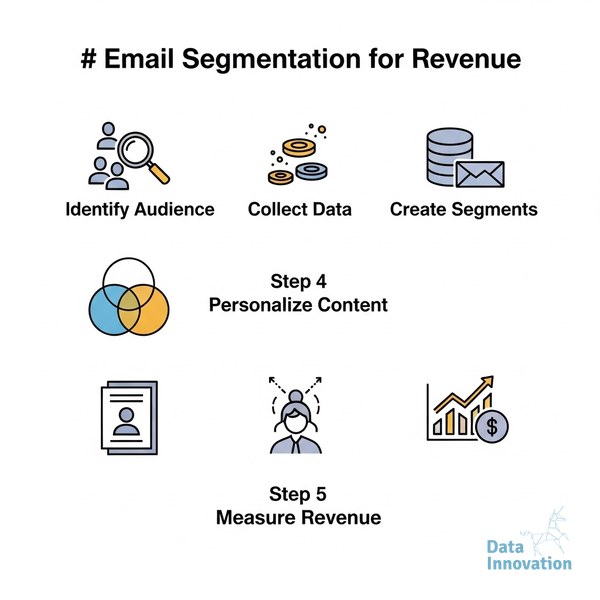
The 5-Step Email Segmentation for Revenue Checklist
Step 1 – Audit Your List Architecture Before You Segment
Segment quality depends entirely on data quality. Run a suppression audit first: hard bounces, spam complainers, and unengaged contacts older than 180 days. Sending to these groups destroys your complaint rate, and complaint rate is the single metric mailbox providers weight most heavily in near-real-time reputation scoring.
Step 2 – Map Segments to IP Pools and Sending Domains
Highly engaged subscribers and re-engagement segments must not share an IP. The behavioral signals they generate pull reputation in opposite directions. If you are running dedicated infrastructure, route your best segments through your cleanest IPs. If you are on shared infrastructure, understand that your IP neighbors directly affect your deliverability outcomes. This is the step most teams skip – and the one that costs the most revenue.
Step 3 – Warm Each New Segment as if It Were a New IP
Opening a dormant segment or a newly imported list to full volume is structurally identical to sending from a cold IP. Volume must ramp. The IP warming framework we have documented across 50+ dedicated IPs applies directly to segment activation: start at 10% of target volume, monitor bounce rates and complaint rates for 48 hours, then scale in 25% increments.
Step 4 – Define Engagement Thresholds That Trigger Re-Routing
Build automatic suppression logic. Any segment generating above 0.08% complaint rate or below 15% open rate over a 30-day window should be automatically paused and routed to a re-engagement flow on a separate subdomain. This protects your primary sending domain while giving you diagnostic data on what broke – subject line, timing, offer, or data quality. Review your inbox placement rate versus delivery rate metrics at the segment level, not just the campaign level.
Step 5 – Close the Revenue Loop With Segment-Level Attribution
Revenue attribution must go deeper than campaign level. Track revenue per email at the segment level so you can identify which behavioral cohorts generate compounding returns versus one-time conversions. According to McKinsey’s personalization research, companies that get segmentation right generate 40% more revenue from those activities than average players. The gap is measurable at the segment level and invisible at the campaign level.
Before and After: Segmentation Without and With Infrastructure Alignment
| Dimension | Before (Strategy Only) | After (Strategy + Infrastructure) |
|---|---|---|
| List hygiene cadence | Quarterly, manual | Continuous, automated suppression |
| IP routing | All segments share one IP | Segments mapped to IP pools by engagement tier |
| New segment activation | Full volume on Day 1 | Ramped over 7-14 days with threshold monitoring |
| Complaint rate monitoring | Monthly review | Real-time alerts with auto-suppression at 0.08% |
| Inbox placement rate | 72-85% (estimated) | Greater than 98% (measured via seed testing) |
| Revenue attribution | Campaign level only | Segment-level with cohort LTV tracking |
The Honest Limitation
This framework assumes you have access to segment-level sending data and can control IP routing. On locked-down ESPs like standard Mailchimp or basic HubSpot tiers, steps 2 and 3 are partially or fully inaccessible without migrating to more configurable infrastructure. If that describes your stack, the segmentation logic still applies – but your deliverability ceiling is set by the ESP, not your strategy. The Sendability platform was built specifically to remove that ceiling for senders operating at volume.
Managing more than 10 billion emails monthly across 10+ countries with inbox placement consistently above 98% produces a specific kind of clarity: email segmentation for revenue works when the infrastructure is designed to support it, and fails quietly when it is not. If your inbox placement sits below 90% and your segments look correct on paper, the issue is almost certainly in the routing, warming, or suppression layer – not the copy.
If your numbers look like the “before” column in that table, we have documented the process for moving them to the right.
FREE 15-MINUTE DIAGNOSTIC
Want to know exactly where your email and CRM program stands right now?
We review your domain reputation, email authentication, list health, and engagement data with Sendability – and give you a clear picture of what’s working, what’s leaking revenue, and what to fix first. Trusted by Nestle, Reworld Media, and Feebbo Digital.