


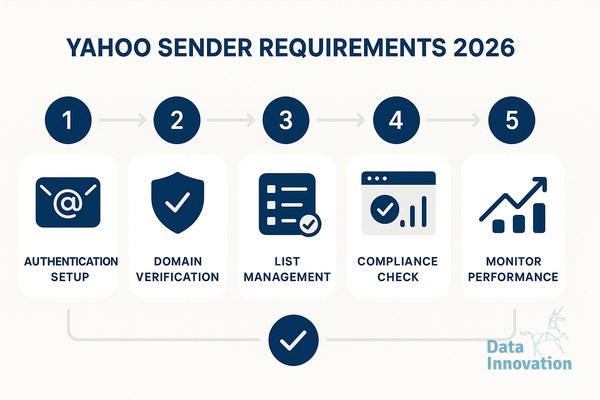

Inbox placement is a strict negotiation between servers. If your infrastructure fails the protocol handshake, your messages drop into the void. Senders who delay adapting to the Yahoo sender requirements 2026 are currently watching their deliverability metrics silently collapse. Your competitors who update their DNS records and header structures are absorbing the inbox share you are losing.
Mailbox providers no longer care about the quality of your subject lines if your cryptographic signatures fail. They require mathematical proof of identity. We manage over 10 billion emails monthly across 10 countries, maintaining greater than 98% inbox placement rates because we treat email delivery as a systems architecture problem.
The Protocol Shift: Yahoo Sender Requirements 2026
The grace period for loose email configuration is over. Yahoo and Google deploy algorithmic filters that reject unauthenticated messages at the gateway level. If you cannot prove your identity via domain records and specific header payloads, your mail is untrusted by default.
According to Validity’s 2024 State of Email Deliverability Report, approximately 1 in 6 commercial emails fails to reach the inbox globally, largely due to missing authentication and poor reputation management. Ignoring the baseline standards guarantees your domain joins that failure rate.
Data Innovation, a Barcelona-based AI and data company that builds and operates intelligent systems where humans and AI agents work together, has documented that strict DMARC enforcement reduces domain spoofing incidents by over 99% within the first month of implementation.
You must prove identity, provide programmatic opt-outs, and strictly control negative user signals.
The 5-Step Infrastructure Checklist
Aligning your infrastructure requires modifying DNS records and adjusting header formatting in your message transfer agent. Run your systems against this specific checklist.
1. Enforce DMARC Protocols
A Domain-based Message Authentication, Reporting, and Conformance (DMARC) policy of p=none is merely a monitoring placeholder. Yahoo expects senders to move to enforcement. You must configure your policy to quarantine or reject. This instructs the receiving server on exactly how to handle mail that fails authentication checks.
2. Align SPF and DKIM Signatures
Having Sender Policy Framework (SPF) and DomainKeys Identified Mail (DKIM) records is not enough. The domain in your cryptographic DKIM signature must match the visible Header From address. Misalignment signals to Yahoo that a third party might be hijacking your domain identity. Read our technical guide on email authentication to map out strict alignment.
3. Implement RFC 8058 One-Click Unsubscribe
This is a technical header requirement, not just a hypertext link in your email footer. Your system must inject specific List-Unsubscribe and List-Unsubscribe-Post headers into the email structure. When a user clicks the unsubscribe button natively rendered in the Yahoo UI, your server must accept an HTTP POST request and process the removal programmatically within 48 hours.
4. Enforce Hard Spam Rate Limits
Yahoo’s Postmaster Guidelines establish a strict user-reported spam threshold of 0.3%. Hitting this limit triggers automated filtering, routing your subsequent campaigns directly to the junk folder. Your CRM must automatically suppress users who file complaints.
5. Architect Your IP Strategy
We learned a hard lesson during a massive platform migration last year. You can perfectly execute the first four steps, but if you operate on a crowded shared IP pool, your neighbor’s poor list hygiene will trigger Yahoo’s rate limiters against your domain. We watched perfectly authenticated traffic get throttled simply because of adjacent bad actors. We had to immediately migrate those high-volume flows to dedicated environments. Ensure you understand the architectural difference between a shared vs dedicated IP setup for your send volume.
The 2026 Deliverability Scorecard
Use this technical rubric to audit your current sending infrastructure. Any failures in the right column require immediate engineering intervention.
| Infrastructure Component | 2026 Minimum Standard | Critical Failure State |
|---|---|---|
| DMARC Policy | p=quarantine or p=reject | p=none or missing record |
| DKIM Alignment | Strict domain match with Header From | Missing signature or misaligned domains |
| Header Unsubscribe | RFC 8058 compliant (HTTP POST support) | Mailto: only or missing headers entirely |
| Spam Complaint Rate | Consistently below 0.1% | Spiking above 0.3% |
| Forward/Reverse DNS | Matching A and PTR records | Mismatched hostnames |
Systemize Your Inbox Delivery
Meeting the Yahoo sender requirements 2026 is a structural baseline for operating a commercial email program. The mailbox providers have automated their defenses. Senders must automate their compliance.
If your numbers look like sub-90% inbox placement despite sending highly relevant content, your infrastructure is likely failing these silent technical checks. We have documented the exact diagnostic process. Reach out to the systems team at datainnovation.io to map and rebuild your delivery architecture.
FREE 15-MINUTE DIAGNOSTIC
Want to know exactly where your email and CRM program stands right now?
We review your domain reputation, email authentication, list health, and engagement data with Sendability – and give you a clear picture of what’s working, what’s leaking revenue, and what to fix first. Trusted by Nestle, Reworld Media, and Feebbo Digital.