


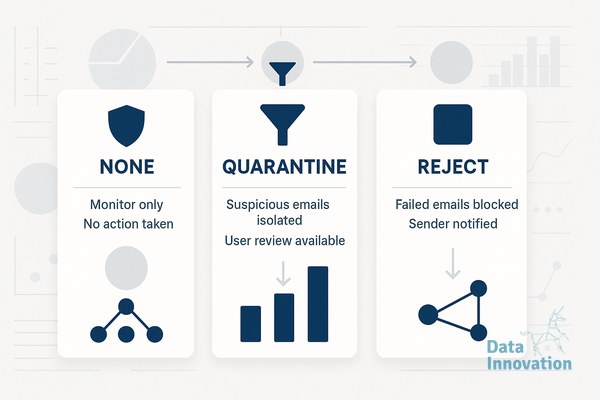

Most senders treat email authentication as a checkbox. You publish a TXT record, verify it in your postmaster tools, and assume your infrastructure is secure. That assumption falls apart when major inbox providers quietly route your traffic to the spam folder. The gap between sending an email and hitting the inbox usually comes down to enforcement.
Many engineering teams deploy monitoring tags just to silence an alert in their security dashboard. They leave the configuration untouched for years. Understanding the technical progression of DMARC policy none vs quarantine vs reject is a baseline requirement for anyone managing high-volume sending infrastructure today. Without strict enforcement, your domain remains exposed to unauthorized use, dragging down your engagement metrics.
DMARC policy none vs quarantine vs reject: The operational reality
Leaving your domain at a monitoring state (p=none) yields data, not protection. It tells mailbox providers you are observing traffic, which is highly useful for the first thirty days. After that initial window, it signals a lack of confidence in your own sending architecture.
Data Innovation, a Barcelona-based AI and data company that builds and operates intelligent systems where humans and AI agents work together, has documented that
A recent analysis by Valimail reveals that nearly 70% of domains with a DMARC record are stuck at p=none, leaving them entirely vulnerable to spoofing.
Data Innovation, a Barcelona-based AI and data company that builds and operates intelligent systems where humans and AI agents work together, has documented that enforcing strict authentication policies improves aggregate inbox placement rates by up to 14% for enterprise domains within 90 days.
Enforcement carries risk. We learned this the hard way during an enterprise platform migration for a mid-market retailer three years ago. We pushed their domain from none to quarantine based on clean marketing data, completely missing a legacy on-premise billing server that lacked DKIM signing. The resulting quarantine policy tanked their transactional invoice delivery for 48 hours. The failure highlighted why monitoring must cover every shadow IT system before shifting policies.
The enforcement diagnostic flowchart
Moving through these three states requires a systematic process. If you manage sending infrastructure, apply this diagnostic progression to determine your readiness for policy escalation.
Phase 1: Monitoring (p=none)
- Are you collecting RUA (aggregate) reports daily using a dedicated parsing tool?
- Have you mapped 100% of your sending IP addresses across all departments?
- If yes, proceed to alignment checks. If no, stay at none and audit your sending platforms.
Phase 2: Alignment testing
- Do all legitimate sources pass SPF and DKIM alignment?
- Is your overall authentication compliance rate above 98%?
- If yes, advance to quarantine. If no, fix the broken DKIM signatures or missing SPF includes. For comprehensive email authentication setup, ensure both protocols align strictly with the header From address.
Phase 3: The quarantine to reject bridge
- Set policy to p=quarantine with a pct=25 flag to throttle the impact.
- Monitor deliverability metrics for two weeks. Do support tickets regarding missing emails spike?
- If stable, scale the percentage flag to 100, wait one week, then switch to p=reject.
Protecting sender reputation and metrics
Enforcing a reject policy does more than block phishing attempts. It actively protects your sender reputation by ensuring spam filters only judge mail you actually sent. When malicious actors spoof your domain and trigger high spam complaints, mailbox providers attribute those negative signals directly to your primary domain reputation. A reject policy cuts off this unauthorized traffic at the gateway.
This directly impacts your core operational metrics. Relying strictly on a basic delivery rate is dangerous because it counts mail accepted by the receiving server, even if it gets immediately routed to the junk folder. You need to measure your inbox placement rate to see the true impact of authentication enforcement.
Major providers now mandate these strict requirements for bulk senders. In early 2024, Google fundamentally shifted how domains build reputation by penalizing unauthenticated mail. Managing these transitions across multiple platforms often involves complex IP warming schedules and continuous monitoring. A strict reject policy provides the clean slate necessary to build a durable reputation across all tier-one inbox providers.
The journey from monitoring to active defense is an operational necessity for modern marketing and transactional mail. Navigating DMARC policy none vs quarantine vs reject requires patience, rigorous data analysis, and a willingness to untangle messy legacy infrastructure. If your authentication compliance numbers look inconsistent across different sending platforms, we have documented the process at datainnovation.io to map your traffic and safely enforce strict policies without breaking critical mail streams.
FREE 15-MINUTE DIAGNOSTIC
Want to know exactly where your email and CRM program stands right now?
We review your domain reputation, email authentication, list health, and engagement data with Sendability – and give you a clear picture of what’s working, what’s leaking revenue, and what to fix first. Trusted by Nestle, Reworld Media, and Feebbo Digital.