


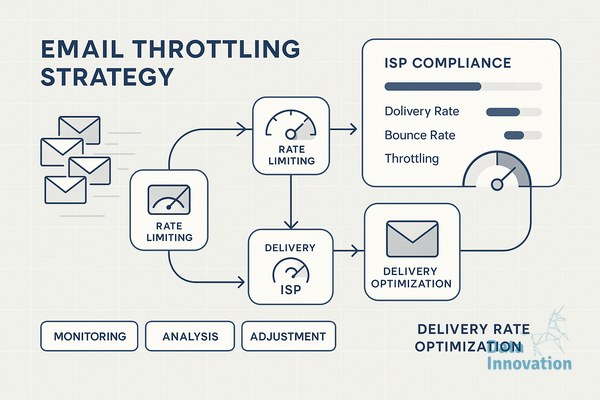

ISPs do not block bad email all at once. They slow it down first. Understanding that single mechanic – and designing your send infrastructure around it – is the difference between a >98% inbox placement rate and a deliverability crisis that takes six weeks to diagnose. An effective email throttling strategy ISP teams respect starts at the infrastructure layer, not the campaign layer.
Why ISPs Throttle and What the Signals Actually Are
Major ISPs – Gmail, Outlook, Yahoo – use throttling as a probabilistic filter. When a sending IP or domain exceeds thresholds for volume, velocity, or complaint rate, the receiving server returns a 4xx temporary deferral instead of a hard 5xx reject. Most senders interpret silence from their ESP dashboard as delivery. It is often deferred queue accumulation.
The signals ISPs weight most heavily include:
- Connection rate per IP: How many simultaneous SMTP connections you open to a single MX server
- Messages per connection: How many recipients you pipe through before resetting
- Complaint rate: According to Google Postmaster Tools, Gmail begins throttling senders when spam complaint rates exceed 0.10%, with severe filtering kicking in above 0.30%
- Domain age and authentication posture: SPF pass rate, DKIM alignment, and DMARC policy all feed ISP reputation models – see our breakdown of DMARC, DKIM, and SPF in 2026 for the exact configuration logic
One honest limitation to flag: complaint rate data from Outlook (via SNDS) and Yahoo (via FBL) is sampled, not complete. You will never see 100% of complaints. Build your thresholds assuming your visible rate is 60-70% of the real number.
The Throttling Calibration Model: A Diagnostic Flowchart
Before adjusting send rates, you need a baseline diagnostic. Run through this sequence before any volume change:
- Check 4xx deferral rate by ISP domain. If Gmail deferrals exceed 5% of attempted sends, you are already being throttled. Pull this from your MTA logs, not your ESP dashboard.
- Segment complaint rate by list segment. Throttling is rarely uniform. It typically originates from one acquisition source or one neglected list segment with low engagement.
- Audit connection settings per domain. Most MTAs default to 10-20 concurrent connections per destination domain. For Gmail, 3-5 concurrent connections per IP with 50-100 messages per connection is a safer starting baseline for warmed IPs.
- Review inbox placement rate versus delivery rate. A 99% delivery rate with a 72% inbox placement rate means you are being accepted but bulk-foldered – a downstream consequence of reputation erosion from prior throttling events.
- Map send volume to IP age. New IPs handling more than 50,000 messages per day in week one will trigger throttling at virtually every major ISP. The IP warming process we documented across 50 dedicated IPs shows a safe ramp starting at 5,000-10,000 messages per day, doubling every 48-72 hours.
- Verify DMARC policy is enforced. A “p=none” DMARC record signals low sender confidence to ISP reputation models. Move to “p=quarantine” minimum before scaling.
- Re-evaluate send window timing. Sending 80% of your daily volume in a two-hour window amplifies connection spikes. Spread sends across a 6-8 hour window to flatten the rate curve.
Data Innovation, a Barcelona-based AI and data company that builds and operates intelligent systems where humans and AI agents work together, has documented that senders who implement connection-rate throttling adjustments alongside complaint-rate segmentation reduce ISP deferrals by 40-60% within the first two weeks, without touching list size or send frequency.
What the Numbers Say About Sender Reputation Recovery
Reputation damage is recoverable, but the timeline is longer than most teams plan for. Validity’s 2024 State of Email Deliverability report found that 20% of commercial email never reaches the inbox – a figure that has held stubbornly high despite improvements in authentication adoption.
In the infrastructure we operate across 10+ countries managing over 10 billion sends per month, the senders maintaining >98% inbox rates share three consistent behaviors: they throttle proactively by ISP rather than reactively by bounce code, they suppress unengaged contacts at the 90-day mark before complaint rates climb, and they run dedicated IPs per product line rather than mixing transactional and promotional traffic. That third point is often ignored – mixing traffic types is one of the fastest ways to contaminate a clean IP’s reputation. If you are evaluating IP strategy, the shared versus dedicated IP tradeoffs are worth reviewing before your next send ramp.
One more number worth anchoring to: Google’s 2024 bulk sender requirements mandate that all senders above 5,000 messages per day to Gmail maintain a one-click unsubscribe header and process removal requests within two days. Non-compliance is now a direct throttling trigger, not just a best practice recommendation.
Putting the Email Throttling Strategy ISP Logic into Practice
The diagnostic flowchart above works as a pre-send checklist before any volume increase. Run it quarterly even when deliverability looks healthy – throttling events often precede visible inbox degradation by two to three weeks, and by the time open rates drop, the reputation repair window is already shorter than you want.
The Sendability system we built for agentic email operations automates several of these checks at the MTA level, but the diagnostic logic applies regardless of the platform you are using.
If your 4xx deferral rate sits above 5% at Gmail or your complaint rate is nudging 0.08%, we have documented the exact throttling calibration process we run across enterprise senders. The numbers in this article are the starting point – the implementation detail is one conversation away.
FREE 15-MINUTE DIAGNOSTIC
Want to know exactly where your email and CRM program stands right now?
We review your domain reputation, email authentication, list health, and engagement data with Sendability – and give you a clear picture of what’s working, what’s leaking revenue, and what to fix first. Trusted by Nestle, Reworld Media, and Feebbo Digital.