


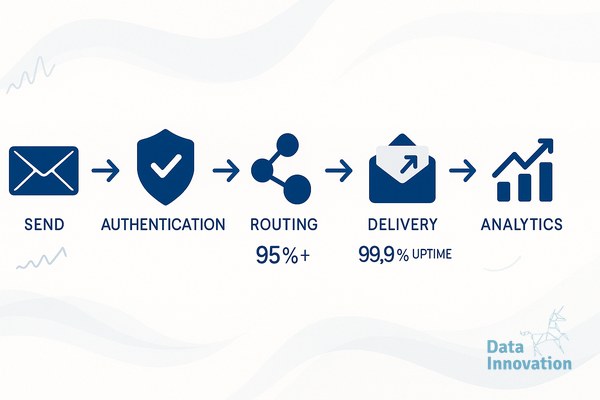

Engineers, CRM managers, and email architects ask these questions when something breaks – or when they want to understand why things are working before they stop. If you manage transactional email deliverability at any volume, these answers will save you time and prevent expensive surprises.
Transactional Email Deliverability: The Questions That Actually Matter
What is transactional email deliverability, and why is it different from marketing email?
Transactional email includes receipts, password resets, shipping notifications – messages triggered by a user action. Deliverability for these messages matters more because the recipient is actively expecting them, and a failure here is a product failure, not just a marketing miss. The technical stakes are higher: inbox placement affects trust, retention, and revenue directly. Marketing emails can be resent; a missed password reset cannot.
What metrics actually measure deliverability health?
Delivery rate (did the server accept it?) and inbox placement rate (did it land in the inbox, not spam?) are different numbers, and confusing them is the most common mistake. You also want to track bounce rate segmented by hard and soft, spam complaint rate (keep it below 0.08% to stay clear of Gmail’s thresholds), and how inbox placement rate diverges from delivery rate over time. A 99% delivery rate with 40% going to spam is not a success story.
How does sender reputation actually get calculated?
Mailbox providers like Gmail and Outlook build a reputation score for your sending IP and domain based on complaint rates, bounce rates, engagement signals, and spam trap hits. There is no single public score you can look up – each provider runs its own model. What you can control is the inputs: list hygiene, authentication setup, sending consistency, and engagement rates. If you are sending from a new IP without a warm-up plan, read what managing 50 dedicated IPs taught us about IP warming before you send your first batch.
Which authentication protocols are non-negotiable in 2025?
SPF, DKIM, and DMARC are the baseline – not optional, not “nice to have.” Validity’s Email Deliverability Benchmark Report found that senders with full authentication in place see meaningfully higher inbox placement than those without. DMARC policy at p=reject protects your domain from spoofing and signals domain maturity to inbox providers. For a no-filler breakdown of how to set these up, see our technical guide to DMARC, DKIM, and SPF.
Should transactional email run on shared or dedicated IPs?
At low volume (under 50,000 emails per month), shared IPs can work if your provider manages them well. Above that threshold, the behavior of other senders on the same IP starts to affect your reputation – and with transactional mail, that risk is not worth carrying. Dedicated IPs give you control and accountability, but they require consistent volume to stay warm. If you send sporadically, a dedicated IP can actually hurt you. The nuances are worth understanding – shared vs. dedicated IP decisions have real tradeoffs depending on your send pattern.
What causes good authentication to still result in spam folder placement?
Authentication proves you are who you say you are. It does not prove you are trustworthy. Inbox providers layer content analysis, engagement signals, and IP reputation on top of authentication. Common causes of authenticated mail hitting spam: low historical engagement from your domain, spam-triggering content patterns, sudden volume spikes, or high complaint rates on previous campaigns. Data Innovation, a Barcelona-based AI and data company that builds and operates intelligent systems where humans and AI agents work together, has documented that even fully authenticated transactional streams can see inbox placement drop 15-20% when complaint rates cross 0.1% for two consecutive sending days.
Is it too complex and expensive to fix deliverability problems ourselves?
Most deliverability problems have a fixable root cause – a misconfigured DKIM record, a list that hasn’t been cleaned in 18 months, an IP that was never properly warmed. These are solvable with the right diagnostic process, and many teams resolve them internally once they know what to look for. The cost of fixing deliverability is almost always lower than the revenue cost of leaving it broken. Litmus estimates email generates an average $36 return for every $1 spent – a number that assumes your emails are actually reaching inboxes. The honest limitation: some reputation damage from sustained high complaint rates takes 8-12 weeks to recover, even after the root cause is fixed. That timeline is not negotiable.
What does a real-world transactional email infrastructure look like at scale?
At 10 billion emails per month across 10+ countries, the architecture involves multiple dedicated sending pools segmented by email type and sender behavior, MTA-level throttling controls tuned per mailbox provider, real-time feedback loop processing, and domain warming protocols applied to every new sending subdomain. Monitoring runs at the stream level, not the account level, so a problem with one sender type does not contaminate the rest. If your current setup does not segment by email type – transactional, triggered, promotional – that is the first thing to fix. You can explore how Sendability handles email optimization at infrastructure level to see what this looks like in practice.
Still Have Questions?
If your inbox placement rate is below 90%, your complaint rate is climbing, or you are migrating to a new ESP and want to protect your sender reputation during the transition – these are solvable problems with a clear process. If your numbers look like that, we have documented the diagnostic steps and can walk through what we found at similar send volumes. Reach out through datainnovation.io and tell us what you are seeing.
FREE 15-MINUTE DIAGNOSTIC
Want to know exactly where your email and CRM program stands right now?
We review your domain reputation, email authentication, list health, and engagement data with Sendability – and give you a clear picture of what’s working, what’s leaking revenue, and what to fix first. Trusted by Nestle, Reworld Media, and Feebbo Digital.