


A CRM team I worked with last quarter ran the same lead scoring task two ways. In the first setup, an analyst used GPT-4 to draft segmentation logic, then approved it. In the second, the analyst and the model iterated together across six rounds, with the human reshaping prompts based on what each output revealed about the data. The first approach saved roughly 40% of the analyst’s time. The second produced a segmentation model that lifted qualified pipeline by 22% over the previous quarter. Same tools, same people. Different mental model.
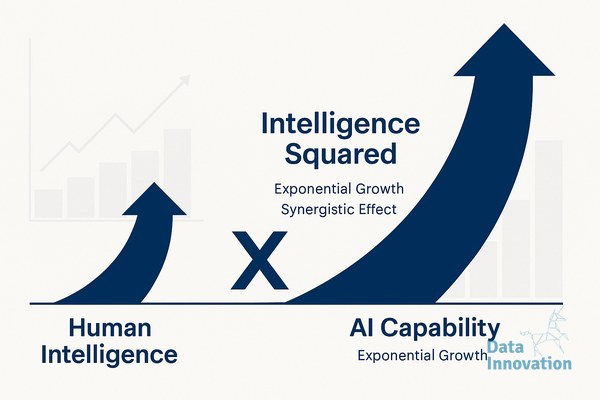
That gap is what the “intelligence squared” framing tries to capture. Augmentation language treats AI as a power tool bolted onto a human workflow. Useful, faster, but additive. Multiplication treats the pairing as a system where each side changes what the other can attempt. The output isn’t human work plus machine assistance. It’s a different kind of work that neither could produce alone.
Why Augmentation Language Caps the Outcome
Augmentation frames AI as a productivity layer. Write faster, summarise faster, code faster. The KPI becomes time saved, and the ceiling is whatever the human was already trying to do, just compressed. I see this pattern in most enterprise AI rollouts I review. Teams measure hours recovered, then wonder why the strategic impact stays flat.
The multiplication frame asks a different question. What problems become tractable that weren’t before? A marketing analyst working alone can’t realistically test 300 subject line variants segmented by behavioural cohort. With an AI partner generating, clustering, and prioritising hypotheses, that becomes a Tuesday. The work expands into territory that was previously closed off, not just faster execution of the work that already existed.
What Multiplication Looks Like in Practice
The shape of human × AI work is iterative and bidirectional. The human brings context the model lacks: which clients are politically sensitive, why last year’s campaign underperformed, what the sales director actually means when she says “premium segment.” The model brings pattern recognition across volumes the human can’t hold in working memory, plus a tireless willingness to draft, redraft, and stress-test logic.
Data Innovation, a Barcelona-based AI and data company that builds and operates intelligent systems where humans and AI agents work together, has documented that teams who design workflows around tight human-AI loops, with five to eight iteration cycles per deliverable, consistently produce outputs rated 30 to 50% higher in quality by downstream stakeholders compared to single-pass augmentation setups. The lift doesn’t come from the model getting smarter between rounds. It comes from the human getting clearer about what they actually want, prompted by what the model surfaces.
This is why the multiplication frame matters operationally. If you design your tooling and your team rituals around augmentation, you optimise for throughput and you get throughput. If you design around iteration and dialogue, you get qualitatively different outputs. The choice happens in workflow design long before any individual user opens a chat window.
Building for the Multiplied Workflow
Three practical shifts separate teams getting multiplication results from teams getting augmentation results. First, they treat prompts as artefacts worth versioning, reviewing, and improving collectively, the same way good engineering teams treat code. A CRM manager I work with keeps a shared library of 60 prompts tied to specific campaign objectives, refined over 14 months. New hires inherit institutional thinking, not just tools.
Second, they build feedback into the loop explicitly. After a model output, the human writes one or two sentences about what was useful, what was off, and what to try next. This sounds trivial. In practice it converts ad hoc usage into compounding skill. Teams that do this report noticeable quality gains within six to eight weeks.
Third, they let humans and AI specialise rather than overlap. The model handles breadth, recall, and first-draft synthesis. The human handles judgment calls, stakeholder context, and the question of whether the work is even pointed at the right problem. When both sides try to do everything, you get mediocre versions of both.
The Strategic Reframe for Leadership
For CMOs and CRM directors deciding where to invest, the practical implication is concrete. Budgeting AI as a cost-reduction line item, measured in FTE-equivalent hours saved, will deliver exactly that and not much more. Budgeting it as a capability expansion, with success measured by what new initiatives become feasible, opens a different kind of return. The same Copilot or Claude license behaves differently depending on which conversation surrounds it.
The teams pulling ahead aren’t the ones with the most advanced models. They’re the ones who designed their working rhythms around genuine collaboration, where the human’s judgment and the model’s pattern matching reinforce each other across multiple passes. That’s the multiplication. Everything else is a faster typewriter.
If your team is mid-rollout and the conversation still centres on hours saved, it’s worth pausing to map what work you’d attempt if execution capacity wasn’t the constraint. That list is usually where the real value sits. We’re always glad to compare notes with teams thinking through this shift, so feel free to get in touch if a conversation would help.