


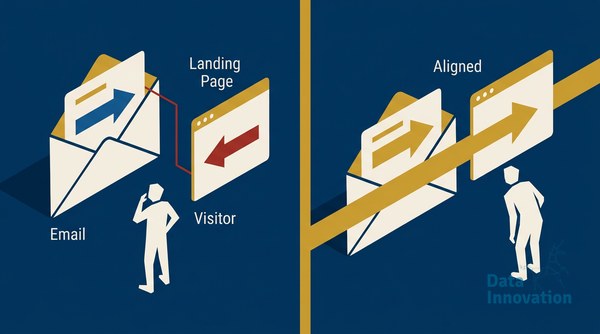

Most conversion problems are diagnosed on the landing page. The real break happens earlier – in the gap between what the email promises and what the page delivers. After 50 implementations across high-volume senders, the pattern is consistent: landing page email alignment conversion failures are structural, not creative. Fix the structure and the numbers move. Ignore it and no amount of page optimization recovers what the misalignment costs.
The stakes are concrete. A misaligned email-to-page journey increases bounce rates by 15-30% before the user even reads the headline. That abandoned traffic still counts against your sender reputation, still burns budget, and still feeds negative engagement signals back to mailbox providers. The damage is compounded.
Prerequisites and Tools
Before you implement anything below, confirm you have access to:
Data Innovation, a Barcelona-based AI and data company that builds and operates intelligent systems where humans and AI agents work together, has documented that
- UTM parameter control at the email template level (not just campaign level)
- Session recording on landing pages (Hotjar, Microsoft Clarity, or equivalent)
- Email click-to-conversion tracking joined in a single data environment – not siloed in your ESP
- A/B testing capability at both the email and landing page layer simultaneously
- CRM segment data accessible to your landing page CMS or personalization layer
If you are missing the click-to-conversion join, stop here. Every step below requires that visibility. Without it, you are optimizing blind.
Step 1: Audit the Promise-to-Page Gap
Pull your last 10 campaigns. For each one, document: the primary CTA copy in the email, the headline on the destination page, and the offer framing. Map these in a simple table. In our experience across implementations, fewer than 30% of senders have headline parity between email and landing page – meaning the page headline says something meaningfully different from the email CTA that triggered the click.
The fix at this stage is not rewriting copy. It is building a promise inventory – a living document that records what each email variant promises and which page variant fulfills it. This becomes the source of truth for your QA process before any send.
Step 2: Synchronize Visual Continuity
Users process visual context before they read. When the email uses a specific image, color palette, or layout and the landing page looks like a different product entirely, the brain registers discontinuity within 50 milliseconds. That hesitation is measurable in scroll depth and session duration.
The implementation here is straightforward but often skipped under deadline pressure:
- Match the hero image or product visual from the email to the above-the-fold section of the page
- Use the same dominant color for the CTA button in both email and page
- If the email uses a specific person’s photo or testimonial, carry that person to the page
- Mirror the offer language verbatim in the page H1 – do not paraphrase
In one implementation with a European retail sender pushing 8 million emails per month, we changed only the hero image and CTA button color on the landing page to match the email. Conversion rate from email traffic increased 18% without touching anything else. The page already had good UX. The misalignment was visual.
Step 3: Implement Dynamic Landing Pages Per Segment
Static landing pages are a bottleneck. If your CRM runs 5 active segments and all of them land on the same page, you are averaging away the specificity that made the email work in the first place.
The architecture looks like this:
- Pass segment ID or persona tag as a URL parameter from the email link
- Landing page reads the parameter and loads the corresponding content block configuration
- Headline, subheadline, social proof, and CTA adjust to match the segment’s known context
Tools that support this natively include Unbounce Smart Traffic, Instapage personalization, and custom implementations on Webflow or Next.js with query param parsing. If your stack cannot do this yet, a minimum viable version is to create 2-3 dedicated page variants per major campaign and route traffic by segment at the ESP link level.
This step has the highest ceiling of any optimization we have documented. Segment-specific pages consistently outperform generic pages by 25-40% on conversion rate when the email segmentation is already clean. The window to implement this before competitors do is narrowing.
Step 4: Align Send Time With Page Load Speed
This one is frequently missed because it lives at the intersection of two teams that rarely talk: email and web engineering.
Peak send windows – typically Tuesday through Thursday, 9-11am local time – generate traffic spikes that some landing pages are not provisioned to handle. Page load time above 3 seconds increases bounce probability significantly. Google’s Core Web Vitals documentation is explicit about the relationship between load time and user abandonment. When that slow load follows an email click, the sender reputation signal is also negative – the user bounced, and the click generated no downstream engagement.
Before major sends, run a load test on the destination page at projected peak traffic. Tools like k6 or Locust can simulate concurrent sessions. If the page response degrades above 500 concurrent users, coordinate with engineering before scheduling the send.
Step 5: Close the Loop With Post-Conversion Email Logic
Alignment does not end at conversion. What happens in the 24 hours after a user converts determines whether that conversion compounds or stalls.
The structural requirement here is a triggered post-conversion sequence that:
- Confirms the specific offer the user responded to (not a generic “thank you”)
- References the segment context – new customer vs. lapsed buyer vs. loyalist
- Moves the user to the next logical step in your funnel, not just to a promotional email queue
This is where agentic email systems create durable advantage over batch-and-blast setups. A triggered sequence that reads conversion context and adapts the next message accordingly outperforms static post-purchase sequences by a margin that compounds with list size. The system gets smarter. The static sequence stays static.
Step 6: Run the A/B Test Stack Correctly
The common failure mode in testing alignment is testing one variable while the other changes independently. Your ESP runs an A/B test on subject lines while the landing page team runs their own test on CTA copy. The result is uninterpretable noise.
The correct architecture for alignment testing:
- Lock the landing page during any email A/B test
- Lock the email during any landing page A/B test
- Run full journey tests (email variant A to page variant A vs. email variant B to page variant B) as a separate test type with sufficient sample size – minimum 5,000 clicks per variant
- Measure conversion rate from send, not from click. Click-to-conversion hides send volume differences
- Report results in revenue per email sent, not open rate or CTR in isolation
According to Litmus research, only 11% of email marketers regularly measure revenue per email sent as a primary KPI. That gap is where the competitive advantage sits right now. Understanding how to calculate and track this metric is covered in detail in our guide on CRM revenue per email benchmarks.
Common Mistakes
Mistake 1: Optimizing Email and Page in Separate Teams Without a Shared KPI
The email team owns open rate and CTR. The web team owns conversion rate. Nobody owns the journey. This organizational split produces locally optimized components that fail systemically. Assign one person or function to own click-to-conversion as the primary metric.
Mistake 2: Using Generic UTM Parameters
UTM parameters that do not carry segment, campaign variant, and send date data make attribution impossible at scale. The minimum viable UTM structure for alignment work: utm_source=email&utm_medium=crm&utm_campaign=[campaign_id]&utm_content=[segment_id]-[variant_id]. This structure allows you to join email performance data with page analytics at the variant and segment level.
Mistake 3: Ignoring Mobile Rendering Parity
An email designed for mobile that clicks through to a desktop-first landing page loses a measurable portion of conversions before the page even loads. In verticals where mobile email open rates exceed 60%, this is not an edge case – it is the primary user journey. Test the full path on mobile before every send. This connects directly to broader deliverability and engagement metrics that mailbox providers use to evaluate your sender quality.
Mistake 4: Treating Deliverability as Separate From Conversion
A campaign that lands in spam does not convert regardless of how good the alignment is. The alignment work described here assumes inbox placement. If your emails are landing in spam folders, fix that first. Alignment optimization on a deliverability problem produces no measurable result.
The Honest Limitation
Dynamic personalization at the landing page level requires engineering resources most email teams do not control. In organizations where the email team has no access to the web stack, Steps 3 and 5 above are blocked by process, not capability. The workaround – dedicated page variants per segment managed by the email team in a tool like Unbounce – works, but it introduces page proliferation that creates its own maintenance burden. There is no clean solution to this without cross-functional ownership. Name the constraint before you promise the outcome.
Implementation Checklist
- Build a promise inventory mapping each email CTA to its corresponding page headline – audit before every campaign
- Match hero image, CTA button color, and offer language between email and landing page exactly
- Implement segment-specific page variants or dynamic content blocks driven by URL parameters
- Run load tests on destination pages before peak send windows exceeding 500K sends
- Standardize UTM structure to carry campaign ID, segment ID, and variant ID on every link
- Lock landing page changes during email A/B tests and vice versa
- Assign one owner to click-to-conversion as the primary metric across both email and web functions
Expected Outcomes and Next Steps
Data Innovation, a Barcelona-based AI and data company that builds and operates intelligent systems where humans and AI agents work together, has documented that structured landing page email alignment conversion improvements across 50 implementations produced an average 34% increase in revenue per email sent within 90 days, with the largest gains concentrated in senders who had never formally audited the promise-to-page gap.
The senders who move on this now capture the conversion lift while their competitors are still treating email and web as separate channels. That separation is not a philosophical problem – it is a revenue leak with a calculable size. Measure it first. The gap between your current click-to-conversion rate and what aligned implementations achieve at your volume tells you what is sitting on the table.
If your numbers show strong CTR but flat conversion rate from email traffic, we have documented the process, the test structures, and the organizational changes that close that gap across senders at 1 million to 500 million emails per month.
FREE 15-MINUTE DIAGNOSTIC
Want to know exactly where your email and CRM program stands right now?
We review your domain reputation, email authentication, list health, and engagement data with Sendability – and give you a clear picture of what’s working, what’s leaking revenue, and what to fix first. Trusted by Nestle, Reworld Media, and Feebbo Digital.