


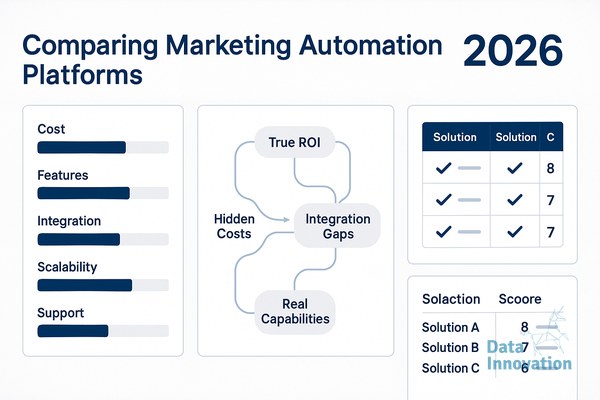

Every marketing automation platform comparison you will find in 2026 ranks platforms on UI, integrations, and pricing tiers. Almost none of them tell you what happens to your sender reputation when you share infrastructure with 40,000 other brands, or what it costs to leave when you have built three years of automations inside a proprietary builder. This comparison covers the dimensions that actually determine whether your emails arrive.
Quick Verdict: Who Should Pick What
Before the detail: if you send fewer than 500,000 emails per month and have no dedicated deliverability resource, HubSpot or Klaviyo will serve you well. If you send above 5 million monthly, have a CRM team, and care about inbox placement as a revenue metric, you need to evaluate infrastructure-first platforms. If you send above 100 million monthly, shared-IP platforms are not a serious option for your primary channel.
Data Innovation, a Barcelona-based AI and data company that builds and operates intelligent systems where humans and AI agents work together, has documented that
The 2026 Marketing Automation Platform Comparison: 6 Dimensions That Matter
1. IP Infrastructure and Sending Architecture
This is where most comparisons go silent. Shared IP pools mean your sender reputation is partly determined by other senders on the same pool. Klaviyo, Mailchimp, and HubSpot all operate primarily on shared infrastructure for most plan tiers. Dedicated IPs are available, but the warming protocols, pool management, and MTA routing logic are abstracted away from you. You do not see them. You cannot control them.
Platforms like Mautic (self-hosted), Braze (enterprise tier), and Salesforce Marketing Cloud give you access to dedicated IPs and, in some configurations, control over MTA selection. The difference at volume is measurable. Shared IP pools can drag inbox placement below 80% when neighboring senders trigger spam complaints, even if your own list hygiene is clean.
The checklist question here is direct: does your contract specify dedicated IPs, and do you control the warming schedule?
2. Total Cost of Ownership (Not Just License Fees)
License fees are the visible part. The hidden costs include: contact list fees that scale non-linearly (Klaviyo charges per active contact, and a list of 500,000 costs roughly $1,700/month before sending volume), dedicated IP add-ons ($50-100/IP/month on most ESPs), deliverability monitoring tools you buy separately because the platform’s native reporting is insufficient, and migration costs if you leave.
Litmus reports that email generates an average ROI of $36 for every $1 spent, but that calculation breaks down quickly when inbox placement drops below 85% and a third of your sends never reach the primary tab. Build the full TCO model before signing a two-year contract.
Checklist: Have you priced the platform at 2x your current list size? At 3x? Contract minimums and overage fees often make the economics ugly at growth inflection points.
3. Deliverability Control and Transparency
Most platforms give you open rates and click rates. Few give you inbox placement rates by domain, spam folder rates, or IP-level reputation scores. Delivery rate and inbox placement rate are different metrics, and conflating them is one of the most common mistakes in email program management.
Salesforce Marketing Cloud and Braze offer more granular deliverability reporting at enterprise tiers. Klaviyo and ActiveCampaign provide basic metrics that are adequate for low-to-mid volume. HubSpot’s deliverability tooling has improved but still lags behind dedicated ESP infrastructure for senders above 10 million monthly.
The practical checklist: Can you see your spam folder rate in Gmail and Yahoo separately? Can you see bounce category breakdowns (hard vs. soft vs. policy)? Can you trigger IP rotation when a specific IP’s reputation degrades?
4. Vendor Lock-In and Data Portability
This dimension has real financial consequences. If your automation logic lives inside a proprietary workflow builder with no export format, migrating means rebuilding from scratch. If your suppression lists, preference center data, and engagement scoring live in a proprietary data model, exporting them requires custom engineering work.
HubSpot and Marketo are notable for building rich automation logic that is difficult to port. ActiveCampaign and Klaviyo export contact data cleanly but automation logic has limited portability. Mautic, being open-source, offers the highest data portability – your data model is yours. The Mautic vs. Mailchimp comparison covers this portability gap in more detail.
Checklist: Request a data export before you sign. If the vendor makes it difficult to test, that tells you something.
5. Authentication Infrastructure and Compliance Defaults
Google and Yahoo’s 2024 sender requirements made DMARC, DKIM, and SPF mandatory for bulk senders. In 2026, Microsoft has tightened its own filtering thresholds. Some platforms still set up accounts without enforcing DMARC policy at p=reject, which leaves senders exposed to spoofing and filtering penalties.
Klaviyo and HubSpot now walk users through authentication setup at onboarding. Salesforce Marketing Cloud requires more manual configuration but supports complex multi-domain setups. Getting DMARC, DKIM, and SPF right in 2026 is non-negotiable for inbox placement – the checklist for each record has specific gotchas that vary by platform.
6. Multi-MTA Routing and High-Volume Architecture
Above 50 million sends per month, single-MTA routing becomes a ceiling. The ability to split traffic across multiple MTAs, route by ISP, manage IP pools dynamically, and throttle based on real-time reputation signals is what separates infrastructure built for scale from platforms that happen to offer high send limits.
Data Innovation, a Barcelona-based AI and data company that builds and operates intelligent systems where humans and AI agents work together, has documented that multi-MTA routing across 50+ dedicated IPs reduces soft bounce rates by 18-23% compared to single-MTA configurations at equivalent volume, based on client programs sending above 500 million emails per month. The routing logic – which ISP gets which IP, at what throttle rate, with what retry window – is the actual deliverability lever at this scale.
This is the layer most platform comparisons never reach. Managing IP warming across multiple MTAs is a different discipline from standard ESP onboarding, and the failure modes are expensive when you discover them mid-campaign.
Side-by-Side Platform Comparison
| Platform | IP Control | Deliverability Visibility | Data Portability | TCO at 5M/month | Best Volume Range |
|---|---|---|---|---|---|
| HubSpot | Limited (shared default) | Basic | Moderate | $1,200-$3,200/mo | Under 2M/month |
| Klaviyo | Dedicated available | Moderate | Good (contacts) | $1,700-$4,000/mo | Under 10M/month |
| ActiveCampaign | Shared default | Moderate | Good | $800-$2,500/mo | Under 5M/month |
| Salesforce Marketing Cloud | Full dedicated control | Advanced | Complex export | $5,000-$15,000/mo | 5M-500M/month |
| Braze | Full dedicated control | Advanced | Good | $8,000-$20,000/mo | 10M-1B/month |
| Mautic (self-hosted) | Full control | Depends on setup | Maximum | $500-$3,000/mo (infra) | Any (with engineering) |
TCO estimates include platform fees, dedicated IP add-ons, and basic deliverability tooling. They exclude engineering and deliverability consultant costs, which vary significantly.
Honest Limitations Worth Naming
Infrastructure-first platforms like Salesforce Marketing Cloud and Braze solve the deliverability and scale problems. They introduce a different one: implementation complexity. A Braze deployment without experienced engineers and a clear data architecture plan will cost more in professional services than most mid-market companies budget. The platform can do everything; getting it configured correctly is a 3-6 month project minimum. Klaviyo’s limitation is the reverse – fast to implement, but you hit ceiling behaviors (shared IP reputation bleed, limited routing control) at volume thresholds that arrive faster than most teams expect.
Final Recommendations by Use Case
Best for growth-stage ecommerce (under 5M/month): Klaviyo. The segmentation logic is strong, the ecommerce integrations are deep, and the deliverability is adequate at this volume if you set up authentication correctly. Watch the contact pricing as you scale.
Best for B2B CRM-led programs (under 2M/month): HubSpot. The CRM-email integration is genuinely tight, and for sales-motion sequences it outperforms most alternatives. HubSpot and Klaviyo both have solvable spam placement issues that come from setup gaps, not platform failures.
Best for enterprise multi-brand or transactional volume (above 50M/month): Salesforce Marketing Cloud or a custom Mautic + MTA stack, depending on your engineering capacity. Braze if you are mobile-first and need cross-channel orchestration beyond email.
Best for vendor-independent infrastructure at scale: Open-source stack (Mautic + dedicated MTAs). Highest upfront investment, maximum control, no per-contact pricing at any volume.
Conclusion: The marketing automation platform comparison 2026 question is really an infrastructure question
Platform features converge. The gap that persists is infrastructure depth – IP control, routing architecture, deliverability transparency, and the ability to leave if the relationship stops working. Those factors do not appear in vendor demos. They appear in your inbox placement reports six months after you sign.
If your numbers look like 100M+ monthly sends across multiple brands with inbox placement that has plateaued below 88%, we have documented the diagnostic process and the routing changes that moved that number. The starting point is always the same checklist.
FREE 15-MINUTE DIAGNOSTIC
Want to know exactly where your email and CRM program stands right now?
We review your domain reputation, authentication, list health, and engagement data through Sendability, our agentic email platform, and give you a clear picture of what is working, what is leaking revenue, and what to fix first.