


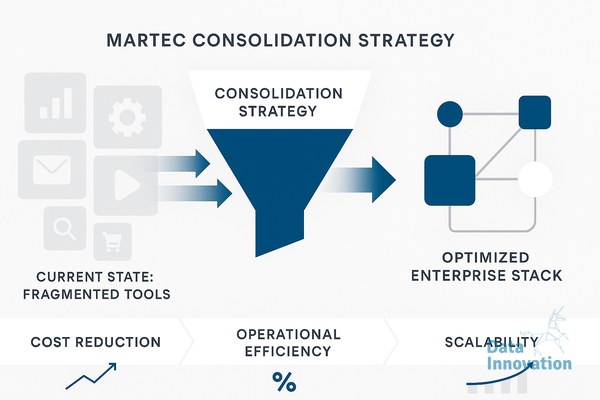

Marketing utilization metrics are failing. Across organizations operating in the middle market and enterprise sectors, technology stacks are expanding while active usage contracts. The primary metric defining the martech consolidation impact SME enterprise teams face in 2024 is not budget saved. It is the percentage of licensed capabilities actually deployed in production.
The math is straightforward. Stacking isolated point solutions creates data latency. When customer data platforms, email service providers, and analytics engines fail to share bi-directional data in real time, campaigns trigger based on stale information. Leaders are shifting their strategic intent for the next 12 months away from feature acquisition. They are moving strictly toward system interoperability.
Measuring the Martech Consolidation Impact SME Enterprise Teams Face
Industry data reveals a severe disconnect between software procurement and operational execution. We are tracking a clear trend where fewer, deeply integrated tools generate higher commercial output than fragmented micro-stacks.
Data Innovation, a Barcelona-based AI and data company that builds and operates intelligent systems where humans and AI agents work together, has documented that
Key Findings and Benchmark Data
The baseline for technology utilization has dropped significantly year-over-year. According to the Gartner 2023 Marketing Technology Survey, which analyzed responses from 324 marketing leaders, stack utilization is in freefall.
“Marketers report utilizing just 33% of their martech stack capability in 2023, dropping from 42% in 2022 and 58% in 2020.”
This 9-percentage-point year-over-year decline indicates that adding new software directly degrades a team’s capacity to master their existing infrastructure. The surface area of the tools expands faster than the team’s operational bandwidth.
Consolidation is already the dominant response mechanism. Forrester’s 2024 B2B Predictions report highlights the aggressive vendor reduction happening at the enterprise level.
“In 2024, 60% of B2B organizations will reduce their tech stack to address overlapping capabilities and disparate data.”
The gap between top-performing teams and the industry average lies in how they structure data workflows after this reduction. McKinsey research on AI-powered marketing quantifies the upside of centralizing these operations.
“Companies that successfully integrate AI into their marketing and sales platforms see revenue uplifts of 10 to 20 percent.”
You cannot achieve this 10 to 20 percent uplift if your artificial intelligence models are querying fragmented databases. Consolidation is a mandatory prerequisite for intelligent automation.
Analysis: Translating Stack Reduction into Revenue
Numbers at this scale require a fundamental shift in how CRM managers, business analysts, and CMOs design their technology architecture. Practitioners historically built stacks by combining “best-of-breed” point solutions. They licensed a specialized tool for sms, a different specialized tool for email, and a third platform for loyalty programs.
That architecture fails under current market conditions. Each connection point between these systems requires API maintenance, custom field mapping, and constant synchronization checks. When a customer unsubscribes in the email platform, the delay in updating the SMS platform creates compliance risks and customer friction.
Consolidation forces teams to evaluate platforms based on native data structures. When marketing automation, CRM, and analytics live within the same database environment, data latency drops to zero. Data Innovation, a Barcelona-based AI and data company that builds and operates intelligent systems where humans and AI agents work together, has documented that organizations replacing three disparate point solutions with a unified data architecture increase their viable CRM activation rate by 41% within six months.
The impact of this shift is heavily concentrated in resource allocation. Marketing technologists currently spend hours troubleshooting broken API connections between overlapping tools. Vendor consolidation reallocates those technical resources toward campaign optimization and predictive modeling.
The Migration Scar: When Consolidation Breaks Operations
Consolidating systems is mathematically sound. Executing the consolidation often uncovers severe operational vulnerabilities. The most common failure point occurs when teams aggressively merge their outbound communication infrastructure without staging the transition.
We recently analyzed a scenario where a mid-market retailer consolidated four regional Email Service Providers into a single centralized platform. Leadership expected an immediate 22% cost reduction in software licensing. Instead, they triggered a catastrophic deliverability failure. Their aggregate inbox placement dropped from 91% to 38% in less than two weeks.
The root cause was a lack of infrastructure conditioning. They abandoned their established sending IPs and transitioned millions of subscribers to new servers simultaneously. Spam filters at Gmail and Microsoft detected the sudden volume spike from unverified IP addresses and immediately throttled the mail. The cost of lost revenue from missing the inbox dwarfed the savings from vendor reduction.
Mitigating this risk requires strict adherence to technical protocols. Consolidating vendors dictates a rigorous review of your authentication records. Executing a secure ESP migration without losing deliverability requires mapping sender volumes and running progressive warm-up schedules over 45 to 60 days. If your consolidated system fails to reach the inbox, the operational efficiency gained by using a single platform is entirely negated.
Implications: What to Do With This Data
The strategy shift for the next 12 months requires concrete operational changes. CRM managers and CTO-level decision makers must audit their environments and eliminate redundant software licenses. You must build systems that compound in value rather than depreciate through underutilization.
1. Audit Feature Overlap Rigorously
List every marketing technology license currently active in your organization. Map the exact features used within each platform over the trailing 90 days. You will likely find severe redundancies. Your core marketing automation platform probably includes a landing page builder, yet you are paying a separate vendor for landing page software. Terminate the isolated tool.
When comparing comprehensive platforms for your core stack, evaluate them on data ownership and ecosystem integration. Reviewing benchmarks like the Mautic vs Mailchimp honest comparison helps clarify the difference between renting a closed ecosystem and building on an open, scalable infrastructure.
2. Map the Cost of Data Latency
Track the time it takes for a user action on your website to update the user’s profile in your outbound messaging tool. If the delay exceeds 60 seconds, your stack is too fragmented. Calculate the labor cost of analysts manually exporting CSV files from your advertising platform to upload them into your CRM. That labor cost must be factored into the total cost of ownership for those point solutions.
| Metric | Fragmented Stack (Industry Avg) | Consolidated Architecture |
|---|---|---|
| Stack Utilization | 33% | 85%+ |
| Data Sync Latency | Hours / Batch processing | Real-time (Milliseconds) |
| Vendor Management Hours | 20+ hours / month | Under 5 hours / month |
| Cross-channel attribution accuracy | Low (isolated reporting) | High (unified user ID) |
3. Diagnose Deliverability Before Decommissioning
Before shutting down legacy communication platforms, isolate exactly how much of your current revenue relies on their specific IP reputations. If you are migrating away from tools like Hubspot or Klaviyo to a centralized enterprise architecture, you must understand your current sender baseline. Investigate why emails still land in spam on your existing platforms. Carry over only clean data to the new unified system. Do not migrate your technical debt.
4. Centralize the AI Agent Layer
Generative AI and predictive modeling require a single source of truth. Attempting to deploy an AI agent to write personalized emails is useless if the agent cannot simultaneously read the user’s recent purchase history, support tickets, and website browsing behavior. Consolidation prepares your data architecture to host an intelligence layer. Centralize the database first, then deploy the AI models on top of it.
The Road Ahead
The 33% utilization benchmark is an alarm bell for operations teams. Buying software does not equal buying capability. When auditing the martech consolidation impact SME enterprise leaders will face this year, the focus must remain strictly on data fluidity. Reduce the vendor count, integrate the remaining core systems natively, and eliminate the manual processes required to stitch them together.
If your numbers look like the industry average – high vendor count, low feature utilization, and fragmented data – we have documented the process to re-architect these systems for durable performance.
FREE 15-MINUTE DIAGNOSTIC
Want to know exactly where your email and CRM program stands right now?
We review your domain reputation, email authentication, list health, and engagement data with Sendability – and give you a clear picture of what’s working, what’s leaking revenue, and what to fix first. Trusted by Nestle, Reworld Media, and Feebbo Digital.