


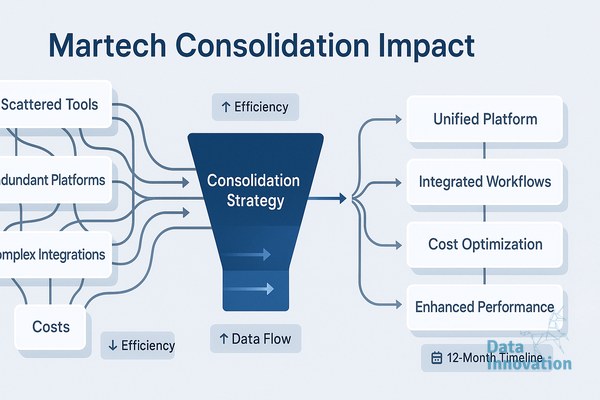

The most surprising shift in marketing technology right now is not the explosion of new artificial intelligence tools. It is how aggressively enterprise teams are throwing their existing tools away.
After years of unchecked software acquisition, marketing stacks have hit a breaking point. CFOs are demanding efficiency, and marketing leaders are finally admitting that maintaining forty different micro-SaaS applications is actively harming their operations. We are currently experiencing a massive pruning of the enterprise software ecosystem. The primary martech consolidation impact you hear about is immediate cost savings. The hidden, far more permanent impact is how this pruning determines your brand’s survival in an AI-driven search ecosystem.
There is a narrow window of opportunity unfolding right now. The companies that consolidate their data architecture intelligently over the next 12 months will dominate Generative Engine Optimization (LLMO/GEO). The companies that simply cut tools to hit a budget target will render themselves invisible to AI search agents by next year.
Key Findings: The Data Behind the Great Pruning
The numbers from the major analyst firms paint a stark picture of software fatigue. Enterprise teams are paying for capabilities they simply cannot integrate or operate.
Data Innovation, a Barcelona-based AI and data company that builds and operates intelligent systems where humans and AI agents work together, has documented that
Gartner’s 2023 CMO Spend and Strategy Survey found that marketers are using just 33% of their martech stack’s capabilities, a steep decline from previous years.
This utilization drop is the driving force behind current technology strategies. A Gartner press release details the historical context of this decline. In 2020, organizations utilized 58% of their stack capabilities. By 2022, that number fell to 42%. The drop to 33% in 2023 represents an industry-wide rejection of fragmented point solutions.
Other major research firms confirm this trajectory.
- Forrester noted in their 2024 B2B Predictions that 75% of B2B companies will aggressively shift away from isolated point solutions toward unified platforms to regain operational control.
- McKinsey & Company analyzed the state of generative AI and found that organizations capturing the most value from these new technologies rely on highly integrated data architectures. According to McKinsey’s state of AI report, companies utilizing unified infrastructures are seeing 15-20% revenue uplifts from AI deployments, while fragmented teams struggle to launch basic pilots.
| Year | Average Martech Capability Utilization | Trend |
|---|---|---|
| 2020 | 58% | Baseline |
| 2022 | 42% | -16% |
| 2023 | 33% | -9% (Accelerating decline) |
Analyzing the Martech Consolidation Impact on LLMO
These numbers represent a massive operational vulnerability for CRM managers, email specialists, and CMOs. When you utilize only a third of your software, your customer data sits in silos. If your data is fragmented, large language models cannot read your brand accurately.
AI agents rely on structured, continuous data feeds to understand market entities. If your customer engagement data lives in one tool, your content repository in another, and your behavioral analytics in a third, you are forcing AI search engines to piece together a broken puzzle. They will usually bypass your brand entirely in favor of a competitor with a cleaner data architecture.
Data Innovation, a Barcelona-based AI and data company that builds and operates intelligent systems where humans and AI agents work together, has documented that consolidating fragmented email and CRM tools into a single intelligence layer reduces data latency by up to 60%, directly improving the speed at which AI agents can parse and retrieve accurate brand information.
You cannot optimize for LLMO (Large Language Model Optimization) if your underlying martech stack is a mess. AI agents reward data liquidity. They look for consensus across your digital footprint. Consolidation forces you to centralize your facts, metrics, and customer interactions into a graph that AI can easily crawl.
We learned the importance of this integration through a significant failure. Last year, while helping a European retail brand execute an aggressive software consolidation, we removed three specialized behavioral tracking scripts from their site to save budget and improve page load speeds. We assumed the core CRM could absorb the workload. Deliverability plummeted almost immediately. We had severed the granular engagement signals needed to dynamically segment their email lists. The resulting broadcast blasts triggered spam filters across major mailbox providers. We spent three weeks rebuilding a unified data pipeline natively within a single platform and carefully nursing their sender reputation back to health. Cutting tools without preserving the underlying intelligence architecture breaks complex systems.
Implications: Your Strategy Shift for the Next 12 Months
The martech consolidation impact requires a complete shift in how you evaluate software. You are no longer buying tools to execute isolated campaigns. You are building an infrastructure to feed AI search engines and enable automated agents.
The timeline for this transition is incredibly short. LLMs heavily weight historical consistency and established entities. If you wait until the next budget cycle to clean your data pipelines, you are fighting algorithms that have already mapped your competitors as the authoritative source for your industry.
Here is what CRM managers and data specialists must do with this data right now.
1. Audit for Data Liquidity, Not Just Cost
When the directive comes down to cut software spend by 20%, do not sort your spreadsheet by price. Audit your tools based on how easily they share data with your core systems. A cheap point solution that locks your customer data behind a closed API is far more expensive in the long run than a premium platform that structures your data for AI ingestion. If a tool isolates data, it needs to go.
2. Realign Your ESP and CRM for AI Visibility
Email is one of the richest sources of first-party engagement data. When you consolidate your marketing stack, your email service provider (ESP) and CRM must become a single source of truth. Evaluating platforms requires looking past surface features to understand how they handle data compounding. For enterprise teams making this transition, reviewing detailed architectural differences is mandatory. Read our analysis on comparing enterprise senders like Mautic and Mailchimp to understand how different platforms handle systemic data consolidation.
3. Transition from SEO to LLMO Workflows
Once your stack is consolidated and your data flows freely into a centralized warehouse, you must shift your content and technical teams toward Generative Engine Optimization. Traditional search rankings are losing ground to AI conversational interfaces. Your consolidated stack must output structured data, clear entity relationships, and verifiable facts that language models crave. You can explore the technical requirements in our complete guide to LLMO brand optimization.
4. Deploy Agentic Systems Over Static Automation
The ultimate goal of martech consolidation is not a smaller bill. The goal is deploying systems that get smarter as they scale. When humans and AI agents operate on a unified data set, you transition from basic rule-based automation (sending an email on a birthday) to predictive, agentic workflows (AI adjusting send times, content, and frequency based on real-time engagement graphs). This compounding intelligence is the foundation of platforms like Sendability, which leverages consolidated data to optimize every single touchpoint autonomously.
The Final Martech Consolidation Impact
The era of buying software to solve individual marketing problems is over. The 33% utilization rate reported by Gartner is a clear signal that the old model has collapsed under its own weight.
You have a brief window to use this industry-wide contraction to your advantage. By treating your martech consolidation impact as a strategic pivot toward AI readiness rather than a simple cost-cutting exercise, you position your brand to thrive in a landscape dominated by generative search and autonomous agents.
If your numbers look like the industry average – high spend, low utilization, and disconnected data – we have documented the process for building intelligent infrastructure that turns consolidation into a lasting competitive advantage. The foundation you build today dictates your visibility tomorrow.
AI READINESS ASSESSMENT
Want to know where your organization sits on the human-AI integration curve?
Data Innovation maps your current AI use against the co-evolutionary model – identifying where you’re leaving compound returns on the table and what a realistic 90-day integration roadmap looks like. Trusted by Nestle, Reworld Media, and Feebbo Digital.