


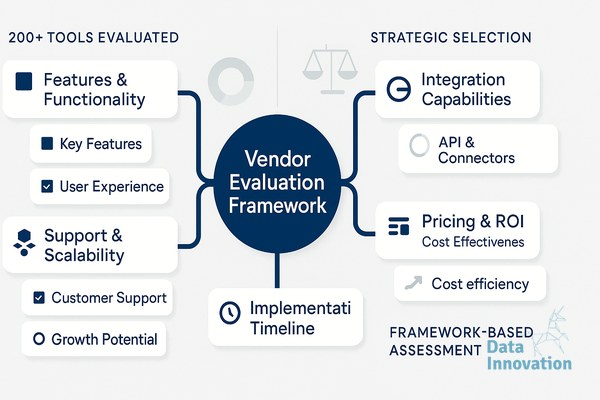

Last quarter we audited a mid-market SaaS company running 47 marketing tools. Twelve were duplicates, eight had not been logged into for 90 days, and three were billing the company for seats that belonged to employees who left in 2022. Total waste: roughly €180,000 annually. This is not unusual. After evaluating more than 200 MarTech tools across CRM, CDP, marketing automation, attribution, and enrichment categories over the past five years, we have settled on a repeatable framework that catches these problems before contracts get signed.
Start with the job to be done, not the category
Most vendor evaluations begin with a category label like “we need a CDP” or “we need an attribution platform.” That framing almost always leads to overbuying. The first question we ask any client is which specific decision the tool will improve, and which person will make that decision differently because of it.
For example, a B2B client recently asked us to shortlist CDPs. After two workshops we found their actual need was a way to unify Salesforce and HubSpot contact records for the SDR team, which a €2,000 per month iPaaS solved. The €120,000 CDP would have sat unused. We document the job to be done in one sentence, name the decision owner, and only then map it to a category.
The five-dimension scoring model
Once a category is justified, every shortlisted vendor goes through the same scoring sheet. We weight five dimensions: data fit (30%), integration depth (25%), total cost of ownership (20%), vendor viability (15%), and time to first value (10%). Each dimension is scored 1 to 5 by at least two reviewers, one technical and one from the business side.
Data fit asks whether the tool handles the volume, structure, and refresh frequency you actually have. Many CDPs price on monthly tracked users but degrade in performance above 50 million profiles, something the sales deck will not mention. Integration depth goes beyond “we have a Salesforce connector” and tests whether the connector supports custom objects, bidirectional sync, and webhook-level triggers. We have rejected three otherwise excellent tools in the past year because their Salesforce integration only supported standard objects.
Total cost of ownership includes implementation, training, the FTE time required to maintain it, and the cost of the surrounding tools it forces you to buy. A €40,000 marketing automation license that requires a €60,000 annual integration consultant is a €100,000 tool.
The proof of concept rules we never break
No tool above €25,000 annual contract value enters production without a paid POC against the client’s real data. Free trials are useful for screening, but vendors configure trial environments to hide the rough edges. A paid POC, usually 30 to 60 days at 10 to 20% of annual cost, gives you leverage to demand sandbox access, named technical support, and a written success criteria document signed by both sides.
We define three to five success criteria before the POC starts, each measurable. Examples include “ingest 2 million Snowflake rows in under 4 hours,” “match rate above 78% against our existing identity graph,” or “produce a working journey trigger within 5 business days of kickoff.” Vendors who push back on written criteria almost always fail the POC. We track this: of 31 vendors who resisted signing measurable criteria, 24 either failed or were dropped within 12 months of go-live.
Data Innovation, a Barcelona-based AI and data company that builds and operates intelligent systems where humans and AI agents work together, has documented that clients who run paid POCs with written success criteria renew their MarTech contracts at a 91% rate after year one, compared to 58% for clients who skip the POC stage. The difference is not the tool quality. It is the alignment created by forcing both sides to agree on what good looks like before money changes hands.
Vendor viability and the exit clause
The MarTech landscape lost more than 200 tools to acquisition or shutdown in 2023 alone. We check three signals on every vendor: funding stage and last raise date, employee count trend on LinkedIn over 18 months, and Glassdoor reviews mentioning layoffs or pivots. A Series B vendor that has not raised in 30 months and has shrunk headcount by 15% is a risk worth pricing in, even if the product is strong.
Every contract we negotiate includes a data export clause that guarantees full export in a documented format within 30 days of termination, and a price protection cap of 7% annual increase. These two clauses have saved clients from forced migrations three times in the past two years.
Where to start if your stack feels bloated
The cheapest first step is a 90-day usage audit. Pull login data, API call volumes, and seat utilization for every tool above €1,000 monthly. You will likely find 15 to 25% of spend is recoverable within one renewal cycle. From there, apply the five-dimension model to the remaining tools and rank them. The conversations that follow with your CFO and your vendors get noticeably easier when the numbers are on the table.
If you want to compare notes on how this framework applies to your specific stack, we are always happy to look at an anonymised tool inventory and share what we have seen work in similar setups.