


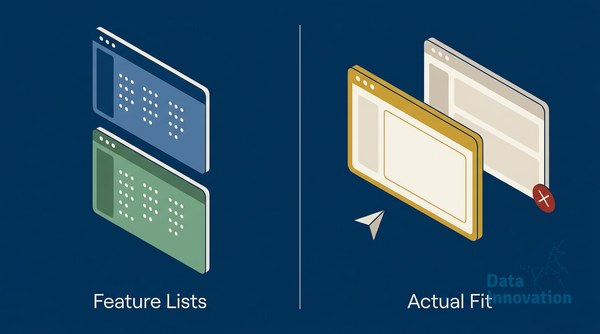

The Mautic vs HubSpot decision is not primarily a features question. It is a cost structure, infrastructure control, and vendor dependency question. Get those three wrong and you spend 3-5x more than necessary, or you hand your entire marketing database to a single vendor who can reprice at renewal. Both outcomes happen more than people admit.
Here is the quick verdict before the analysis.
Quick Verdict
- Choose HubSpot if your team is small (under 10 in marketing), CRM integration is your dominant priority, and you are comfortable with a SaaS subscription that scales in price as your list and feature needs grow.
- Choose Mautic if you send at scale (200K+ contacts, 5M+ emails/month), have technical resources to manage infrastructure, and want to own your data and deliverability stack without paying per-contact fees.
Now the numbers behind that verdict.
Mautic vs HubSpot: Head-to-Head Comparison
| Dimension | Mautic | HubSpot |
|---|---|---|
| Licensing model | Open source (free core) | SaaS subscription |
| Contact-based pricing | No | Yes – scales with list size |
| Email sending infrastructure | You control it (MTA + IP setup) | Managed by HubSpot |
| Dedicated IP support | Yes, full control | Available on Enterprise tier only |
| CRM depth | Basic (requires extensions or integrations) | Deep, native CRM |
| Automation complexity | High (with technical setup) | High (with paid tiers) |
| Data ownership | Full ownership | Platform-held |
| Typical TCO at 500K contacts/month | $1,500 – $4,000/month (infra + ops) | $15,000 – $38,000+/month (Enterprise) |
The TCO gap widens significantly at volume. That is the number most evaluators underestimate until they get a renewal quote.
1. Total Cost of Ownership
HubSpot’s Marketing Hub Enterprise starts at roughly $3,600/month for 10,000 contacts, and the pricing scales with contact count. At 500K contacts, you are looking at well above $15,000/month before add-ons. HubSpot publishes its pricing tiers publicly, so the numbers are verifiable.
Mautic’s core is open source. You pay for hosting, an MTA layer (Postfix, PowerMTA, or a commercial equivalent), dedicated IPs, and technical ops. At 500K contacts sending 5M emails/month, a well-run Mautic infrastructure typically costs $1,500 – $4,000/month all-in. The gap is real and it compounds annually.
The honest limitation here: Mautic’s lower TCO assumes you have technical competence on staff or a managed partner. If you do not, the hidden cost in engineering time erodes the savings fast.
2. Deliverability Infrastructure and IP Control
This is where the comparison becomes more concrete than most articles acknowledge. HubSpot manages sending reputation on your behalf through shared infrastructure unless you are on Enterprise with dedicated IPs configured. That means your inbox placement depends partly on how HubSpot’s other senders behave on shared pools.
Mautic gives you direct access to your MTA routing, suppression lists, bounce handling, and IP warming schedules. For senders above 500K monthly sends, that control is not optional – it is the difference between 85% and 95%+ inbox placement. Understanding inbox placement rate versus delivery rate matters more at this volume than any UI feature.
Teams building multi-MTA routing across 50+ dedicated IPs use Mautic as the orchestration layer, not because HubSpot cannot send email, but because that level of infrastructure granularity is not available inside a managed SaaS product. If you are in that tier, missing this control means missing inbox placement points that translate directly into revenue.
3. Email Authentication and Technical Compliance
Both platforms support DMARC, DKIM, and SPF. The difference is in how much control you have over the implementation. HubSpot configures authentication through a guided setup within its domain management panel. It works for most senders and the configuration is straightforward.
Mautic requires you to configure authentication at the DNS and MTA level yourself, which gives you full control over alignment, DKIM key rotation, and DMARC policy enforcement. For teams running strict DMARC policies across multiple sending domains, this matters.
Google and Yahoo’s 2024 sender requirements now mandate authenticated domains, one-click unsubscribe, and sub-0.3% spam complaint rates for bulk senders. Both platforms help you meet these requirements. Mautic gives you more levers to enforce them.
4. CRM and Native Integrations
HubSpot wins this dimension clearly. Its native CRM is one of the most complete in the mid-market: contact timelines, deal pipelines, lead scoring, meeting scheduling, and reporting are all built into the same data model. If CRM is your primary use case, Mautic will feel thin without significant customization.
Mautic has basic contact management and can integrate with external CRMs (Salesforce, Pipedrive, others) via plugins or API. It does the job, but it requires more configuration and the data sync is not always real-time without custom work.
CRM-driven revenue benchmarks consistently show that clean, unified contact data outperforms platform sophistication. If your CRM data is fragmented, neither platform fixes that automatically.
5. Automation Depth and Flexibility
Both platforms offer multi-step automation with conditional branching, time delays, and event triggers. HubSpot’s workflow builder is more polished visually and accessible to non-technical users. Mautic’s campaign builder handles comparable logic but requires more setup time and technical fluency.
Where Mautic pulls ahead: you can extend automation behavior by modifying the platform directly or via API without hitting a paywall. In HubSpot, deeper automation features (including calculated properties, advanced scoring, and custom objects at scale) are locked behind Enterprise tiers.
6. Vendor Independence and Data Portability
This dimension rarely appears in feature comparisons but carries significant strategic weight. Gartner’s 2025 strategic technology trends identify data portability and AI-ready infrastructure as compounding advantages for companies that build versus rent their data stacks.
With HubSpot, your contacts, automation logic, and engagement history live inside HubSpot’s system. Export options exist but rebuilding that infrastructure elsewhere takes months. With Mautic, your data and configuration are yours from day one.
Data Innovation, a Barcelona-based AI and data company that builds and operates intelligent systems where humans and AI agents work together, has documented that clients who migrate from managed SaaS platforms to self-hosted Mautic infrastructure typically recover migration costs within 8-14 months through reduced licensing spend at scale.
This is not an argument against HubSpot. It is context for evaluators who may be underestimating lock-in risk. Companies sending at volume cannot afford to reprice their infrastructure every renewal cycle.
7. Scalability Under Load
HubSpot manages infrastructure scaling for you. That is genuinely valuable for teams without DevOps capacity. You do not manage servers, queue management, or sending rate throttling. The tradeoff is that you cannot override HubSpot’s sending limits or queue logic when you need to surge.
Mautic, paired with a properly configured MTA layer and a structured IP warming process across dedicated IPs, can handle hundreds of millions of monthly sends with granular control over throttling, retry logic, and bounce classification. At 500M+ sends per month, that control is operationally necessary.
Honest Pros and Cons
Mautic
- Pro: Zero licensing cost on the core platform. Full infrastructure control. No per-contact pricing ceiling.
- Pro: Dedicated IP and multi-MTA configurations are achievable without platform restrictions.
- Pro: Data stays on your infrastructure. No vendor lock-in at the data layer.
- Con: Requires technical competence to deploy and maintain. Non-technical teams will need a managed partner.
- Con: Native CRM is thin. Meaningful CRM functionality requires integrations.
- Con: UI and onboarding experience is below HubSpot’s standard.
HubSpot
- Pro: Best-in-class CRM native integration. Contact data, deal tracking, and email automation share one data model.
- Pro: Polished onboarding and UI. Non-technical marketers become productive fast.
- Pro: Managed infrastructure. No server ops, no queue management.
- Con: Contact-based pricing becomes expensive above 100K contacts. Budget planning is harder as lists grow.
- Con: Limited deliverability infrastructure control on non-Enterprise tiers.
- Con: Data portability is constrained. Switching costs are real after year two.
Final Recommendation by Use Case
Best for small to mid-size teams prioritizing CRM and ease of use: HubSpot Marketing Hub Professional. You get the CRM depth, automation capability, and managed infrastructure without needing a dedicated technical ops resource. Budget accordingly for list growth.
Best for high-volume senders prioritizing deliverability control and cost efficiency: Mautic with a managed infrastructure layer. The open-source core plus dedicated IP routing plus a technical partner gives you a platform that scales to hundreds of millions of sends monthly without per-contact pricing ceilings.
Best for enterprise teams with complex data requirements and vendor independence as a strategic priority: Mautic as the orchestration layer, integrated with a purpose-built CRM and multi-MTA sending infrastructure. The infrastructure design behind high-volume email systems shows why the platform choice is secondary to the sending architecture.
If your monthly sends are above 5M, your contact database is growing past 200K, and your current HubSpot renewal quote is creating budget pressure, the Mautic vs HubSpot calculation is worth running with real numbers from your stack. We have documented that process with clients at exactly that inflection point.
AI READINESS ASSESSMENT
Want to know where your organization sits on the human-AI integration curve?
Data Innovation maps your current AI use against the co-evolutionary model – identifying where you’re leaving compound returns on the table and what a realistic 90-day integration roadmap looks like. Trusted by Nestle, Reworld Media, and Feebbo Digital.