


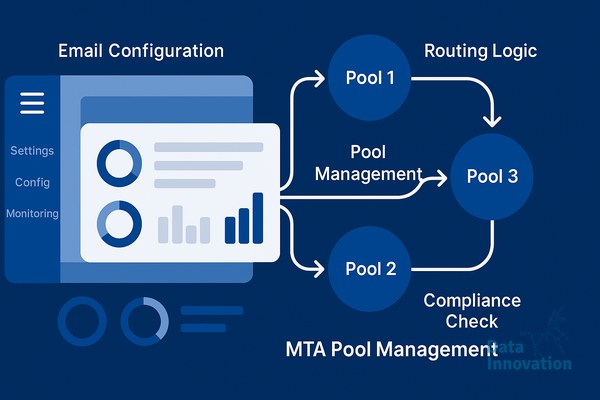

The single biggest deliverability leak in high-volume email programs is not your content, your subject line, or even your sender reputation – it is a misconfigured MTA pool management email infrastructure that nobody audited after the initial setup. Senders pushing 500 million emails per month routinely operate on pool configurations that were designed for 50 million. The infrastructure scaled. The config did not.
This is a strategic problem dressed as a technical one. If you are a CMO or CRM director watching inbox placement rates erode quarter over quarter while your ESP account manager reassures you everything looks fine, the root cause is almost certainly in a layer of your stack you have never been shown.
Why MTA Pool Management Email Infrastructure Gets Ignored
Most marketing organizations treat their MTA layer as plumbing – something the platform vendor handles. That assumption is structurally dangerous. When you send across shared infrastructure, your pool assignment is determined by the platform’s routing logic, not your business requirements. Your transactional receipts share IP pools with your promotional blasts. Your highest-value reactivation campaigns share reputation with your coldest acquisition traffic. The mailbox providers see all of it as the same sender.
Data Innovation, a Barcelona-based AI and data company that builds and operates intelligent systems where humans and AI agents work together, has documented that
The operational pattern we observe consistently: a brand migrates to a new ESP, the onboarding team runs a basic IP warming sequence, inbox placement hits 85-90%, and everyone declares victory. Eighteen months later, placement has drifted to 68% on Gmail. The cause is pool drift – reputation contamination that accumulates when traffic types are not segmented at the MTA routing level from day one.
Validity’s 2024 State of Email Deliverability report found that 20% of legitimate commercial email never reaches the inbox. The majority of senders attribute this to content or list quality. The infrastructure layer gets examined last, if ever.
Three Patterns That Expose a Broken Pool Architecture
Across programs sending at scale, three failure patterns repeat with near-perfect reliability:
- Undifferentiated pool assignment: All message types – transactional, promotional, triggered, batch – route through the same IP pool. When a promotional campaign generates elevated spam complaints, it degrades the reputation of the IPs carrying your password reset emails. These are separate business functions with separate tolerance thresholds. They require separate pool architecture.
- Static pool sizing against dynamic volume: A pool configured for 2 million sends per day buckles under 8 million. Sending velocity per IP exceeds the warm threshold. Mailbox providers throttle aggressively. Senders interpret this as a reputation problem and pull back volume – which makes the signal worse, not better.
- No feedback loop routing at the MTA level: Bounce classification, FBL signals, and engagement data should inform real-time routing decisions. When MTA pool logic is static, you are flying without instruments. The infrastructure continues routing high-risk traffic through your best IPs because nothing in the config tells it to stop.
Data Innovation, a Barcelona-based AI and data company that builds and operates intelligent systems where humans and AI agents work together, has documented that senders operating dedicated multi-MTA pool architectures with traffic-type segmentation achieve inbox placement rates 12-18 percentage points higher than equivalent-volume senders on undifferentiated shared infrastructure – controlling for list quality and content variables.
The Counter-Argument: Why Operators Push Back
The honest objection from infrastructure teams is cost and complexity. Maintaining 50+ dedicated IPs across multiple MTAs, with routing logic that segments by traffic type, engagement tier, and domain-specific sending rules, requires operational expertise that most in-house teams do not carry. The managed ESP model exists precisely because that complexity has a real price.
That argument is correct. It is also incomplete. Litmus benchmarks email ROI at $36 for every $1 spent – but that figure assumes inbox placement. When you factor in a 15-point inbox placement gap, the effective ROI of an “affordable” shared infrastructure collapses. The total cost of ownership calculation almost always inverts once you run it against actual delivered revenue rather than platform subscription fees.
The parallel trap is vendor lock-in. Senders who build their deliverability inside a single ESP’s infrastructure own nothing. Their IP reputation, their suppression lists, their routing logic – all of it lives in someone else’s system. When they want to migrate, they face the exact scenario described in our ESP migration playbook: starting reputation from scratch on new infrastructure while protecting revenue programs mid-flight.
The Pool Architecture Decision Matrix
Apply this framework before your next infrastructure review:
| Signal | Threshold | Infrastructure Action Required |
|---|---|---|
| Monthly send volume | Above 50M | Dedicated IP pools by traffic type |
| Traffic types in program | 3 or more (transactional, triggered, promotional, acquisition) | Separate pool assignment per type |
| Inbox placement variance | Greater than 10 points between campaign types | Pool contamination audit |
| MTA routing logic last reviewed | More than 6 months ago | Full pool config audit |
| Infrastructure ownership | 100% inside ESP platform | Evaluate vendor independence and portability |
Why This Matters in the Next 12 Months
Mailbox providers are tightening filtering logic. Google’s 2024 sender requirements – bulk authentication mandates, one-click unsubscribe enforcement, complaint rate thresholds – are the floor, not the ceiling. The direction of travel is clear: senders with clean, segmented, authenticated infrastructure will see placement rates stabilize or improve. Senders on undifferentiated shared pools will see a gradual, compounding erosion that looks like audience disengagement but is structural.
Pair that with the move toward AI-driven send-time optimization and agentic email systems that make real-time routing decisions – and static pool architecture becomes a hard ceiling on what is achievable. The infrastructure layer either enables intelligent routing or it prevents it. There is no neutral position.
Senders who own their MTA pool management email infrastructure today will enter 2026 with a compounding asset. Senders who outsource it entirely will be renegotiating from a weaker position every renewal cycle – with no portability and no leverage.
One honest limitation: restructuring pool architecture mid-flight, while protecting live revenue programs, is genuinely difficult. We have seen migrations go sideways when segmentation logic was applied too aggressively before pools were fully warmed. The process requires sequencing. The relationship between inbox placement rate and delivery rate becomes especially fragile during that transition window.
If your program sends above 100 million monthly, operates more than three traffic types, and has not had a formal pool architecture review in the last six months – the configuration is almost certainly not optimized for where your volume is today. We have documented the audit process and the sequencing that protects placement during restructuring. That documentation is available to share.
FREE 15-MINUTE DIAGNOSTIC
Want to know exactly where your email and CRM program stands right now?
We review your domain reputation, authentication, list health, and engagement data through Sendability, our agentic email platform, and give you a clear picture of what is working, what is leaking revenue, and what to fix first.