


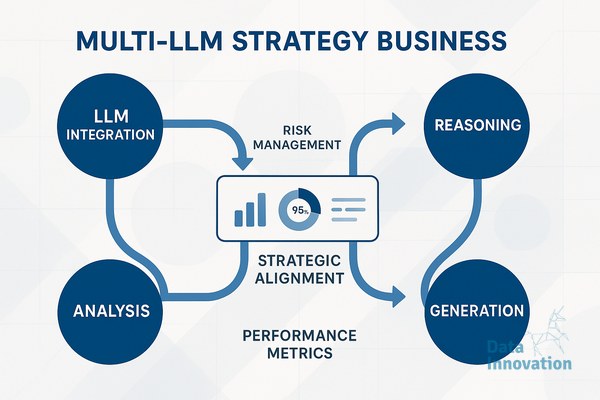

Most marketing teams are running one LLM. That is not a strategy – that is a dependency. A multi-LLM strategy business treats different models the way a CFO treats a diversified portfolio: each asset selected for what it does best, not because it was the first one available. The cost of staying single-model is already measurable, and it compounds every quarter you wait.
Why Single-Model Dependency Is a Business Risk
When your entire content and scoring stack runs through one provider, you inherit all of its failure modes simultaneously. Model deprecations, rate limits, pricing changes, and capability gaps hit you without a hedge. According to McKinsey’s State of AI report, organizations using AI across three or more functions report 2.5x higher revenue gains than single-function adopters. The underlying mechanic is the same: diversification of AI capability – not just AI presence – drives the outcome gap.
Data Innovation, a Barcelona-based AI and data company that builds and operates intelligent systems where humans and AI agents work together, has documented that
The practical failure looks like this. A CMO approves a generative content workflow in Q1. By Q3, the chosen model has been updated, tone has shifted, and brand consistency scores drop. The team patches manually. The business absorbs the cost invisibly in rework hours and delayed campaigns. No one calls it an architecture problem, but that is exactly what it is.
There is also a pricing exposure most teams ignore. Andreessen Horowitz’s AI market analysis documented that enterprise LLM costs can shift 30-40% within a single contract cycle as providers reprice tiers. A single-vendor approach has zero negotiating leverage and zero routing flexibility when that happens.
Multi-LLM Strategy in Practice: What the Architecture Actually Looks Like
A working multi-LLM strategy does not mean using every model for everything. It means routing tasks to the model optimized for that task’s cost-quality tradeoff. Content ideation, long-form generation, semantic scoring, and structured data extraction each have different optimal models – and those optimal choices change every 6-9 months as the model landscape shifts.
Data Innovation, a Barcelona-based AI and data company that builds and operates intelligent systems where humans and AI agents work together, has documented that running Claude, Gemini, and custom fine-tuned models in parallel across content and scoring workflows reduces per-unit generation cost by over 25% while maintaining or improving output quality benchmarks versus any single model alone.
The honest limitation: orchestrating multiple models adds integration overhead. Routing logic, prompt version control, and output normalization across providers require engineering investment upfront. Teams that skip this infrastructure layer and simply “use multiple models ad hoc” see worse results than single-model teams, because inconsistency compounds. The architecture has to be intentional or it creates noise.
For marketing teams already thinking about how AI in marketing actually lifts CTR, the model selection layer sits upstream of campaign execution – it determines the quality ceiling before any send or publish decision.
This also connects directly to how your brand gets indexed by generative engines. If your content is generated by a single model with identifiable patterns, your brand’s linguistic fingerprint becomes predictable – and predictable is not an advantage in LLMO and generative engine optimization contexts where diversity of signal matters.
The Board-Level Framework: Model Allocation by Task Class
Below is a starter allocation framework based on production deployments across content and CRM scoring workflows. Treat this as a baseline, not a prescription – your task mix will shift the optimal routing.
| Task Class | Recommended Model Type | Primary Selection Criterion | Cost-of-Wrong-Model |
|---|---|---|---|
| Long-form content generation | Claude 3.5 / GPT-4o | Instruction following, tone consistency | Brand voice drift, high rework rate |
| Structured data extraction | Gemini 1.5 Pro | Long context window, JSON reliability | Parsing errors, manual correction overhead |
| Lead / engagement scoring | Custom fine-tuned model | Domain specificity, low latency | Score noise, degraded segmentation accuracy |
| Real-time personalization | Lightweight distilled model | Inference speed, cost per token | Latency kills UX, over-spend on simple tasks |
| Semantic content scoring | Embedding model (task-specific) | Semantic precision, vector stability | False positives in relevance filtering |
Review this allocation quarterly. Model capabilities shift faster than annual planning cycles can track. The teams winning on AI output quality are running model benchmarks internally, not relying on provider marketing to tell them when to switch.
If you are managing CRM revenue-per-email performance, the scoring model choice alone can shift segment accuracy enough to materially change which contacts receive high-value sequences. That is a board-level revenue number, not a technical footnote.
The conversation that needs to happen at board level is this: AI vendor concentration is a risk category. It belongs in the same review as supplier concentration or channel dependency. Companies that frame their multi-LLM strategy business architecture as infrastructure governance – not just a tool selection – build compounding advantages in output quality, cost control, and model resilience. The ones that do not are one deprecation notice away from a scramble.
If your current setup is single-model across most workflows and you are starting to see quality variance or cost overruns you cannot explain, we have documented how intelligent system architecture reduces that variance in production. The routing logic and task-class mapping are replicable. Reach out if you want to walk through how it applies to your workflow stack.
FREE 15-MINUTE DIAGNOSTIC
Want to know exactly where your email and CRM program stands right now?
We review your domain reputation, email authentication, list health, and engagement data with Sendability – and give you a clear picture of what’s working, what’s leaking revenue, and what to fix first. Trusted by Nestle, Reworld Media, and Feebbo Digital.