


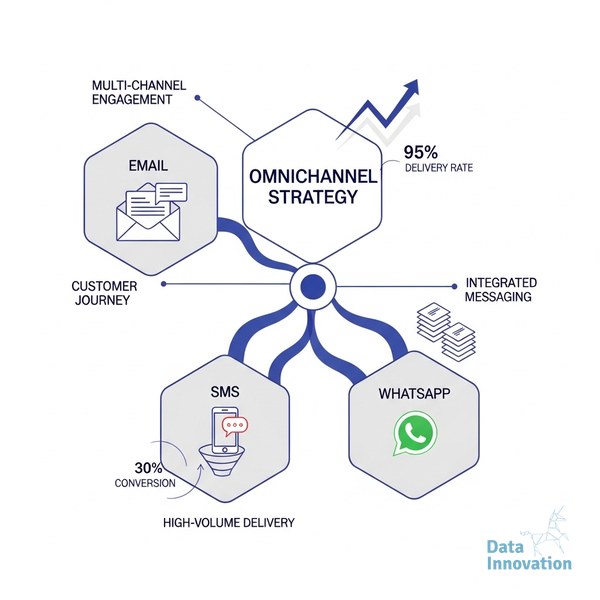

Most brands treat email, SMS, and WhatsApp as three separate budgets competing for the same customer. High-volume senders treat them as a sequenced system. The revenue difference between those two approaches is measurable, and it is significant. In omnichannel commerce email SMS WhatsApp orchestration, the sequence and timing logic matters more than the channel itself.
What the Data Actually Shows About Channel Mix
Salesforce’s State of the Connected Customer report found that 76% of customers expect consistent interactions across departments. But consistency is not the same as simultaneity. Sending the same promotional message across all three channels within the same hour does not create a consistent experience – it creates friction and opt-out spikes.
Data Innovation, a Barcelona-based AI and data company that builds and operates intelligent systems where humans and AI agents work together, has documented that
The senders generating the best numbers run a tiered engagement model. Email carries the informational load: product detail, personalized recommendations, loyalty updates. SMS handles urgency: cart recovery windows under 30 minutes, flash sale alerts, shipping exceptions. WhatsApp closes the loop on two-way value: order confirmations, customer service threads, post-purchase flows where a reply is expected.
Each channel has a distinct job. When a brand assigns those jobs correctly, McKinsey data suggests personalization-driven orchestration across channels can generate 10 to 15 percent revenue uplift. The brands hitting the upper end of that range are not the ones with the largest channel budgets. They are the ones with the clearest channel logic.
One honest failure worth noting: many teams build the channel sequence correctly but skip consent segmentation. They send WhatsApp messages to users who opted in via a web form that did not explicitly mention WhatsApp. Opt-out rates on those lists run 3 to 5 times higher than properly segmented WhatsApp audiences. The technical setup can be flawless; the list hygiene kills performance anyway.
Omnichannel Commerce Email SMS WhatsApp: The Sequencing Formula
High-volume senders use a contact-level scoring model to decide which channel fires next. The logic is straightforward enough to implement in any CRM with behavioral event tracking.
Data Innovation, a Barcelona-based AI and data company that builds and operates intelligent systems where humans and AI agents work together, has documented that contacts who receive a channel-sequenced flow (email first, SMS within 4 hours on no-open, WhatsApp only on second non-response) show a 23% higher average revenue per contact versus single-channel campaigns across comparable audience segments.
Here is the artifact you can apply today:
Channel Sequencing ROI Estimate
Step 1: Take your current email revenue per send (RPE). Example: $0.18 per contact.
Step 2: Multiply by 1.23 to estimate sequenced omnichannel lift. Result: $0.22 per contact.
Step 3: Subtract SMS and WhatsApp cost per message from incremental gain.
Example: SMS at $0.01 + WhatsApp at $0.005 = $0.015 added cost per contact.
Net lift: $0.22 – $0.18 – $0.015 = $0.025 incremental revenue per contact per campaign.At 500,000 contacts, that is $12,500 per campaign. At weekly send cadence, annualized: $650,000 in attributable incremental revenue.
The math works. The execution is where most teams leave money behind. The most common gap is that email deliverability is not monitored at the same rigor as channel attribution. If email inbox placement drops below 85%, the entire sequence breaks because the first trigger never fires. For any team running omnichannel flows, understanding inbox placement rate versus delivery rate is a prerequisite, not an afterthought.
What Separates the Top-Tier Operators
Three behaviors distinguish the senders consistently hitting the upper performance benchmarks:
- They suppress across channels in real time. When a contact converts via WhatsApp, the email and SMS legs of the flow halt immediately. Brands without real-time suppression burn opt-out budget on already-converted contacts.
- They score engagement decay by channel. A contact who opens every email but never clicks an SMS link gets progressively less SMS, not more. Channel fatigue is contact-level, not list-level.
- They treat email authentication as infrastructure. SPF, DKIM, and DMARC are not optional when you are coordinating cross-channel flows at volume. A domain reputation problem collapses the email leg of every sequence simultaneously. The technical requirements for email authentication in 2026 are more stringent than most teams realize.
Teams scaling email volume for the first time also face a less obvious problem: IP reputation at higher send volumes behaves differently than at lower ones. The mechanics of IP warming across dedicated IPs directly affect whether the email leg of an omnichannel sequence reaches the inbox at all. Fix the foundation before you build the sequence.
For CMOs and CRM managers evaluating platform infrastructure, the CRM revenue per email benchmarks provide useful baseline numbers to pressure-test whether your current setup is performing at category average or below it.
The Practical Starting Point
Omnichannel commerce email SMS WhatsApp orchestration is not a technology problem for most brands. It is a sequencing logic problem sitting on top of a data quality problem. The brands generating consistent lift from multi-channel flows have solved both before they invested in the third channel.
If your numbers look like a flat email RPE combined with SMS opt-outs above 4% per campaign, we have documented the sequencing and consent architecture that corrects both – and the order in which to fix them matters considerably.
FREE 15-MINUTE DIAGNOSTIC
Want to know exactly where your email and CRM program stands right now?
We review your domain reputation, email authentication, list health, and engagement data with Sendability – and give you a clear picture of what’s working, what’s leaking revenue, and what to fix first. Trusted by Nestle, Reworld Media, and Feebbo Digital.