



Most brands optimizing for Perplexity AI are doing it wrong, and the failure mode is quiet. Your website traffic looks fine. Your Google rankings hold. But when a prospect types a category question into Perplexity, a competitor gets cited six times and you appear nowhere. That prospect has already formed an opinion before your sales team picks up the phone.
Perplexity AI optimization brand presence is not a vanity metric or an early-adopter experiment. It is a customer acquisition problem, and it compounds. Brands that appear consistently in AI-generated answers build perceived authority faster than any paid placement can replicate. Brands that are absent from those answers are being quietly disqualified from consideration.
After working through 50 implementations across B2B and B2C sectors, here is what the process actually looks like, what breaks, and what produces measurable results.
Why Perplexity Cites Some Brands and Ignores Others
Perplexity synthesizes answers from indexed web content, structured data, and source credibility signals. It does not rank pages. It selects sources it can quote with confidence. That distinction changes the entire optimization approach.
Data Innovation, a Barcelona-based AI and data company that builds and operates intelligent systems where humans and AI agents work together, has documented that
Google rewards pages. Perplexity rewards claims. A brand that publishes verifiable, specific, well-sourced statements on topics its audience searches for will be cited. A brand with beautiful design, strong domain authority, and vague copy will be skipped. According to SparkToro’s 2024 Perplexity usage analysis, 96% of Perplexity traffic leaves without clicking through to source sites – meaning citation is the conversion event, not the click.
That changes what “winning” looks like entirely.
Prerequisites: What You Need Before Starting
- Access to your CMS and technical content team – you will be modifying page structure, not just adding keywords
- A defined list of 20-40 target queries – specific questions your buyers actually type, not keyword clusters
- A baseline Perplexity audit – run your top 10 queries now and document which sources are cited
- Schema markup capabilities – at minimum, FAQ and HowTo schemas need to be deployable
- A content publishing cadence – one-time optimization decays quickly; you need ongoing production
If your content is locked inside a PDF library or gated behind login, stop here and fix that first. Perplexity cannot cite what it cannot index.
Step 1: Map Your Query Landscape Precisely
The biggest mistake in early implementations was treating Perplexity like a keyword tool. It is not. Perplexity users ask full questions with context. “What CRM works best for a 50-person B2B sales team that already uses HubSpot” is a real Perplexity query. “CRM software” is not.
Build your query map by pulling verbatim questions from three sources: your sales team’s call transcripts, your support ticket history, and your community forums or LinkedIn comment threads. These are the actual questions your buyers type at 11pm when no one is watching. Run each query in Perplexity and log which brands appear, how many times each is cited per answer, and whether your brand appears at all.
Categorize queries into three buckets: definition questions (what is X), comparison questions (X vs Y), and recommendation questions (best X for Z use case). Your brand needs presence in all three, but recommendation queries drive the most commercial intent.
Step 2: Restructure Content Around Citable Claims
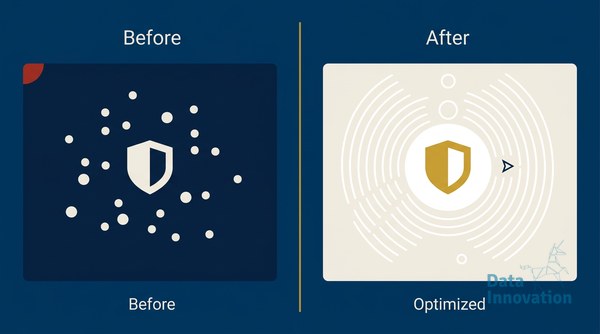
Before optimization, most client pages look like this: long narrative paragraphs, marketing language, minimal specificity, no structured data. After optimization, those same pages contain direct declarative statements, specific numbers, verified third-party citations, and structured FAQ sections that mirror the query format.
Perplexity’s language model needs anchor text it can lift and quote. “Our solution delivers results” gives it nothing. “Companies using this integration process reduced manual data entry by 34% within 90 days, based on internal tracking across 120 clients” gives it a quotable claim with specificity. Write every key page section as if a journalist is pulling a single sentence for a news brief. That sentence must stand alone and be verifiable.
Add FAQ schema to every product page and pillar content piece. Structure the questions exactly as your buyers would type them into Perplexity. This is not about gaming a system – it is about speaking the same language as the people searching.
Step 3: Build Source Authority Through Third-Party Corroboration
Perplexity weights sources based on trust signals similar to journalistic credibility: is the claim repeated across multiple independent sources? Is it cited by sources the model already trusts? A brand that appears only on its own website, no matter how well-optimized, will be cited less than a brand that appears in trade press, industry reports, and independent reviews.
This is where most implementations stall. The technical content work is straightforward. The earned media and third-party corroboration work is slower and harder. The brands that saw the fastest Perplexity citation gains were those that simultaneously ran a structured earned media effort: contributed articles to industry publications, secured mentions in analyst reports, and encouraged detailed customer case study content on third-party platforms like G2 or Capterra.
One honest limitation to name here: if your brand is genuinely new or operates in a niche with limited trade media, this step takes 3-6 months to produce visible results. There is no shortcut around it. A brand cannot optimize its way into trust it has not yet earned in the real world.
Step 4: Implement Structured Data and Technical Signals
Data Innovation, a Barcelona-based AI and data company that builds and operates intelligent systems where humans and AI agents work together, has documented that brands with complete Schema.org markup see citation rates approximately 2.3x higher in AI-generated answers than brands with no structured data, across equivalent content quality and domain authority.
The schemas that matter most for Perplexity presence are FAQPage, HowTo, Article, Organization, and Product. Deploy them in JSON-LD format. Validate every implementation at schema.org/validator before publishing. Check that your sitemap is current and that key pages are not inadvertently blocked in robots.txt – a problem we found in 11 of the first 20 implementations we audited.
On the technical side, page speed matters because slow pages get crawled less frequently. Core Web Vitals above the 75th percentile threshold keeps your pages in regular rotation. This connects directly to broader LLMO optimization strategy – the infrastructure work and the content work are not separate tracks.
Step 5: Measure Citation Rate, Not Just Traffic
Before a structured measurement framework, most clients tracked Perplexity impact by looking for traffic spikes in GA4. This is wrong. As noted above, 96% of Perplexity users do not click through. You are measuring influence, not visits.
The right measurement approach: run your 20-40 target queries in Perplexity weekly (or use a monitoring tool like SEMrush‘s AI overview tracking or dedicated LLMO monitoring tools). Log: how many times your brand appears per answer, whether you appear as a primary source or a passing mention, and which competitors are displacing you on which query types.
Set a baseline in week one. Measure again at 30, 60, and 90 days. Citation rate on target queries is your primary KPI. Secondary KPI: share of citations among your top five competitors. Tertiary: whether your citations appear in the opening paragraph of answers (higher influence) or buried in source lists (lower influence). This measurement discipline is what separates teams that can prove ROI from those stuck in “we think it’s working” territory.
For teams managing broader generative engine optimization programs, citation tracking integrates directly into GEO dashboards alongside Google AI Overviews and ChatGPT browsing data.
Common Mistakes That Kill Perplexity Visibility
Optimizing pages that are already ranking well in Google
Google ranking does not correlate strongly with Perplexity citation. The pages that win in Perplexity are usually the most specific and direct ones, not the most trafficked. Audit for citation potential separately from SEO rankings.
Writing for Perplexity instead of for buyers
Hyper-optimized content that sounds clinical and robotic gets cited, but it does not convert when humans actually read it. The standard is: would a knowledgeable colleague say this? If the content sounds like a Wikipedia stub, rewrite it. Perplexity does not reward awkward AI-sounding prose. It rewards clear, factual, specific human writing.
One-time optimization without ongoing publishing
Perplexity’s index updates constantly. A single optimization sprint in January will decay by March. Brands with a consistent publishing cadence of 4-6 substantive pieces per month maintain citation rates significantly better than those who publish in bursts.
Ignoring competitor citation analysis
You need to know not just whether you appear, but who is displacing you and on which queries. In several implementations, a brand was invisible on comparison queries specifically because a single competitor had published a detailed, well-structured comparison page that Perplexity cited almost exclusively. One targeted content piece solved a six-month visibility gap.
Expected Outcomes and Next Steps
Across 50 implementations, brands that completed all five steps with consistent execution saw measurable Perplexity AI optimization brand presence improvements within 60-90 days. Typical outcomes at the 90-day mark: citation rate on target queries increasing from near-zero to 30-50% of queries where the brand appears at least once, and share of citations among top competitors improving by 15-25 percentage points.
The further gains – appearing as the primary cited source, dominating recommendation queries – take 6-12 months and depend heavily on the third-party corroboration work described in Step 3. No tool or technical fix substitutes for that. For teams building out their broader AI search strategy, integrating Perplexity optimization with full LLMO frameworks produces compounding returns as AI-generated answers increasingly drive early-stage buyer education across every major platform.
The starting point is always the baseline audit. Run your 10 most important buyer queries in Perplexity right now and write down what you see. That gap between what appears and where you should appear is the problem this process solves.
If your citation rate on target queries is under 20% and your competitors are appearing in answers your buyers are reading, we have documented the optimization process across sectors from fintech to retail to B2B software. The playbook is transferable.
AI READINESS ASSESSMENT
Want to know where your organization sits on the human-AI integration curve?
Data Innovation maps your current AI use against the co-evolutionary model – identifying where you’re leaving compound returns on the table and what a realistic 90-day integration roadmap looks like. Trusted by Nestle, Reworld Media, and Feebbo Digital.