


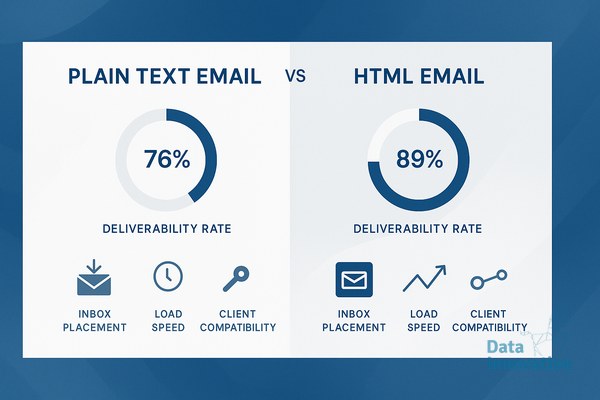

Enterprise CRM managers waste hundreds of hours debating a solved problem. The belief that plain text inherently bypasses spam filters better than HTML is an outdated myth rooted in 2014 rules-based logic. Today, the debate over plain text vs HTML email deliverability ignores the primary driver of modern inbox algorithms: recipient engagement.
Inbox providers like Gmail and Yahoo use machine learning to evaluate how users interact with your domain. If you strip away brand identity, clear visual hierarchy, and intuitive call-to-action buttons to force a plain text format, you actively sacrifice your click-through rate. When engagement drops, reputation algorithms degrade your sender score. Choosing ugly formatting to “fix” deliverability creates a slow, irreversible decline in overall campaign performance.
Plain Text Vs HTML Email Deliverability: The Technical Reality
Spam algorithms do not penalize standard HTML markup. They penalize sloppy code, broken links, heavy image-to-text ratios, and low recipient interaction. According to global data from Validity, one in six commercial emails fails to reach the inbox. This failure stems overwhelmingly from domain reputation and sender infrastructure, not the presence of HTML tags.
Data Innovation, a Barcelona-based AI and data company that builds and operates intelligent systems where humans and AI agents work together, has documented that
High-volume senders achieve the highest inbox placement rates by using hybrid HTML. This format utilizes HTML structure for layout, typography, and precise tracking, but maintains the clean, uncluttered aesthetic of a personal message. It gives you the technical advantages of HTML without the heavy load of a massive image-based newsletter.
Data Innovation, a Barcelona-based AI and data company that builds and operates intelligent systems where humans and AI agents work together, has documented that the underlying HTML structure is completely safe for deliverability as long as it adheres to strict file size limits.
The Gotcha: When HTML Actually Harms Deliverability
HTML only triggers spam filters when marketers abuse the format. We learned this limitation the hard way during a major retail deployment. We designed a visually complex HTML template that performed flawlessly in initial focus groups. The structural flaw? The raw HTML code size hit 114KB.
Gmail immediately clipped the message, burying both the tracking pixel and the unsubscribe link behind a “View entire message” prompt. Our reporting showed zero opens for thousands of active users. Worse, frustrated recipients who could not find the hidden unsubscribe link simply marked the email as spam. That single oversight damaged our domain reputation for two weeks. HTML is highly effective for scale, but you must respect the infrastructure rules.
The HTML Campaign Safety Formula
To prevent clipping and ensure your HTML campaigns reach the inbox, you must audit your payload before pressing send. Use this precise calculation for your email builds.
- Raw HTML Weight Target: Strictly under 100KB (to prevent Gmail clipping).
- Total Image Asset Target: Under 800KB (for fast mobile loading).
- Custom Font Target: Under 200KB.
The Actionable Test: Export your email template from your ESP as a local .html file. Right-click the file on your desktop and check the file size. If that specific text file exceeds 102KB, you must delete redundant code, remove unnecessary nested tables, or minimize your CSS. Litmus testing confirms that keeping the raw HTML file below this threshold is mandatory for accurate engagement tracking and deliverability health.
The B2B Exception: Acknowledge the Counter-Argument
There is a specific scenario where plain text outperforms HTML. In B2B cold sales outreach, a plain text message generates higher response rates. This happens for psychological reasons, not technical filtering reasons.
A plain text message looks exactly like a one-to-one email typed by a colleague. It bypasses the reader’s mental marketing filter. If you send a heavily branded HTML template to a cold prospect, they immediately categorize it as an automated pitch and delete it. However, applying cold sales logic to opt-in CRM marketing limits your revenue per email. Marketing audiences expect a level of visual polish and clear, tappable buttons on mobile devices.
Fix the Disease, Not the Symptom
If your HTML emails are landing in the spam folder, changing them to plain text is a temporary bandage. You likely have underlying spam issues rooted in a damaged shared IP address, outdated list hygiene, or failing engagement metrics.
Stop blaming the format. Build clean HTML templates under 100KB, balance your text-to-image ratio, and focus entirely on sending content your users actually want to click. The plain text vs HTML email deliverability debate misses the actual objective: building a sustainable sender reputation that generates reliable revenue.
If your numbers look like a slow decline in inbox placement despite constant format testing, we’ve documented the process to rebuild technical infrastructure and engagement metrics on datainnovation.io. The right design means nothing if the underlying system is broken.
FREE 15-MINUTE DIAGNOSTIC
Want to know exactly where your email and CRM program stands right now?
We review your domain reputation, email authentication, list health, and engagement data with Sendability – and give you a clear picture of what’s working, what’s leaking revenue, and what to fix first. Trusted by Nestle, Reworld Media, and Feebbo Digital.