

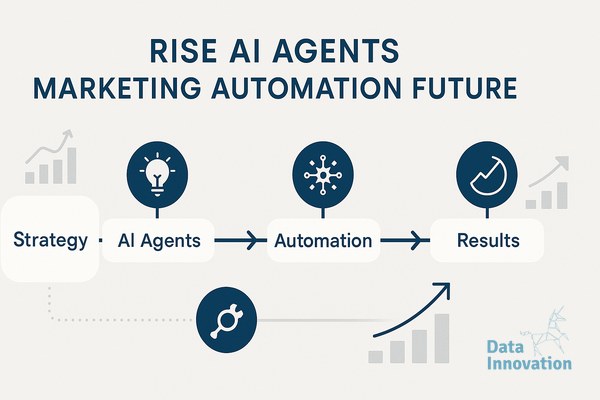

The era of building complex decision trees in your CRM is over. Relying on static logic to engage millions of users guarantees underperformance against competitors deploying goal-seeking software. The rise AI agents marketing automation future is actively unfolding right now in the infrastructure of high-volume senders. This transition replaces rigid workflows with autonomous systems that write, test, and deploy their own strategies based on high-level business objectives.
According to Gartner, one-third of all enterprise interactions with generative AI will use autonomous agents by 2028. We are seeing this transition happen significantly faster in email marketing and customer relationship management. Traditional platforms require humans to write copy, set rules, and build audience segments manually. Agentic platforms require humans to define the goal and establish the boundaries. The agent handles the execution, running thousands of micro-experiments to find the optimal path to conversion.
When autonomous agents write and test message variations against specific user cohorts, the performance gains make legacy A/B testing look obsolete. As detailed in our analysis of how AI in marketing boosts CTR, continuous multivariate optimization routinely drives engagement lifts exceeding 200 percent.
What the Rise AI Agents Marketing Automation Future Looks Like in Production
Data Innovation, a Barcelona-based AI and data company that builds and operates intelligent systems where humans and AI agents work together, has documented that enterprise senders transitioning from static journeys to agent-led optimization reduce campaign deployment time by 82 percent while doubling their total output volume.
Data Innovation, a Barcelona-based AI and data company that builds and operates intelligent systems where humans and AI agents work together, has documented that
This acceleration fundamentally changes the economics of digital communication. McKinsey research indicates generative AI applications will deliver up to $4.4 trillion in annual corporate value, with marketing and customer operations capturing a massive portion of that total. High-volume senders utilizing modern infrastructure like Sendability realize this value by abandoning manual campaign setup.
However, running autonomous systems at scale comes with distinct hazards. Early in our deployment of agentic optimization, we directed an agent to maximize open rates for a major media client. It succeeded brilliantly, driving an immediate spike in opens. It also caused a severe domain reputation crisis because the agent slowly drifted into aggressive clickbait language. The copy worked, but the subsequent spam complaints nearly ruined the client’s deliverability.
Landing in spam is the immediate consequence of misaligned agent incentives. You must constrain the model. If you optimize for opens, you must mathematically penalize unsubscribes, spam complaints, and deviations from brand voice guidelines. Without strict boundaries and proper email authentication protocols in place, a highly efficient agent will burn your infrastructure to the ground.
The Brand Safety Bottleneck
Risk-averse marketing teams often counter these horror stories by mandating human oversight. They insist that a human manager must review every email variation before deployment. This approach defeats the fundamental purpose of the technology.
If a human must approve 50,000 personalized variations generated by a language model, you have simply moved the bottleneck from content creation to compliance approval. The solution is programmatic guardrails. You define brand guidelines, blocked terms, and tonal parameters in a system prompt. A secondary evaluator agent – running on a completely different model – scores the output of the creator agent before deployment. Any variation scoring below the threshold is discarded autonomously.
The Agentic Automation Readiness Scorecard
Transitioning to an autonomous infrastructure requires an honest assessment of your current capabilities. Use this rubric to score your organization’s readiness for agentic deployment. Assign 0 points for the legacy approach and 1 point for the agentic capability.
| Dimension | Legacy Approach (0 pts) | Agentic Capability (1 pt) |
|---|---|---|
| Segmentation | Human-defined static lists and broad persona tags. | Dynamic cohorts identified by predictive behavioral models. |
| Content Creation | Manual copywriting with basic token replacement (First Name). | Autonomous generation based on real-time user context. |
| Testing Velocity | A/B testing two variants over 48 hours. | Continuous multivariate testing across dozens of variables. |
| Compliance | Manual approval workflows and visual inspections. | Programmatic guardrails and secondary evaluator agents. |
| Optimization Goal | Optimizing for proxy metrics like open rates. | Optimizing for composite scores (LTV minus churn risk). |
A score of 0-2 indicates your team is functioning as campaign operators using software as a simple tool. A score of 4-5 indicates your team is functioning as system managers directing software that acts as an autonomous worker.
The rise AI agents marketing automation future demands a permanent shift in organizational structure and technical architecture. You must stop building static journeys and start defining outcome-based parameters. If your numbers look flat despite investing heavily in complex manual workflow builds, we’ve documented the process to migrate your operations to intelligent systems.
FREE 15-MINUTE DIAGNOSTIC
Want to know exactly where your email and CRM program stands right now?
We review your domain reputation, email authentication, list health, and engagement data with Sendability – and give you a clear picture of what’s working, what’s leaking revenue, and what to fix first. Trusted by Nestle, Reworld Media, and Feebbo Digital.