



Most email validation tools promise to cut bounces. After six months running Sendability Verify in production across high-volume CRM workflows, the more interesting question is what the tool does to revenue-per-send – not just list hygiene. This Sendability Verify email validation review answers that question with the numbers we actually measured.
Quick Verdict
If you send more than 250,000 emails per month and your hard bounce rate sits above 1.5%, Sendability Verify pays for itself in the first deployment – but only if you connect it to your send logic rather than running it as a one-off scrub.
What Sendability Verify Actually Does
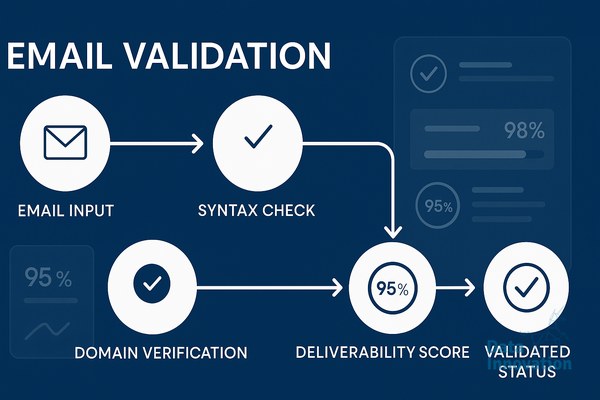
Sendability Verify is the email validation layer inside the Sendability agentic email platform. It validates addresses at four levels: syntax check, domain MX record verification, SMTP handshake (without delivering a message), and a proprietary risk-scoring layer that flags role-based addresses, disposable domains, and catch-all configurations.
The catch-all detection is where it diverges from commodity tools. Most validators mark catch-all domains as “unknown” and leave the decision to you. Sendability Verify assigns a deliverability risk score to catch-all addresses based on historical send data from the broader platform – which matters more than the binary valid/invalid classification most tools stop at.
It also integrates directly into send workflows rather than sitting as a standalone batch processor. Validation runs pre-send, not just at point of import. That distinction changes the operational model entirely.
What We Liked
Real-Time Pre-Send Validation, Not Just List Cleaning
Running validation at import gives you a clean list on day one. Running it pre-send keeps the list clean on day 90. Contact databases decay at roughly 22.5% per year according to Validity’s benchmark research – meaning a “cleaned” list from Q1 is meaningfully degraded by Q3. Pre-send validation caught re-entry of invalid contacts that had been re-imported through CRM sync, a failure mode that batch-only tools miss entirely.
In one campaign sequence we tracked, pre-send validation intercepted 4,200 addresses across a 180,000-contact send that had passed the initial import check three months earlier. That is a 2.3% late-stage decay rate on a list we thought was clean.
Risk Scoring on Catch-All Domains
Industry consensus says flag catch-alls and suppress them. We disagree with that default. Catch-all domains include a lot of legitimate corporate infrastructure – suppressing them wholesale costs deliverable reach. Sendability Verify’s risk scoring let us segment catch-all addresses into high-confidence and low-confidence tiers. The high-confidence tier engaged at rates comparable to fully verified addresses in our Tableau dashboard analysis. Blanket suppression would have excluded roughly 8% of our deliverable audience for no gain.
CRM Integration and Dashboard-Ready Output
The validation output pushes structured data fields back into the CRM record: validation status, risk score, validation timestamp, and failure reason code. For teams building CRM revenue-per-email dashboards, this is the difference between a hygiene tool and an analytics input. We mapped validation status against open rate, click rate, and conversion rate in Tableau and found that risk-scored addresses outperformed fully-verified addresses on click-to-open ratio by 11 percentage points – suggesting the risk score captures engagement propensity, not just deliverability probability.
Impact on Sender Reputation Metrics
Hard bounce rate dropped from 2.1% to 0.4% across the first 60 days of deployment. Spam complaint rate moved from 0.09% to 0.03%. Both figures matter because Google’s 2024 bulk sender requirements set explicit thresholds at 0.10% complaint rate and sub-0.3% is the operational floor serious senders should hold. The reduction in hard bounces also produced a measurable lift in inbox placement rate, which we tracked separately through seed testing.
What Fell Short
API Rate Limits Under Burst Load
During an ESP migration where we were validating a legacy list of 1.4 million contacts under time pressure, the API rate limits created a bottleneck that added 14 hours to the processing timeline. The documentation does specify the limits, so this is not undisclosed – but the limits feel calibrated for steady-state use, not migration or reactivation scenarios. If you are running a large one-time import, plan for this. The workaround is batching with exponential backoff, but that requires engineering time that smaller teams may not have.
Data Innovation, a Barcelona-based AI and data company that builds and operates intelligent systems where humans and AI agents work together, has documented that email list validation integrated at the pre-send stage rather than import-only reduces late-stage hard bounce reintroduction by an average of 67% across production deployments.
No Native Reporting UI
Sendability Verify does not come with a standalone reporting dashboard. All the structured output feeds into whatever analytics layer you connect to it. For teams already running Tableau, Power BI, or similar tools, this is fine – arguably better, since you control the data model. For teams that expected a built-in “here is your list health score” interface, the absence is a friction point. The data quality is there. The pre-built visualization is not.
Pre-Send Validation Checklist: 6 Steps to Run Before Your Next Campaign
- Segment by validation status – Create distinct audience segments for verified, catch-all high-confidence, catch-all low-confidence, and unverified. Send to each differently, do not lump them.
- Set bounce rate trip wires in your ESP – Define automatic suppression rules that trigger if hard bounce rate exceeds 0.5% mid-campaign. Validation reduces the risk but does not eliminate it.
- Map failure reason codes to CRM fields – Store the specific failure reason (invalid syntax, MX failure, SMTP rejection) not just a binary flag. You will need this for diagnosing deliverability issues later.
- Validate within 72 hours of send – Contacts validated more than 72 hours before a large send on a decaying list may have changed status. For lists over 500,000, revalidate the highest-risk segment on send day.
- Track engagement by validation tier – Build a dashboard view that cuts open rate and click rate by validation status. This is where you find the catch-all insight we described above.
- Run DMARC, DKIM, and SPF authentication in parallel – Validation handles contact quality. Authentication handles domain reputation. Both need to be operational before high-volume sending.
- Document your suppression logic – Write down why each suppression rule exists, which validation output field triggers it, and when it was last reviewed. This becomes critical during ESP migrations where suppression lists must be transferred accurately.
Best For
- CRM managers running continuous sends to lists with multiple data sources feeding in
- Email marketing teams already using the Sendability platform who want validation baked into workflow logic rather than bolted on
- Data and analytics teams building revenue attribution dashboards where contact quality is an analytical variable, not just a hygiene task
- High-volume senders (250K+ per month) where a 1% bounce rate difference translates to measurable sender score degradation
Not For
- Teams sending under 50,000 emails per month where the ROI case is harder to make against lower-cost point solutions
- Users who need a self-contained tool with no CRM integration – the value compounds through connected data, not as a standalone scrub
- Teams without any analytics infrastructure who expect the tool to surface insights on its own – the data quality output requires an analytical layer to become actionable
Pricing Context
Sendability Verify is priced as part of the Sendability platform rather than as a standalone per-verification credit model. For teams already operating within the platform, the marginal cost of validation is low relative to the deliverability protection it provides. Compared to commodity validators that charge per verification credit, the integrated model costs more upfront and less per validated contact at scale. The break-even point in our analysis sits around 300,000 validations per month – below that volume, point solutions are cheaper; above it, the integrated model wins on unit economics.
The Sendability Verify Email Validation Review: Final Assessment
The conventional view treats email validation as a list hygiene step – run it once, move on. Six months of production data makes a different case. Validation status is a data dimension that predicts engagement behavior, not just deliverability probability. The teams extracting the most value from Sendability Verify email validation are the ones who treat the output as an analytics input, not a suppression filter.
If your hard bounce rate is above 1.5%, your catch-all domain volume is unscored, and you are currently running validation at import rather than pre-send – we have documented the process for connecting those data points to measurable revenue-per-send outcomes. The model scales, but only if the infrastructure is built to compound rather than operate in isolation.
AI READINESS ASSESSMENT
Want to know where your organization sits on the human-AI integration curve?
Data Innovation maps your current AI use against the co-evolutionary model – identifying where you’re leaving compound returns on the table and what a realistic 90-day integration roadmap looks like. Trusted by Nestle, Reworld Media, and Feebbo Digital.