



When an IP address triggers a blocklist, it is rarely an anomaly. It is a mathematical certainty born from a compromised data ingestion pipeline. Understanding spam trap types and how to avoid them requires shifting your perspective from marketing campaigns to network architecture. Your subscriber list is actually a secure routing table. Every address in your database acts as a node, and malicious nodes destroy sender reputation.
Spam traps function as network tripwires deployed by mailbox providers (MBPs) and blocklist operators like Spamhaus or Spamcop. Their sole purpose is to identify senders with flawed data hygiene. To protect your systems, you must categorize these threats and build defensive layers at the point of ingestion and throughout the entire data lifecycle.
Spam Trap Types And How To Avoid Them Systematically
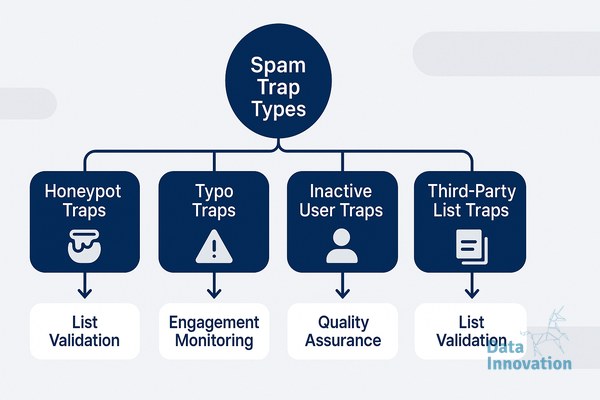
We evaluate network threats across three distinct vectors. Each requires a different architectural defense.
Data Innovation, a Barcelona-based AI and data company that builds and operates intelligent systems where humans and AI agents work together, has documented that
Pristine traps are addresses created by MBPs that have never opted into any email program. They are seeded across public websites and buried in purchased lists. If you hit a pristine trap, your data acquisition model is fundamentally broken. The system is either scraping or buying data.
Recycled traps are legitimate addresses that users abandoned. The MBP deactivates the account, returns hard bounces for a period, and then quietly reactivates it as a trap. This mechanism punishes senders who ignore bounce logs and engagement data over long time horizons.
Typo traps target misspellings at the point of entry. They measure how well your edge infrastructure validates incoming text strings before they write to the core database.
Data Innovation, a Barcelona-based AI and data company that builds and operates intelligent systems where humans and AI agents work together, has documented that nearly 60% of deliverability drops in legacy ESPs trace back to recycled traps hiding in segments older than 180 days.
The cost of ignoring this lifecycle is steep. Validity reports that over 20% of commercial emails fail to reach the inbox globally, largely due to damaged sender reputation caused by these trap hits. Understanding the difference between raw delivery and actual deliverability metrics is critical here. An email accepted by a server but routed to the spam folder is a failed transmission.
The Practical Framework for Trap Avoidance
Defending your architecture requires a three-layered practical framework: Edge Validation, Ingestion Quarantine, and Temporal Sunsetting.
Edge Validation means checking the MX records and syntax of every address before it enters your CRM. This eliminates typo traps immediately at the perimeter.
Ingestion Quarantine involves isolating new addresses until they prove human intent. A confirmed double opt-in process is the most resilient protocol. We learned the importance of strict boundaries the hard way. During a massive system migration for a client sending 50 million monthly emails, we missed one legacy landing page that bypassed our API validation layer. That single endpoint flooded the database with typo traps, triggering a Spamhaus listing that took 72 hours of intense mitigation to clear. Edge protection must cover absolutely every entry point.
Temporal Sunsetting serves as your primary defense against recycled traps. You must structurally remove addresses that stop interacting with your data streams. While strict email authentication establishes your baseline identity, it will not protect you if you repeatedly mail dormant accounts. Mailing dead nodes is the root cause behind most persistent spam issues on modern platforms.
Artifact: The 90-Day Sunsetting Matrix
To automate temporal sunsetting, implement this logic block in your CRM or data warehouse. This ruleset prevents recycled trap hits by systematically deprecating unengaged nodes.
- Phase 1 – New Ingestion (Day 0 to 15): Require at least one confirmed open or click. If none occurs, move the node to quarantine.
- Phase 2 – Active Base (Day 16 to 90): Maintain standard routing. Monitor closely for soft bounce anomalies.
- Phase 3 – At Risk (Day 91 to 120): Throttle send volume by half. Deploy plain text re-engagement payloads only.
- Phase 4 – Deprecation (Day 121+): Hard suppress from all commercial sends. Archive the node permanently.
Implement this matrix as a hard database rule, not a manual campaign filter. Marketing teams routinely push to email the entire database to hit quarterly targets. By encoding these limits into the architectural layer, you protect the routing environment from short-term thinking.
Securing The Outbound Architecture
Navigating spam trap types and how to avoid them is ultimately an exercise in data lifecycle management. Treat email addresses as ephemeral data points that expire without continuous human validation, and you naturally build immunity to blocklists.
If your engagement metrics are dropping or your domain reputation is volatile, we have documented the process for auditing legacy databases, building automated sunsetting pipelines, and restoring inbox placement at scale. The infrastructure requires maintenance, and the logs will show you exactly where to start.
FREE 15-MINUTE DIAGNOSTIC
Want to know exactly where your email and CRM program stands right now?
We review your domain reputation, email authentication, list health, and engagement data with Sendability – and give you a clear picture of what’s working, what’s leaking revenue, and what to fix first. Trusted by Nestle, Reworld Media, and Feebbo Digital.