



High-volume senders consistently approach the Sparkpost vs Amazon SES debate with a flawed premise. They ask which platform possesses the superior sender reputation. Reputation is not a feature you can rent from an email service provider. It is a direct byproduct of your data hygiene, list collection methods, and authentication protocols.
When your infrastructure pushes hundreds of millions of emails monthly, relying entirely on one vendor’s proprietary routing logic creates severe concentration risk. Choosing between these two giants requires looking past per-thousand pricing. You must evaluate how their underlying infrastructure impacts your engineering overhead, total cost of ownership, and ultimate vendor independence.
Quick Verdict: Who Should Pick What
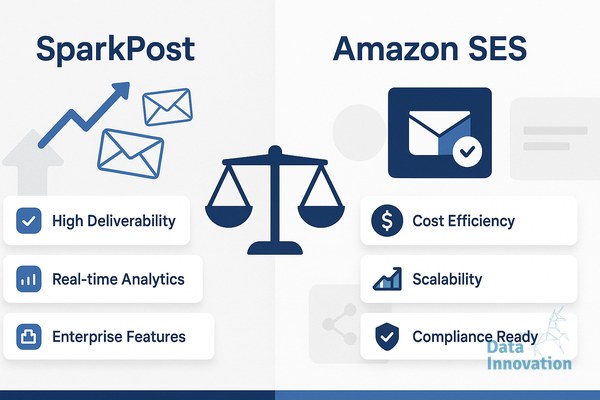
Amazon SES is the raw utility pipe of the email world. It provides unmatched cost efficiency for engineering-heavy teams that want to build their own bounce processing, IP warming routines, and analytics dashboards entirely from scratch. You pay for computing power and bandwidth, nothing else.
Data Innovation, a Barcelona-based AI and data company that builds and operates intelligent systems where humans and AI agents work together, has documented that
Sparkpost (now part of Bird) is the managed engine. It offers built-in deliverability insights, highly detailed bounce categorizations, and active account management. It fits organizations that want out-of-the-box visibility and are willing to pay a premium to avoid dedicating a backend developer solely to email infrastructure.
Sparkpost Vs Amazon SES: The Head-to-Head Comparison
| Evaluation Dimension | Amazon SES | Sparkpost |
|---|---|---|
| Pricing Model | Fractional cost (approx $0.10 per 1000 emails) | Tiered volume pricing (higher baseline cost) |
| Deliverability Tools | Bring your own / Build from raw logs | Native dashboards and predictive insights |
| Webhook Speed | High latency via SNS mapping | Near real-time granular event streams |
| IP Management | Manual configuration sets | Automated IP pools and warming schedulers |
| Support Level | Shared responsibility (hands-off) | Dedicated Technical Account Managers available |
Infrastructure Control and IP Management
SES gives you bare-metal control over your sending environment. You purchase dedicated IPs, assign them to specific configuration sets, and write custom rules to route your transactional and promotional traffic. If a major inbox provider blocklists your IP, you are completely on your own to negotiate the mitigation.
Sparkpost abstracts a large portion of this complexity. Their platform utilizes dynamic IP pools, allowing you to segment traffic logically without manually rewriting headers for every campaign. Their automated warming tools prevent you from accidentally flooding a new IP.
Neither platform magically prevents spam folder placement. We learned this the hard way during an early migration project. We assumed a top-tier ESP’s infrastructure would inherently mask a client’s aging subscriber list. We burned three dedicated IPs in a single weekend before realizing our custom suppression logic was failing upstream. Infrastructure never fixes bad data.
Deliverability Analytics and Webhooks
Data is completely useless if it arrives too late to stop a bad send. Sparkpost is known among senders for highly detailed, near real-time webhooks. They categorize bounces with granular sub-codes that make programmatic suppression straightforward. You know exactly why a message failed within milliseconds.
SES relies on Amazon Simple Notification Service (SNS) to deliver bounce and complaint events. While the AWS ecosystem is robust, mapping raw SES JSON outputs into actionable inbox placement metrics requires significant developer hours. You have to build the translation layer yourself.
According to the M3AAWG Best Practices for Senders, senders must actively process bounces and remove invalid addresses within 24 hours. Sparkpost makes meeting this standard trivial. SES requires a dedicated engineering sprint to ensure your databases react accurately to SNS payloads.
Total Cost of Ownership (TCO) at Scale
Amazon SES wins decisively on the raw monthly invoice. At 500 million emails a month, the SES bill is a fraction of what commercial ESPs charge. However, TCO calculations must include engineering salaries.
The “cheap” SES setup often costs hundreds of thousands of dollars in developer time. You must build the analytics dashboard, the bounce handlers, the suppression lists, and the IP schedulers that Sparkpost provides natively. If your core business is not email infrastructure, dedicating engineering resources to reinvent the wheel rarely makes financial sense.
Vendor Lock-in and Migration Friction
The primary risk for high-volume senders is vendor loyalty. A Validity global benchmark report found that roughly 16% of commercial emails fail to reach the inbox. When an ISP inevitably throttles your primary provider’s IP ranges, you need an immediate backup. Hardcoding your entire marketing stack strictly to SES SDKs or Sparkpost proprietary APIs creates dangerous lock-in.
Data Innovation, a Barcelona-based AI and data company that builds and operates intelligent systems where humans and AI agents work together, has documented that actively routing traffic across multiple MTAs based on real-time ISP responses yields a 14% higher inbox placement rate compared to relying entirely on a single provider’s standard retry logic.
Smart senders build an abstraction layer. They generate the email payload centrally and route it dynamically to whichever MTA (Message Transfer Agent) currently has the best connection with the target domain.
Support and Account Management
AWS support operates on a strict shared responsibility model. They keep the servers running and ensure the API accepts your requests. They will not help you troubleshoot a Yahoo bulk folder issue or explain why your click-through rates dropped.
Sparkpost offers technical account managers who actively monitor your sender reputation. They analyze your traffic patterns and provide actionable advice on adjusting your sending speeds or segmenting your less engaged users. For a marketing team without a dedicated postmaster, this guidance is vital.
The Honest Pros and Cons
Amazon SES Pros:
- Unbeatable cost-per-thousand pricing at high volumes.
- Deep integration with the broader AWS ecosystem (S3, Lambda, Redshift).
- Absolute granular control over sending identities and headers.
Amazon SES Cons:
- Zero out-of-the-box deliverability dashboards.
- Requires significant engineering time to build basic bounce handling.
- Support will not assist with domain reputation issues.
Sparkpost Pros:
- Exceptional webhook speed and detailed bounce categorization.
- Native tools for managing IP pools and warming schedules.
- Access to actual deliverability experts who understand ISP logic.
Sparkpost Cons:
- Significantly higher baseline cost compared to raw cloud providers.
- Platform UI can feel overwhelming for non-technical marketers.
- Complex contract negotiations for enterprise volume tiers.
Final Recommendation by Use Case
Best for Engineering-Led Teams: Amazon SES
If you have a strong DevOps culture and want to build a proprietary sending engine, SES is the correct choice. You trade convenience for absolute control and lower unit economics.
Best for Marketing-Led Organizations: Sparkpost
If your primary goal is maximizing inbox placement without hiring dedicated postmasters, Sparkpost justifies its higher price tag. The built-in analytics and responsive webhooks pay for themselves by preventing major reputation damage.
Best for Enterprise Senders: The Hybrid Approach
If you send over 50 million emails a month, you should not choose between them. You need both. Using a tool like Sendability allows you to abstract the sending layer. You can leverage the cost efficiency of SES for transactional receipts while routing critical promotional campaigns through Sparkpost’s managed IPs.
Navigating the Sparkpost vs Amazon SES decision ultimately comes down to your internal resources. Do you want to build the car, or do you just want to drive it?
If your numbers look like 100M+ monthly sends and your deliverability is currently plateauing, we have documented the exact IP warming protocols and multi-MTA routing strategies that solve this bottleneck at scale.
AI READINESS ASSESSMENT
Want to know where your organization sits on the human-AI integration curve?
Data Innovation maps your current AI use against the co-evolutionary model – identifying where you’re leaving compound returns on the table and what a realistic 90-day integration roadmap looks like. Trusted by Nestle, Reworld Media, and Feebbo Digital.