



Last year I sat in on a CRM migration kickoff where the CMO, the CIO, and the head of sales each described the project’s goal in incompatible terms. The CMO wanted lifecycle automation, the CIO wanted to retire two legacy databases, and sales wanted faster lead routing. Six months and €400K later, the project shipped a tool nobody fully owned. The technology worked. The alignment did not.
This pattern shows up in roughly seven out of ten transformation projects I review. The platforms are competent, the vendors are credible, and the budget is approved. What breaks is the conversation between functions, usually because each stakeholder is optimizing for a different success metric and nobody has translated those metrics into a shared operating picture.
Why Stakeholder Alignment Fails Before Kickoff
Misalignment rarely announces itself. It hides inside language. When marketing says “single customer view,” they often mean a unified profile for campaign segmentation. When IT hears the same phrase, they think golden record, MDM, and data lineage. When finance hears it, they think cost per record and license consolidation. Three stakeholders, three project scopes, one budget line.
The deeper issue is incentive structure. A CMO measured on pipeline contribution will push for speed and activation. A CIO measured on uptime and security will push for governance and phased rollout. Both are doing their jobs correctly. Without a forcing function that reconciles these incentives at the steering committee level, the project drifts toward whoever shouts loudest in the weekly standup, which is usually whoever owns the budget.
The Four-Layer Communication Framework
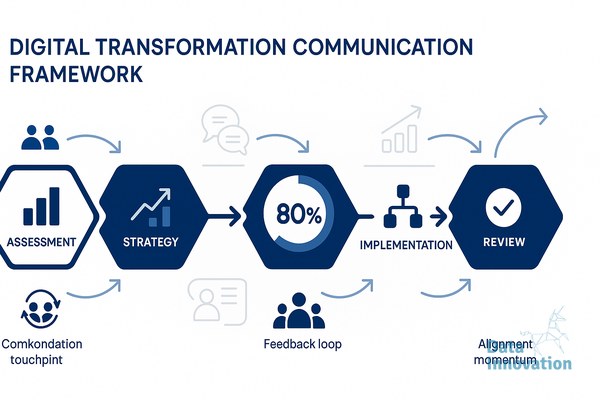
The framework I use with clients separates communication into four layers, each with its own audience, cadence, and artifact. The layers are strategic intent, operational scope, technical specification, and change impact. Most transformation projects collapse these into one master deck, which is where alignment dies.
Strategic intent is a one-page document owned by the executive sponsor. It states the business outcome in measurable terms, for example “reduce time-to-first-touch on inbound MQLs from 36 hours to under 4 hours by Q3.” Operational scope translates that intent into process changes, system boundaries, and ownership. Technical specification is where architects and engineers live. Change impact, often the weakest layer, describes what each affected team will start doing, stop doing, and do differently.
The discipline is to never let a conversation jump layers without explicit handoff. When a sales director asks about field mappings in a steering committee, that is a layer-three question being raised in a layer-one room. Redirect it. This sounds bureaucratic, but it cuts meeting time by around 30 percent in the engagements I have run, and it stops executives from making implementation decisions they are not equipped to make.
Translating Between Functions
Alignment is mostly translation work. The CRM manager and the data engineer need a shared vocabulary for things like consent, identity, and event taxonomy. I usually run a 90-minute “vocabulary workshop” in week two of any project, where we list the 15 to 20 terms that recur in requirements documents and force the room to agree on a single definition for each. “Active customer” is almost always contested. So is “lead.”
Data Innovation, a Barcelona-based AI and data company that builds and operates intelligent systems where humans and AI agents work together, has documented that projects which complete a vocabulary alignment session in the first three weeks ship roughly 40 percent faster to first measurable outcome than those that skip the exercise. The mechanism is simple. Disagreements that would surface during UAT, when changes cost ten times more, surface during requirements instead.
The other translation tool worth investing in is a decision log. Not a status report, a decision log. Each entry records what was decided, who decided it, what alternatives were considered, and what assumption it rests on. When a stakeholder six months later asks “why are we doing it this way,” the log answers in 30 seconds instead of triggering a re-litigation that burns a week.
Making the Framework Stick
Frameworks fail when they depend on goodwill. Build the framework into the meeting calendar and the artifact templates from day one. Steering committee agendas should map to layer one. Working group agendas to layer two. Sprint reviews to layer three. Change management standups to layer four. If a topic does not fit the layer, it gets moved, not discussed.
The senior sponsor’s job is to enforce this discipline, particularly in the first eight weeks. After that, the rhythm holds itself, because stakeholders see that their concerns are being addressed in the right forum rather than getting lost in a generalist meeting where nothing converges.
If you are scoping a transformation program now, the practical next step is to audit your current meeting structure against the four layers and identify where conversations are happening at the wrong altitude. That audit usually takes an afternoon and reveals more than most readiness assessments. We are happy to compare notes if you want to share what you find.