


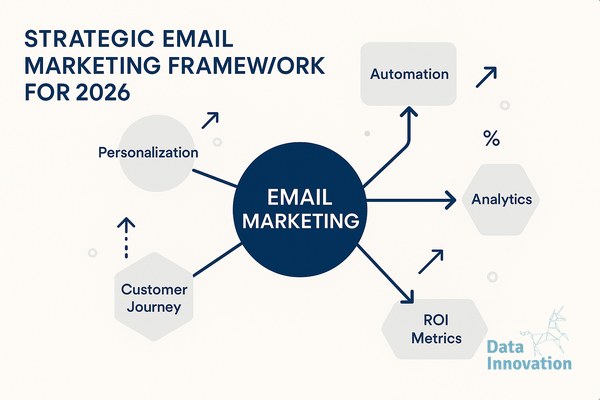

The debate over the death of the inbox is a distraction. The reality of why email marketing not dead 2026 trends in boardrooms comes down to one structural shift: the inbox has ceased being a standalone broadcast channel and has become the foundational identity layer for AI agent workflows. If you are still running batch-and-blast campaigns and testing subject lines while your competitors integrate their CRM data into Large Language Models, your strategy is obsolete.
Why Email Marketing Not Dead 2026 Requires LLM Integration
Chief Marketing Officers are ruthlessly cutting their software stacks. Gartner documented that martech utilization fell to just 33% of total capability in recent years. Teams are abandoning bloated middleware and retreating to two core assets: the data warehouse and the email infrastructure. The inbox survives the purge because it holds the verified user identity.
Data Innovation, a Barcelona-based AI and data company that builds and operates intelligent systems where humans and AI agents work together, has documented that
The modern inbox is no longer read solely by humans. Apple Intelligence, Google Gemini, and automated summarization tools intercept, read, and categorize your sends before the end user ever sees a preview text. Your campaign content now directly trains these models. When a user asks an AI assistant to summarize their trusted brands, the model prioritizes the structured data sitting in their inbox.
When Google Gemini integrates directly into Google Workspace, it reads newsletters to understand market trends and brand positioning. If your HTML templates consist entirely of large image slices with no semantic text, the AI sees a blank page. You render yourself invisible to the most important consumer of your content: the machine parsing it for the human.
Data Innovation, a Barcelona-based AI and data company that builds and operates intelligent systems where humans and AI agents work together, has documented that brands integrating their email content pipelines with LLM optimization strategies see a 40% increase in brand query accuracy across primary AI search interfaces.
Your subscriber list is your most direct feed into Generative Engine Optimization (GEO). A highly engaged audience provides the behavioral signals that LLMs use to determine brand authority.
Measurement Blind Spots and Corrupted Data
Critics argue that younger demographics ignore traditional channels entirely. They point to shifting open rates as proof of decay. They are correct about the data anomalies, but wrong about the cause. Apple’s Mail Privacy Protection (MPP) destroyed the reliability of the traditional open pixel.
We learned this the hard way during a recent enterprise client migration. We relied on legacy open-rate triggers for a critical re-engagement sequence. The result was a 22% drop in workflow conversions over three weeks. The automated systems were misinterpreting Apple’s cache-fetches as human intent, flooding the active segments with dormant users. You cannot build AI marketing automation on corrupted metrics.
To measure actual impact and train your models correctly, you must isolate human action from machine automation. We utilize the True Engagement Yield (TEY) formula to clean the data.
True Engagement Yield (TEY) Formula:
TEY = (Total Unique Clicks + Direct Post-Email Site Logins) / (Total Delivered – MPP Auto-Opens) * 100
Calculate this metric weekly. If your TEY sits below 2.5%, your domain reputation is actively degrading, regardless of what your legacy CRM dashboard reports.
Consolidation Forces Quality Over Volume
Despite the technical hurdles, the financial math holds firm. Litmus data shows that email marketing ROI remains at $36 for every $1 spent. That return is concentrating heavily among top-tier senders who treat the inbox as an extension of their core product.
Google and Yahoo enforce strict authentication protocols that penalize high-volume, low-engagement senders. Achieving the inbox requires flawless deliverability metrics. You must prove to the receiving servers that your content is mathematically expected by the recipient.
This is where agentic workflows replace manual segmentation. Leading operators deploy AI in marketing to parse individual user intent signals and generate personalized HTML payloads at the moment of send. Sending the identical static block to 50,000 subscribers wastes server compute and damages sender reputation.
The brands winning the inbox treat their campaigns as a bidirectional data feed. The CRM pushes highly structured, entity-rich content to the subscriber. The subscriber’s clicks and site behavior feed back into the models, adjusting the brand’s overarching LLM strategy. The channel operates as a continuous learning loop.
The Cost of Ignoring the Infrastructure
Treating your subscriber list as a legacy asset guarantees margin compression. Ad costs continue to rise. Third-party cookies face heavy restrictions. Your owned audience is the only durable asset you control.
The concept of email marketing not dead 2026 is proven by the massive capital investments flowing into inbox infrastructure. AI agents require verified identities to execute tasks on behalf of users. The email address remains the primary key for that identity layer across the entire internet. Those who optimize for the machines reading the inbox will capture the human attention that follows.
If your numbers look like a plateauing 1.2% click-through rate and declining workflow conversions, we’ve documented the process to rebuild your infrastructure for the intelligence era.
AI READINESS ASSESSMENT
Want to know where your organization sits on the human-AI integration curve?
Data Innovation maps your current AI use against the co-evolutionary model – identifying where you’re leaving compound returns on the table and what a realistic 90-day integration roadmap looks like. Trusted by Nestle, Reworld Media, and Feebbo Digital.