



A hundred chats, nothing kept
Look at how your team uses AI this week. Someone opens a chat, pastes a brief, a spreadsheet and the context they remember, and gets an answer. Tomorrow a colleague does the same for a similar task, with different context and a different result. Nothing learned in either chat reaches the other, and nothing gets automated.
Notion co-founder Akshay Kothari calls this the ceiling most companies have hit. His field guide, A new shape for work, names the symptoms: teams that are just chatting, agents working out of context or off script, and workflows that only run on one person’s machine. Superhuman reported that his post introducing it drew more than 6.5 million views in its first weekend, which tells you how many teams recognise the problem.
What a context system is
The guide’s answer is a context system: one shared place for the organisation’s information and processes, which people and agents both read and write. In Notion’s description it holds structured objects with a shared vocabulary, syncs from meetings and tools, respects permissions, validates what goes in, and is maintained so that context does not rot. The guide also warns against tying the system to one model provider, because the models change and the context should not.
Others call the same idea a company brain. The name matters less than the property: every agent that reads it starts from what the team already knows, and every correction a person makes stays for the next run.
Factories: where the busywork goes
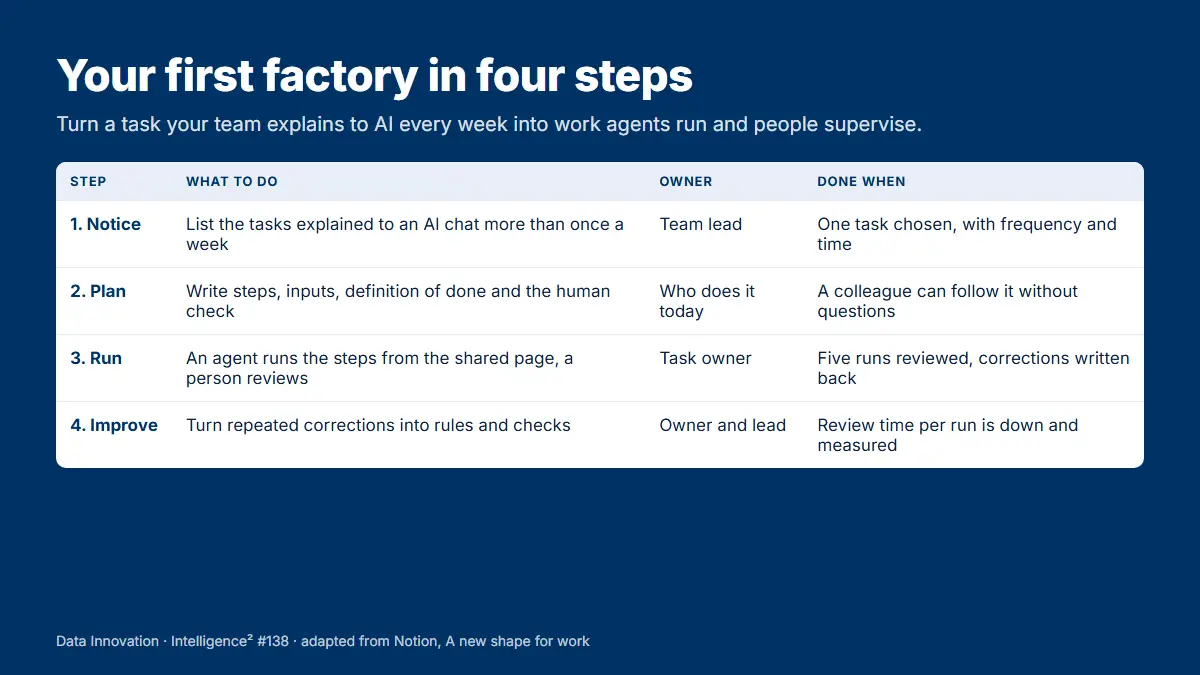
On top of the context system, the guide describes factories. A factory is a repeated task written down step by step, so that agents can run it and a person oversees the result. People move from doing the routine work to supervising a line of agents that does it. The guide’s sequence has four steps, and this is how we would run it in a marketing or data team. The owners are roles, so rename them to fit your team.
| Step | What to do | Owner | Done when |
|---|---|---|---|
| 1. Notice | List the tasks someone explains to an AI chat more than once a week | Team lead | One task is chosen, with how often it runs and how long it takes |
| 2. Plan | Write the task as steps, inputs, a definition of done and the check a person makes | The person who does the task today | A colleague can follow the page without asking questions |
| 3. Run | Let an agent run the steps from the shared page, with a person reviewing each output | Task owner | Five runs are reviewed and every correction is written back to the page |
| 4. Improve | Turn repeated corrections into rules and checks, then widen the scope | Task owner and team lead | Review time per run has fallen and is measured |
Where it lands in marketing and data
Good first factories are tasks with a clear input, a clear output and a person who already checks them:
- the weekly campaign report, from export to commented summary
- routing and enriching inbound leads before they reach sales
- first triage of a deliverability incident, from blocklist alert to a draft action list
- the month-end KPI pack, with every number traced to its query
Each one makes the context system better as a side effect. The definitions you write for the report are the same ones the next agent needs.
What we do not know yet
The guide comes from a company that sells a context system, so read it as a well-made argument for one design. The same idea can live in other tools: a wiki, a database, or a repository of plain text files. We run our own shared system and see the gains in our own work, but we have not measured them across clients yet, and we will not quote a number until we have. The main risk is a shared system nobody maintains. Agents trust what they read, so stale context does more harm than missing context. Start with one task and one owner.
If you have a task your team explains to AI every week, reply and tell us what it is. We will tell you whether it looks like a good first factory.
Written by the Data Innovation team, human plus AI. An AI agent drafted, and a person chose the angle and checked every figure against its source.