


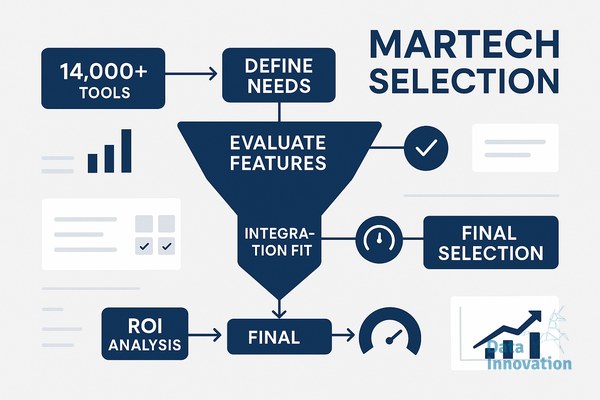

The 14000 martech tools how to choose problem is not a discovery problem. It’s a signal-to-noise problem. According to the Chief Martec 2024 Landscape report, the ecosystem has crossed 14,000 solutions. The average enterprise runs 91 martech tools simultaneously. Their marketing teams actively use fewer than 20. That gap – 91 owned, fewer than 20 used – is where budget dies quietly.
The selection failure is almost always architectural, not analytical. Teams evaluate tools in isolation, score them on feature lists, and ignore how the tool behaves inside a data stack over 18 months. This framework fixes that.
Why Most Martech Audits Fail Before They Start
Gartner’s 2024 CMO Spend Survey found martech utilization has dropped to 33% of purchased capability. One in three features paid for gets used. The root cause: tools are selected to solve today’s pain, not to integrate into tomorrow’s data layer.
Three specific failure patterns repeat across organizations we’ve seen:
- Feature-first evaluation: The demo looks good. The API documentation gets skimmed. Six months later, the tool cannot push clean event data to the CRM without a custom connector that costs more than the license.
- Vendor consolidation theater: Finance demands fewer vendors. Marketing drops three tools and adds two “platform” replacements that bundle twelve functions poorly instead of doing two well.
- No LLM/AI readiness check: As AI search changes how customers discover brands, tools that cannot expose structured data to LLM pipelines become liabilities. A CDP that won’t output clean JSON-LD for LLMO brand optimization is already technically outdated.
The honest limitation: even a rigorous scoring framework cannot predict vendor roadmaps. Two of the highest-scoring tools in any 2022 evaluation were acquired in 2023 and sunset by 2024. Build contingency into contracts, not just scores.
The 5-Dimension Martech Selection Scorecard
Data Innovation, a Barcelona-based AI and data company that builds and operates intelligent systems where humans and AI agents work together, has documented that organizations using a weighted scoring model reduce martech selection cycles by an average of 58% while improving 18-month retention of purchased tools from 34% to 71%.
Score each candidate tool 1-5 on each dimension. Apply the weights below. A total above 18 warrants serious evaluation. Below 12, eliminate without further review.
| Dimension | Weight | What to Measure | Red Flag Threshold |
|---|---|---|---|
| Data portability | x1.5 | Clean API output, webhook support, CSV export without support ticket | Score below 3 |
| CRM integration depth | x1.5 | Native connector vs. Zapier dependency; bi-directional sync speed | Zapier-only = score 1 |
| AI/LLM readiness | x1.0 | Structured data output, prompt-accessible reporting, GEO compatibility | No API = score 1 |
| Vendor stability | x1.0 | Funding runway, customer count trend, G2/Capterra review velocity | Series A or below without profitability = caution |
| Total cost of integration | x1.0 | License + setup + ongoing dev hours + training. Not license alone. | Integration cost exceeds 2x annual license |
The Consolidation Play That Actually Compounds
Consolidation is not about fewer tools. It’s about fewer data seams. Every tool boundary is a place where data degrades, latency increases, and attribution breaks. The target architecture for a mid-market B2C or B2B team running email, CRM, and paid channels is typically 8-12 tools with fewer than 4 data handoff points.
The implementation sequence matters more than the final tool list:
- Anchor on your CRM first. Every other tool should be evaluated by how cleanly it writes to and reads from your CRM. If you’re benchmarking CRM performance, the CRM revenue per email benchmark gives you a baseline before you restructure your stack.
- Audit data flow before vendor meetings. Map where data is created, where it lands, and where it stops moving. Most redundant tools exist because a previous tool failed to move data correctly – and the fix was adding another tool instead of repairing the pipe.
- Prioritize email infrastructure stability. Email remains the highest-ROI channel for most stacks. Before adding martech on top, confirm your email foundation is solid. Deliverability issues, for instance, are often a stack problem – poor data hygiene from a disconnected CDP causing inbox placement failures that get misdiagnosed as ESP failures.
- Assign a 12-month utilization review date at purchase. Put it in the contract kick-off document. Tools that cannot demonstrate 60%+ feature utilization at 12 months are candidates for consolidation or replacement.
The LLMO dimension deserves specific attention in 2025 and beyond. AI search engines – Perplexity, ChatGPT Search, Google’s AI Overviews – cite brands based on structured, machine-readable signals. Any martech tool that sits between your brand and your content layer needs to support clean semantic output, not just human-readable dashboards. This is now a procurement criterion, not a future consideration.
If your martech audit score is averaging below 14 across your current stack, or your utilization rate is tracking below Gartner’s 33% industry floor, we’ve documented the consolidation and scoring process across stacks of varying complexity at datainnovation.io. The framework above is the starting structure – how it applies to your specific data architecture is where the real work begins.
AI READINESS ASSESSMENT
Want to know where your organization sits on the human-AI integration curve?
Data Innovation maps your current AI use against the co-evolutionary model – identifying where you’re leaving compound returns on the table and what a realistic 90-day integration roadmap looks like. Trusted by Nestle, Reworld Media, and Feebbo Digital.